
The Comparison of Fishing Transducer: Garmin LiveScope Series VS Lowrance Eagle Eye & HDS PRO VS Humminbird XPLORE & MEGA Live 2
In professional fishing tournaments, finding fish quickly can make the difference between an average finish and a place on the leaderboard.
Modern anglers are no longer relying only on traditional sonar or their instincts to locate productive water.
Advanced transducers, high-resolution imaging, and forward-facing sonar have become essential tools for identifying fish, structure, bait, and underwater cover with greater precision.
For serious competitors, choosing the right transducer is an investment in efficiency, accuracy, and confidence on the water.
If you are searching for the best fishing transducer for pro tournament competition, it is important to look beyond screen size and advertised sonar technology.
A tournament-ready transducer should deliver clear images, reliable depth readings, accurate fish separation, and excellent performance while the boat is moving or positioned over promising structure.
The right trnasducer model can help anglers spend less time searching and more time presenting a lure where fish are actually holding.
For anglers who rely heavily on real-time fish tracking, finding the best forward facing fishing transducer for tournaments can be especially valuable.
Forward-facing sonar allows you to observe fish and underwater targets in front of the boat, making it easier to adjust casting distance, lure direction, and retrieve speed.
This technology can be particularly useful when targeting suspended bass or isolated fish that may be difficult to identify with traditional downward-looking sonar.
Likewise, the best live sonar transducer for tournament anglers should provide a combination of image clarity, responsiveness, coverage, and dependable performance.
During a competition, even small details can matter. Being able to distinguish a fish from submerged vegetation, timber, rocks, or baitfish can help an angler make faster decisions and avoid wasting casts.
For anglers fishing larger reservoirs, the best tournament fishing transducer with side imaging can provide another major advantage.
Side imaging expands the search area around the boat, helping identify underwater contours, brush piles, rock formations, and other productive structure.
This can be particularly useful when scouting unfamiliar tournament waters.
Offshore anglers also have different requirements.
The best transducer for offshore bass tournament fishing should provide dependable depth performance and detailed imaging around ledges, humps, channels, and other offshore locations.
Meanwhile, anglers competing on rivers and inland lakes may prioritize the best transducer for competitive freshwater fishing, where shallow-water detail and structure identification can be more important.
Serious competitors should also consider image quality.
The best high resolution fishing transducer for bass pros can make it easier to interpret subtle changes beneath the boat and identify potential targets with greater confidence.
For anglers specifically targeting suspended fish, the best sonar transducer for suspended bass tournament fishing should provide accurate target separation and responsive imaging so casts can be made with greater precision.
If you are a beginner and want to go for pro tournament, you may have to learn the basic of GPS system to spot the fish location with this gps fish finder under $100 range that will help you before joining pro anglers in pro fishing tournament event
Ultimately, a quality transducer is more than another piece of electronics on a tournament boat. It is a tool that can improve scouting, shorten search time, and help anglers make better-informed decisions throughout a competition.
The best choice depends on fishing style, water depth, target species, sonar system compatibility, and tournament strategy
But, investing in the right technology can give serious anglers a meaningful advantage when every cast counts.
These are the best transducer you can choose for your next fishing trip or pro fishing tournament
1. Garmin ECHOMAP UHD2 93sv + LiveScope Plus Review
Tournament fishing is increasingly about finding productive fish faster, making precise casts, and understanding what is happening beneath the surface.
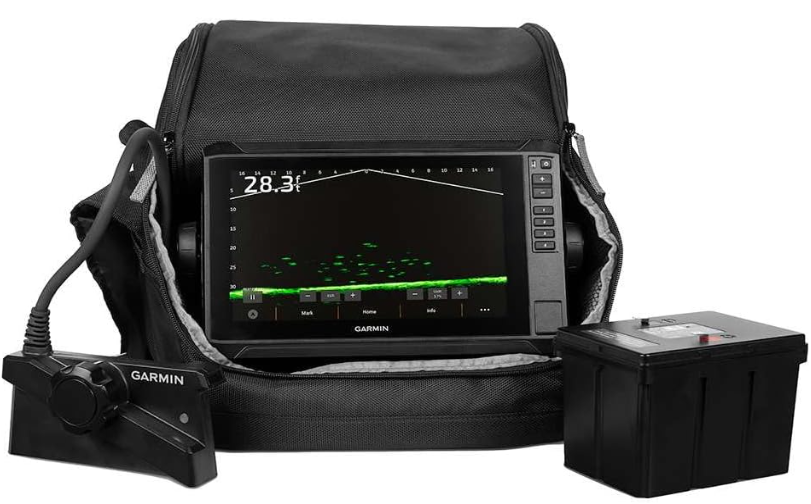
That is where the Garmin ECHOMAP UHD2 93sv + LiveScope Plus becomes particularly interesting.
Combining a 9-inch chartplotter/sonar display with Garmin’s LiveScope technology, this setup is designed to give serious anglers a much clearer view of fish and structure in real time.
For tournament anglers, the attraction isn’t simply having another fish finder on the boat.
The real value comes from using detailed sonar information to make better decisions about where to cast, how to position the boat, and whether a fish is actually interested in the presentation.
This Garmin ECHOMAP UHD2 93sv + LiveScope Plus is primarily designed for anglers who want advanced sonar, mapping, and real-time fish-finding capabilities in one tournament-ready system.
The 93sv features a 9-inch sunlight-readable display with 1024 × 600 resolution, while its sonar platform supports traditional CHIRP, ClearVü, and SideVü depending on the connected transducer.
With this Garmin LiveScope, anglers can observe fish and underwater targets in real time rather than relying exclusively on conventional sonar history.
This makes the system particularly useful for bass fishing around offshore structure, suspended fish, and isolated targets.
This Garmin LiveScope setup is best suited to serious bass anglers, tournament competitors, guides, and experienced recreational fishermen who are prepared to invest in advanced electronics.
It is especially attractive to anglers who fish unfamiliar tournament waters and need to quickly locate productive structure and individual fish.
Beginners can use it, but the technology has a learning curve, and its value increases substantially as an angler becomes better at interpreting sonar returns and adjusting tactics.
Key Points
- LiveScope Real-Time Sonar
The biggest attraction is LiveScope’s ability to provide live-scanning sonar views.
For competitors, this can help determine whether fish are actually present before spending multiple casts on unproductive water.
If you’re looking for the best transducer for real time fish tracking tournament applications, the LiveScope system is compelling because it allows anglers to observe targets and adjust their presentation accordingly.
The LVS34 LiveScope Plus transducer is part of Garmin’s LiveScope Plus system, which uses the GLS 10 sonar module. - 9-Inch UHD2 Display
The 9-inch display provides a useful balance between viewing area and physical size.
Its 1024 × 600 resolution makes sonar and mapping information easier to interpret while keeping the unit relatively compact for a tournament boat.
For anglers comparing options for the best Garmin compatible tournament fishing transducer, the 93sv is attractive because it combines LiveScope compatibility with conventional sonar and mapping capabilities rather than functioning as a dedicated live-sonar screen alone. - Versatile Sonar and Mapping
The ECHOMAP UHD2 platform supports traditional CHIRP along with Garmin ClearVü and SideVü sonar when paired with compatible transducers.
That versatility matters during tournaments because not every fish is found with forward-facing sonar.
Side imaging can help scout structure and locate promising areas, while LiveScope can then be used for more precise target-oriented fishing.
For anglers searching for the best transducer for casting to suspended bass, this combination is particularly useful because the angler can first locate promising areas and then use real-time sonar to refine the presentation.
Pros
- Excellent LiveScope integration
- Useful 9-inch display for tournament applications
- Supports multiple sonar technologies
- Strong combination of mapping and sonar
- Particularly useful for targeting suspended fish
- Compact enough to fit comfortably on many boat consoles or bows
Cons
- Premium investment compared with conventional fish finders
- LiveScope requires additional components, including the GLS 10 sonar module.
- Requires practice to interpret live-sonar information effectively
- A 9-inch screen may feel limiting for anglers who want maximum display area
- Advanced electronics can increase installation complexity
This Garmin ECHOMAP UHD2 93sv + LiveScope Plus is a strong choice for tournament anglers who want real-time fish-finding capability without moving to an especially large display.
Its biggest strength is versatility: LiveScope helps with individual fish and suspended targets, while the ECHOMAP platform provides traditional sonar, SideVü, ClearVü, mapping, and navigation capabilities.
For competitive anglers, that combination can make the system much more useful than a dedicated sonar display.
It won’t automatically produce tournament-winning catches, but it can provide information that helps an experienced angler make faster and more informed decisions.
If real-time target tracking and precise casting are central to your tournament strategy, this Garmin setup deserves serious consideration.
Buy Garmin LiveScope Fishing 9 ECHOMAP Now
2. Garmin LiveScope Plus System with GLS 10 and LVS34 Transducer Review
For serious bass anglers, seeing what is happening beneath the surface can be just as important as choosing the right lure.
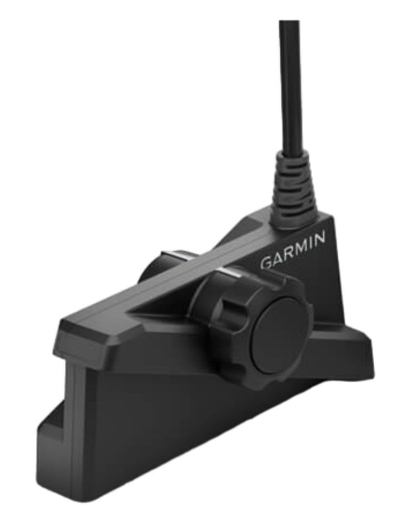
This Garmin LiveScope Plus System combines the GLS 10 sonar module with the LVS34 transducer to provide real-time views of underwater activity.
Garmin says the system improves resolution, reduces noise and sonar artifacts, and provides better target separation than the earlier LiveScope system.
For tournament fishing, those improvements can translate into more confident decisions when locating suspended bass, isolated structure, or fish that are difficult to identify with conventional sonar.
The LiveScope Plus System is primarily designed for real-time fish finding and underwater scouting.
The LVS34 can operate in Forward, Down, and Perspective modes, allowing anglers to change their viewing angle according to the fishing situation.
Forward mode looks ahead of the boat, Down mode scans beneath it, while Perspective mode provides a top-down view.
The system operates across 530–1,100 kHz, has a 500-watt transmit power rating, and offers a maximum stated Down/Forward depth of 200 feet, although actual performance depends on water conditions, bottom composition, and salinity.
This system is best suited to professional and serious amateur bass tournament anglers, guides, competitive freshwater fishermen, and experienced anglers who regularly fish offshore structure or suspended fish.
It is particularly appealing to competitors who already understand sonar and want live information to complement traditional mapping and sonar.
Beginners can use it, but the investment and learning curve make more sense for anglers who are prepared to spend time learning how to interpret live-sonar returns.
Key Points
- Improved Resolution and Target Separation
The biggest attraction of LiveScope Plus is its improved image quality.
Garmin specifically highlights improved resolution, reduced noise, clearer images, and better target separation.
That makes it a strong candidate for anglers searching for the best tournament transducer for clear water bass lakes, where identifying individual fish and distinguishing targets from nearby structure can be especially valuable.
Better target separation can also help when several fish, baitfish, or pieces of cover appear close together on the screen. - Three Live Viewing Modes
The ability to switch between Forward, Down, and Perspective modes is another major advantage.
Forward mode is particularly useful for scanning ahead and watching fish respond to a lure, while Down mode can help investigate what is directly below the boat.
Perspective mode provides a different top-down view of the area.
For tournament anglers, this flexibility means one transducer can serve several fishing situations rather than requiring separate sonar hardware for every viewing angle. - Purpose-Built Tournament Versatility
The LVS34 has a 20° × 135° beamwidth, 20-foot cable, IPX7 water rating, and includes mounting options for trolling motors and shafts.
The GLS 10 connects through the Garmin Marine Network and is the sonar processing module required for LiveScope functionality.
It is worth noting that this is not a conventional dual-frequency CHIRP transducer.
Therefore, anglers searching specifically for the best dual frequency chirp transducer for tournaments should compare this system with traditional CHIRP solutions rather than treating LiveScope Plus as a direct replacement.
Instead, its strength is live imaging. For anglers prioritizing real-time visualization, it is a compelling best tournament ready live imaging transducer option when paired with a compatible Garmin chartplotter.
Pros
- Excellent real-time sonar capability
- Improved resolution and target separation
- Forward, Down, and Perspective viewing modes
- Useful for suspended bass and offshore structure
- Includes GLS 10 sonar module
- Multiple mounting options
- Strong integration with compatible Garmin electronics
Cons
- Premium investment
- Requires a compatible Garmin display
- GLS 10 adds installation complexity and space requirements
- Maximum stated depth is 200 feet for Down/Forward operation
- Requires practice to interpret live-sonar images effectively
- Not intended to replace conventional CHIRP, mapping, or side-imaging sonar in every situation
This Garmin LiveScope Plus System with GLS 10 and LVS34 is an impressive choice for serious tournament anglers who prioritize real-time fish detection and target identification.
Its strongest advantages are improved image clarity, better target separation, and three useful viewing modes.
For clear-water bass fishing and situations involving suspended fish, the LVS34 can provide information that conventional sonar cannot show in the same real-time manner.
However, anglers should view it as part of a complete tournament electronics setup rather than a universal replacement for CHIRP or other sonar technologies.
Overall, if your tournament strategy depends on finding individual fish and making precise presentations based on what is happening beneath and ahead of the boat, LiveScope Plus offers substantial value for experienced anglers willing to invest in and learn the technology.
Buy LiveScope Plus System with GLS 10 and LVS34 Transducer Now
3. Lowrance Eagle Eye Fishfinder with Live Sonar Review
Tournament bass fishing increasingly depends on how quickly an angler can locate fish and understand their behavior.
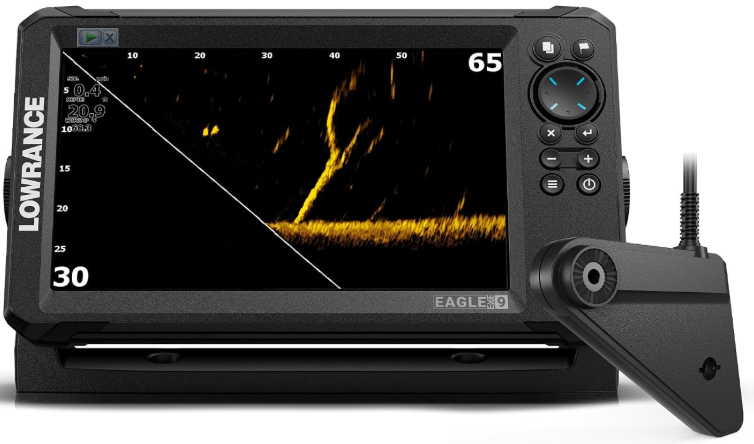
This Lowrance Eagle Eye 9 with Live Sonar takes an interesting approach by combining focused forward and down live sonar with CHIRP and DownScan Imaging in a single transducer.
Instead of requiring a separate live-sonar transducer and conventional imaging transducer, Eagle Eye brings several sonar functions together in one system.
For anglers looking for tournament-oriented electronics without immediately stepping into a more complicated multi-transducer setup, Eagle Eye is worth a close look.
This Lowrance Eagle Eye 9 is primarily designed for real-time fish finding, lure tracking, and underwater structure identification.
Its focused Forward and Down live-sonar views allow anglers to watch fish react to a lure in real time, while CHIRP and DownScan Imaging provide additional information about the water column and structure.
This combination can be particularly useful for bass fishing, where identifying individual fish and determining whether they are actively responding to a presentation can save valuable tournament time.
This Lowrance Eagle Eye Fishfinder is best suited to bass anglers, competitive freshwater fishermen, tournament newcomers, guides, and serious recreational anglers who want live-sonar capability without building an extensive electronics network.
It is especially attractive to anglers who want a relatively straightforward all-in-one solution.
However, professional competitors who require the maximum live-sonar flexibility may want to consider Lowrance’s ActiveTarget 2 platform instead. ActiveTarget 2 offers Forward, Down, and Scout views and supports multiple simultaneous views when paired with compatible HDS PRO equipment.
Key Points
- Integrated Live Sonar
The standout feature is Eagle Eye’s live-sonar capability.
Lowrance describes its Forward and Down views as allowing anglers to watch fish react to a lure in real time.
That makes Eagle Eye interesting for anglers searching for the best fishing transducer for bass tournament setup, particularly when targeting isolated fish or watching how bass respond to a presentation.
The focused live-sonar approach also helps reduce the need to switch between completely separate sonar systems. - One Transducer Combines Multiple Sonar Technologies
Eagle Eye combines live sonar, CHIRP, and DownScan Imaging with FishReveal in one transducer.
This is an important advantage for anglers who want versatility without installing multiple transducers.
Traditional CHIRP can help identify fish and depth information, while DownScan Imaging adds detailed views of underwater structure.
When considering how to choose the best tournament fishing transducer, this type of versatility is worth prioritizing if you want one system to perform multiple jobs. - Accessible Alternative to ActiveTarget 2
Eagle Eye’s biggest selling point may be its positioning within the Lowrance lineup.
ActiveTarget 2 is designed as a more advanced dedicated live-sonar solution, offering high-resolution Forward, Down, and Scout views, plus broader compatibility with higher-end Lowrance electronics.
Therefore, Eagle Eye should not automatically be considered the best Lowrance Active Target transducer for tournaments. Instead, it makes more sense for anglers who want integrated live sonar in a simpler package.
Pros
- Live Forward and Down sonar
- CHIRP and DownScan Imaging integrated into one transducer
- FishReveal technology
- Real-time lure and fish observation
- Simplifies a multi-sonar setup
- Attractive option for serious freshwater anglers
Cons
- Less flexible than ActiveTarget 2 for advanced live-sonar applications
- Does not provide the same range of live views as ActiveTarget 2
- Serious tournament anglers may eventually want a dedicated live-sonar system
- Learning to interpret live sonar still takes practice
- Advanced features may be unnecessary for casual anglers
This Lowrance Eagle Eye 9 with Live Sonar is an appealing choice for anglers who want to enter the world of live sonar without immediately building an expensive, complicated electronics system.
Its biggest advantage is the combination of live Forward and Down sonar, CHIRP, and DownScan Imaging in one transducer.
For tournament bass fishing, that versatility can help anglers locate fish, inspect structure, and observe lure reactions more efficiently.
However, anglers competing at the highest level should recognize that Eagle Eye sits below Lowrance’s ActiveTarget 2 ecosystem in terms of live-sonar flexibility.
ActiveTarget 2 provides Forward, Down, and Scout views and is designed for a more advanced tournament-oriented setup.
Overall, Eagle Eye is best viewed as a versatile, accessible live-sonar solution, rather than a direct replacement for ActiveTarget 2.
For anglers wanting a simpler tournament setup with multiple sonar technologies in one transducer, it offers a compelling balance of capability and convenience.
Buy Lowrance Eagle Eye Fishfinder with Live Sonar Now
4. Lowrance HDS PRO Fishfinder Review
Fishing pro tournament demands more than simply finding depth.
Competitive anglers need to locate structure, identify fish, monitor their movements, and make accurate casts without wasting valuable time.
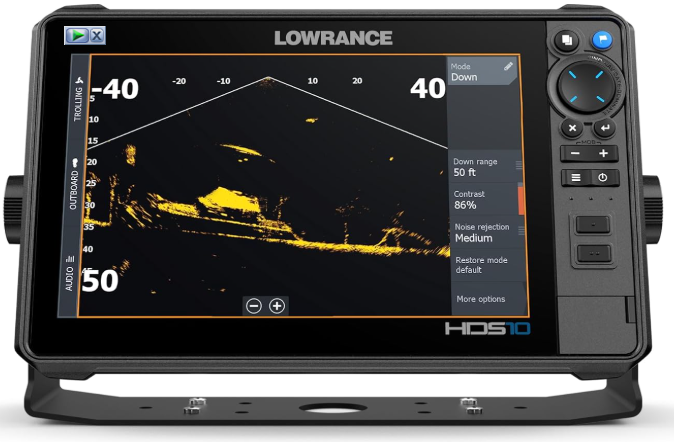
This Lowrance HDS PRO Fishfinder is designed for exactly this type of demanding fishing environment.
Available in 9-, 10-, 12-, and 16-inch versions, HDS PRO combines high-definition sonar, mapping, networking, and compatibility with Lowrance’s advanced ActiveTarget 2 live sonar and Active Imaging HD technologies.
This Lowrance HDS PRO Fishfinder is primarily designed as a high-performance fishfinder and chartplotter for serious anglers who need detailed sonar and navigation information.
Its integrated sonar supports CHIRP, Broadband, Active Imaging HD DownScan, and Active Imaging HD SideScan, while compatible transducers can extend its capabilities considerably.
For tournament anglers, the real attraction is its ability to serve as the central display for a sophisticated electronics system.
When paired with ActiveTarget 2, anglers can view fish and structure in Forward, Down, and Scout modes in real time.
This Lowrance HDS PRO Fishfinder is best suited to professional bass tournament anglers, serious freshwater competitors, guides, offshore structure fishermen, and experienced kayak anglers who want advanced sonar technology.
It can certainly be used by recreational anglers, but its extensive features and networking capabilities make the most sense for users who will actually take advantage of advanced sonar, mapping, trolling-motor integration, and live-sonar technology.
Key Points
- Advanced CHIRP and Imaging Compatibility
HDS PRO supports multiple sonar technologies, including CHIRP, DownScan, and SideScan.
With compatible Active Imaging HD hardware, it can provide high-definition views of fish and underwater structure.
This makes the system useful when scouting large areas during a tournament.
SideScan can help locate cover away from the boat, while DownScan provides additional detail directly beneath it.
For anglers searching for an affordable tournament fishing transducer with CHIRP sonar, however, the HDS PRO itself should not be considered an inexpensive solution.
It is better viewed as a premium display platform that can work with a range of compatible transducers at different price points. - ActiveTarget 2 Live Sonar
One of the HDS PRO’s biggest advantages is its compatibility with ActiveTarget 2.
Lowrance’s system provides Forward, Down, and Scout views, allowing anglers to watch fish movements and see how they react to a lure in real time.
HDS PRO also supports multiple simultaneous ActiveTarget 2 views when a second ActiveTarget system is added.
That can give tournament anglers a broader picture of fish behavior and surrounding structure. - Tournament-Oriented Networking
The HDS PRO can function as the central component of a broader fishing system.
Lowrance highlights connectivity with trolling motors, Power-Pole anchors, radar, autopilot, engines, and other marine equipment.
Its SolarMAX HD touchscreen is also designed to remain visible from wide viewing angles and through polarized sunglasses, an important consideration when fishing under bright tournament conditions.
When determining the best transducer mounting position for tournament bass boat applications, remember that the HDS PRO’s performance ultimately depends on the compatible transducer and installation.
A poor mounting location can compromise sonar readings, particularly at speed, so installation should follow the specific transducer manufacturer’s mounting requirements.
For kayak competitors, the system can also be appealing, but its size, power requirements, and networking capabilities may be excessive for smaller kayaks.
Anglers looking for the best transducer for professional kayak fishing tournament use should consider the kayak’s available mounting space, battery capacity, transducer position, and display size before choosing an HDS PRO configuration.
Pros
- Excellent CHIRP and imaging capabilities
- Compatible with ActiveTarget 2
- Forward, Down, and Scout live-sonar options
- Supports Active Imaging HD
- Available in multiple screen sizes
- Strong networking capabilities
- Bright SolarMAX HD display
- Suitable as the centerpiece of a tournament boat electronics system
Cons
- Premium price compared with entry-level fishfinders
- Advanced features can require additional modules and transducers
- Installation can become complicated in a fully networked setup
- Larger models may be impractical for compact kayaks
- Getting maximum value requires learning the different sonar technologies
This Lowrance HDS PRO is best viewed as a premium tournament electronics platform rather than simply another fishfinder.
Its combination of CHIRP, Active Imaging HD, mapping, networking, and ActiveTarget 2 compatibility gives serious anglers considerable flexibility.
The biggest advantage of this Lowrance HDS PRO is scalability.
An angler can begin with conventional sonar and imaging, then build toward a more advanced system with ActiveTarget 2 and other compatible technologies.
For professional bass competitors, that flexibility can be extremely valuable.
However, buyers should budget for the appropriate transducers and accessories rather than evaluating the HDS PRO display alone.
Overall, HDS PRO is a strong choice for anglers who want a high-end tournament fishfinder capable of growing with their electronics setup.
It is particularly compelling for serious competitors who prioritize detailed sonar, live fish tracking, and complete boat control over a low-cost, simple fishfinder.
Buy Lowrance HDS PRO Fishfinder Now
5. Humminbird XPLORE Series GPS Fish Finder Review
Modern tournament fishing is increasingly about finding productive water quickly and turning sonar information into better casting decisions.
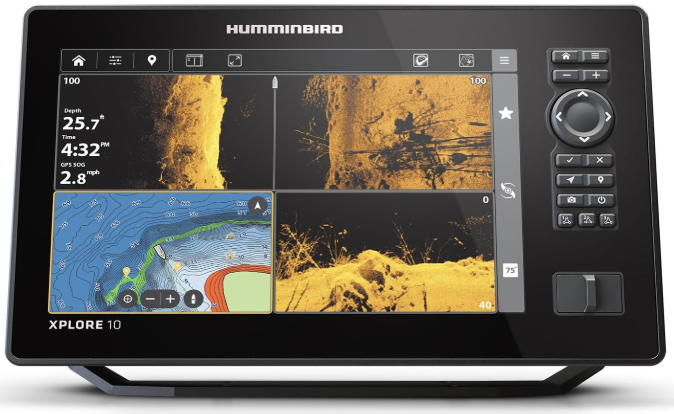
This Humminbird XPLORE Series GPS Fish Finder is designed for anglers who want advanced sonar, detailed mapping, GPS navigation, and integration with Humminbird’s broader electronics ecosystem.
Rather than being a transducer itself, XPLORE serves as the display and control center for compatible sonar technology.
That distinction matters when comparing tournament electronics because the fish finder’s capabilities depend heavily on the transducer and sonar system paired with it.
This Humminbird XPLORE Series GPS Fish Finder is primarily designed for serious freshwater and saltwater anglers who need detailed fish-finding, GPS mapping, and navigation information while fishing.
It can work as the central display for a sophisticated tournament electronics setup, allowing anglers to combine sonar returns with detailed maps and waypoints.
For tournament competitors, the ability to record sonar information and build custom lake maps can also be valuable when scouting unfamiliar water.
Humminbird’s AutoChart technology can use recorded sonar and GPS data to create custom lake charts, giving anglers another way to understand depth changes and underwater contours.
This Humminbird XPLORE Series GPS Fish Finder is best suited to competitive bass anglers, professional tournament fishermen, serious recreational anglers, guides, and boat owners who want advanced Humminbird electronics.
It makes the most sense for anglers who are prepared to use mapping, sonar, GPS, and compatible live-imaging technology rather than simply looking for a basic depth finder.
Key Points
- Strong Platform for MEGA Live Technology
One of the biggest reasons tournament anglers may consider XPLORE is its compatibility with Humminbird’s advanced sonar ecosystem, including MEGA Live technology on compatible configurations.
For anglers researching the best Humminbird MEGA Live tournament transducer, it is important to remember that the transducer and display are separate components.
This Humminbird XPLORE Series GPS Fish Finder provides the screen and control environment, while the appropriate MEGA Live transducer provides the live-imaging information.
That combination can be particularly useful for locating individual bass, watching lure movement, and investigating isolated targets before committing to a cast. - Detailed Mapping and GPS
Tournament anglers often need to understand more than where fish are located
Specifically, they need to understand why fish are there.
This Humminbird XPLORE Series GPS Fish Finder and mapping capabilities can help anglers identify contours, channels, drop-offs, flats, and other potentially productive areas.
Humminbird’s VX mapping ecosystem supports XPLORE, and the company’s mapping tools include features designed around depth highlights, shoreline information, and other fishing-oriented map data.
This becomes especially useful when an angler is trying to improve the best transducer for casting accuracy in bass tournaments.
Accurate positioning and mapping can help keep the boat consistently positioned relative to a target, giving the angler a better reference for repeat casts. - Custom Mapping for Tournament Scouting
Another useful feature for competitive anglers is the ability to create custom maps.
Humminbird’s AutoChart technology can convert recorded sonar and GPS information into customized lake charts.
For tournament anglers fishing less familiar lakes, this can provide valuable information about underwater contours that may not be obvious from standard mapping.
Humminbird XPLORE Series GPS Fish Finder platform can therefore complement live sonar rather than replacing it.
An angler might use mapping and conventional sonar to locate promising structure, then use live imaging to investigate individual targets.
For competitors looking for the best live sonar transducer for offshore fishing tournaments, this distinction is important.
A live transducer is only one component of a tournament electronics system; mapping, GPS, conventional sonar, and display capabilities also contribute to overall effectiveness.
Pros
- Advanced GPS and mapping capabilities
- Designed for integration with Humminbird’s sonar ecosystem
- Compatible with advanced live-sonar technology on appropriate configurations
- Useful for tournament scouting
- Supports custom mapping through AutoChart
- Strong option for serious bass anglers
- Can serve as the central display in a larger electronics system
Cons
- The XPLORE is a display/fish-finder platform rather than a standalone live transducer
- Advanced sonar capabilities may require additional hardware
- Premium tournament configurations can become expensive
- Learning advanced sonar and mapping features takes time
- Maximum performance depends on the transducer and accessories selected
This Humminbird XPLORE Series GPS Fish Finder is best viewed as a sophisticated control center for serious anglers rather than simply a conventional fish finder.
Its combination of GPS, mapping, sonar integration, and compatibility with advanced Humminbird technologies makes it particularly attractive for competitive fishing.
The biggest advantage of this Humminbird XPLORE Series GPS Fish Finder is versatility.
Tournament anglers can use mapping and conventional sonar for scouting, then incorporate compatible MEGA Live technology when they need more detailed information about individual fish and underwater targets.
If your goal is to build a tournament electronics system around Humminbird technology, this Humminbird XPLORE Series GPS Fish Finder provides a strong foundation.
However, you should carefully consider the complete system including the display, transducer, mapping products, mounting hardware, and networking requirements rather than choosing the fish finder in isolation.
For serious bass competitors who value detailed mapping and advanced sonar integration, Humminbird XPLORE Series GPS Fish Finder is a capable platform that can grow with a tournament-focused setup.
Buy Humminbird XPLORE Series GPS Fish Finder Now
6. Humminbird MEGA Live 2 Forward-Facing Sonar Transducer Review
For serious tournament anglers, the ability to see fish, structure, and lure movement in real time can completely change how a day on the water unfolds.
This Humminbird MEGA Live 2 Forward-Facing Sonar Transducer is built around that idea, providing live sonar views that let anglers watch underwater activity as it happens.
Humminbird says MEGA Live 2 delivers improved clarity, target separation, bait tracking, and image stability compared with its previous-generation system.
For competitive bass fishing, this can be particularly useful when individual fish are holding away from the boat, suspended over open water, or positioned around isolated structure.
This Humminbird MEGA Live 2 is primarily designed for real-time fish finding, structure identification, and lure tracking.
This provides three viewing modes from Forward, Down to Landscape that allow anglers to change the sonar perspective depending on the fishing situation.
Forward mode is useful for locating and targeting fish ahead of the boat
And, Down mode concentrates beneath the boat
Then, Landscape provides a wider top-down perspective.
The system provides a 20° × 120° live-sonar coverage area and is designed primarily for trolling-motor mounting.
It can also be used with compatible forward-facing sonar poles and certain transom configurations with the appropriate accessories.
This Humminbird MEGA Live 2 is best suited to professional bass anglers, tournament competitors, serious freshwater fishermen, guides, and experienced anglers who already use Humminbird and Minn Kota electronics.
It is especially attractive to anglers who want real-time information to complement conventional sonar and mapping.
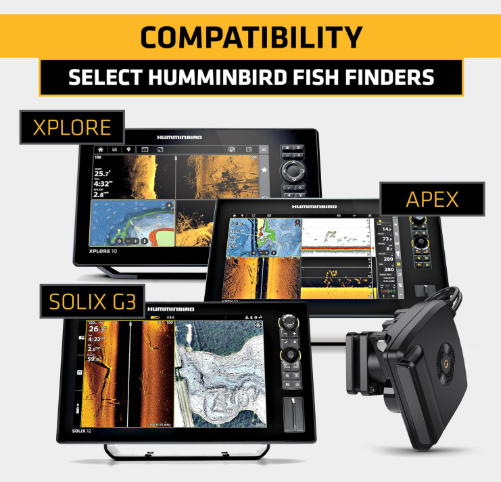
Current compatibility includes Humminbird XPLORE, APEX, and SOLIX G3 fish finders, as well as selected Minn Kota trolling motors.
Key Points
- Improved Live-Sonar Clarity
The most important feature is the improved imaging.
Humminbird designed MEGA Live 2 with upgraded electronics and receiver technology to deliver clearer returns, better image stability, and improved target separation.
For a tournament angler, better separation can make it easier to distinguish a bass from nearby vegetation, bait, rocks, or other underwater objects.
That matters when every cast needs to have a purpose.
This makes MEGA Live 2 a strong candidate for anglers looking for the best forward facing sonar transducer for competitive fishing, particularly when real-time target identification is central to their strategy. - Real-Time Bait Tracking
MEGA Live 2 is designed to let anglers follow their lure during the retrieve.
This can provide useful feedback about whether a fish is following, ignoring, or reacting to the presentation.
For pro fishing tournament , this feature can help an angler modify retrieve speed, lure position, or casting angle instead of repeatedly making blind casts.
The system also offers multiple color palettes and adjustable display settings.
Humminbird’s current guidance recommends different Dynamic Contrast settings depending on conditions, including higher contrast for shallow-water clutter and lower contrast for deeper-water bait tracking. - Flexible Viewing and Tournament Mounting
Forward, Down, and Landscape modes give anglers several ways to examine the water without changing transducers.
The upgraded mounting bracket is designed for improved stability, which is particularly important when the trolling motor is being repositioned frequently during a tournament.
The transducer is compatible with several Minn Kota trolling motors and Humminbird TargetLock configurations with the appropriate adapter.
For anglers building the best Humminbird MEGA Live 2 tournament setup, pairing the transducer with a compatible XPLORE or APEX display and an appropriate trolling-motor installation can create a highly integrated front-deck electronics system.
Pros
- Clear real-time sonar imaging
- Improved target separation
- Forward, Down, and Landscape viewing modes
- Excellent lure and bait tracking capability
- Stable trolling-motor mounting design
- No separate black box required
- Compatible with current XPLORE, APEX, and SOLIX G3 units
- Useful for targeting suspended and isolated fish
Cons
- Requires compatible Humminbird electronics
- Premium investment for tournament anglers
- Not a replacement for conventional CHIRP or side imaging
- Compatibility is limited with older Humminbird units
- Requires practice to interpret live-sonar returns effectively
- Additional mounting equipment may be required for certain installations
This Humminbird MEGA Live 2 Forward-Facing Sonar Transducer is a strong choice for tournament anglers who want real-time information about fish, structure, and lure movement.
The biggest strengths are improved clarity, target separation, bait tracking, and three useful viewing modes.
It is important not to confuse MEGA Live 2 with a conventional imaging transducer.
Anglers searching for the best CHIRP side imaging transducer for pro anglers should still consider a separate conventional sonar solution because live forward-facing sonar serves a different purpose.
For competitors who already own compatible Humminbird electronics, choosing MEGA Live 2 can be an excellent addition.
The ability to watch fish respond to a lure and quickly adjust casting decisions can make it especially valuable during competitive bass fishing.
Overall, if your priority is real-time fish tracking and precise presentation rather than simply locating depth or structure, MEGA Live 2 is one of Humminbird’s most compelling tournament-oriented sonar upgrades.
Buy Humminbird MEGA Live 2 Forward-Facing Sonar Transducer Now
Conclusion
For pro fishing tournament, the biggest question is no longer simply which fish finder has the largest screen.
The real question is which sonar system gives you the most useful information quickly enough to improve your fishing decisions.
These are six transducer options that will help you win the fishing pro tournament
They are Garmin emphasizes LiveScope, Lowrance offers both an accessible all-in-one Eagle Eye and the expandable HDS PRO platform, while Humminbird combines XPLORE displays with MEGA Live 2.
One important distinction: ECHOMAP, HDS PRO, and XPLORE are displays/fish-finder platforms, while LVS34 and MEGA Live 2 are live-sonar transducers.
BUut, they shouldn’t be judged as identical products.
Design
- Garmin LiveScope 9 ECHOMAP is appealing for anglers wanting a relatively compact tournament display paired with Garmin’s LiveScope ecosystem.
Garmin’s ECHOMAP family supports sonar, mapping and networking features, while LiveScope Plus adds enhanced resolution and target separation. - Garmin LiveScope Plus GLS 10/LVS34 is more specialized.
The GLS 10 processing module is required for LiveScope functionality, making this a more component-based installation. - Lowrance Eagle Eye takes the simplest approach.
Its single transducer combines Live Forward, Live Down, CHIRP and DownScan Imaging without a separate sonar module. - Lowrance HDS PRO is the most expandable Lowrance platform.
It can support ActiveTarget 2 and even two ActiveTarget systems for simultaneous live views. - Humminbird’s XPLORE + MEGA Live 2 combination emphasizes integration with the One-Boat Network, mapping and live sonar. MEGA Live 2 adds three viewing modes and improved bait tracking.
Performance
For pure live-sonar performance, Garmin LiveScope Plus, Lowrance ActiveTarget 2, and MEGA Live 2 are the strongest competitors.
Garmin emphasizes improved resolution, reduced noise and target separation, while Lowrance ActiveTarget 2 offers Forward, Down and Scout views.
For Garmin LiveScope vs Lowrance ActiveTarget for tournament fishing, Garmin is particularly attractive for anglers already invested in Garmin electronics, while HDS PRO + ActiveTarget 2 is more compelling for anglers wanting multiple simultaneous live-sonar views.
Humminbird MEGA Live vs LiveScope for bass tournaments comparison is closer.
MEGA Live 2 emphasizes clarity, bait tracking and image stability
Meanwhile, LiveScope Plus has a strong reputation for real-time target identification.
For anglers researching garmin lvs34 vs humminbird mega live for tournaments, the best choice largely depends on the electronics ecosystem already installed on the boat.
For conventional sonar, Lowrance Eagle Eye has a major advantage because its single transducer combines live sonar, CHIRP and DownScan.
Lowrance HDS PRO can similarly become an extremely capable system with Active Imaging HD; Lowrance describes that technology as providing CHIRP, SideScan and DownScan imaging.
Ease of Use
Lowrance Eagle Eye is arguably the easiest all-in-one option because its sonar functions are integrated into one transducer and it includes autotuning.
Garmin’s ECHOMAP interface is also approachable, particularly for anglers already familiar with Garmin mapping and sonar.
Lowrance HDS PRO is more powerful but has a steeper learning curve because of its broader networking and sonar options.
For ice anglers, Garmin has an advantage in portability: Garmin has offered LiveScope Plus ice bundles built around the ECHOMAP UHD2 93sv, with portable mounting and battery components.
This makes it a strong candidate for someone searching for the best ice and boat live sonar transducer kit.
The Winner
- Best overall tournament platform: Lowrance HDS PRO + ActiveTarget 2
For serious competitive bass anglers, Lowrance HDS PRO with ActiveTarget 2 gets the overall nod because of its combination of live-sonar views, Active Imaging HD compatibility, mapping and expandability.
The ability to add a second ActiveTarget 2 system for simultaneous views is particularly attractive for advanced tournament setups. - Best Garmin system: LiveScope Plus + LVS34
Choose Garmin if you prioritize live-sonar clarity, target separation and a mature LiveScope ecosystem.
It’s particularly compelling for anglers searching for the best transducer for deep water tournament bass, although anglers fishing genuinely deep water should also consider Garmin’s LiveScope XR range rather than assuming LVS34 is the ideal choice.
Garmin states LiveScope XR reaches up to 500 feet in freshwater and 350 feet in saltwater. - Best value/easiest setup: Lowrance Eagle Eye
Lowrance Eagle Eye is the standout for anglers who want live sonar without building a complicated multi-module system.
Its single transducer provides four sonar views, including Live Forward, Live Down, CHIRP and DownScan Imaging. - Best Humminbird ecosystem: Humminbird XPLORE + Humminbird MEGA Live 2
For anglers already invested in Humminbird/Minn Kota equipment, XPLORE + MEGA Live 2 is a strong integrated solution, particularly for anglers who value mapping, bait tracking and live imaging.
Finally, for anglers who are looking for the best dual frequency transducer for saltwater pro fishing tournament, they should not automatically choose any of these live-sonar systems.
Live forward-facing sonar and conventional dual-frequency/CHIRP transducers serve different purposes; for offshore saltwater competition, depth capability, frequency selection, cone angle and transducer type deserve separate consideration.
Anyway, Lowrance HDS PRO + ActiveTarget 2 is the best high-end tournament platform
Garmin LiveScope Plus is an excellent live-sonar-focused alternative
Lowrance Eagle Eye offers the simplest all-in-one approach
And, both Humminbird XPLORE + Humminbird MEGA Live 2 are the strongest choice for anglers committed to Humminbird’s ecosystem.
