
Avoid Bird Nest or Backlash on Spinning Reel: 10 Easy Tips
Few things are more frustrating than making a perfect cast, only to watch a huge loop of fishing line suddenly fly off your spinning reel. One moment everything is working smoothly, and the next, your line is tangled into a messy bundle that interrupts your fishing session.
If you have experienced this problem, you are not alone. Loose loops, line twist, and tangled fishing line are common problems for spinning reel anglers, especially beginners. The good news is that most of these problems are preventable with a few simple adjustments and better fishing habits.
Although anglers sometimes call this problem a bird’s nest, the term is more commonly associated with baitcasting reels. On spinning reels, the problem usually involves line twist, loose coils, or loops jumping off the spool. Understanding what causes these tangles is the first step toward preventing them.
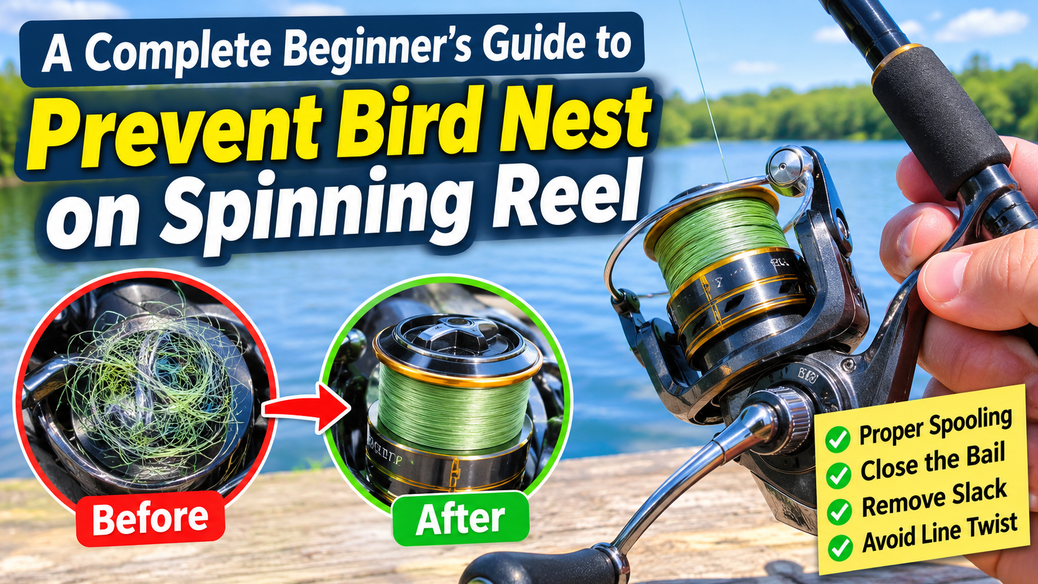
And, if you want to avoid bird nest on spinning reel setups for good, the fix is almost always in how you spool, how you close the bail and how you manage slack.
In this guide, we will explain how to avoid bird nest on spinning reel, properly spool fishing line, close the bail correctly, eliminate loose loops, and deal with tangles when they happen. These practical techniques are from several experienced anglers so you can spend less time picking knots and more time catching fish.
1. Understand Why Spinning Reels Develop Bird Nests
Before learning how to prevent bird’s nest on a spinning reel, you need to understand why it happens.
Unlike baitcasting reels, spinning reels release line from a stationary spool during casting. The line comes off in coils, and these coils can sometimes overlap, twist, or jump away from the spool.
Several common situations contribute to this problem:
-
- Overfilled spool: Too much fishing line makes it easier for loose coils to jump off the spool.
- Line twist: Twisted fishing line naturally forms coils when it becomes slack.
- Loose line: Reeling in slack line can create loose loops around the spool.
- Incorrect spooling: Putting line onto the reel with the wrong orientation can introduce additional twists.
- Improper bail operation: Reeling against a loose or poorly positioned line can create tangles around the bail arm.
- Closing the bail with slack line, which leaves small loops on the spool.
- Line that was spooled loosely or in the wrong direction.
- Existing line twist from inline spinners, crawler harnesses or lures that spin without a proper swivel.
- Line with strong spool memory, especially stiff monofilament put on a small spool.
Once you understand these causes, you can prevent many frustrating tangles before they become serious problems.
2. Never Overfill Your Spinning Reel Spool
One of the easiest ways to prevent loose loops is to avoid putting too much fishing line on your spinning reel.
When the spool is overfilled, there is not enough room to keep the line securely in place. During casting, coils can jump off the spool unexpectedly, creating large loops that eventually become tangled.
How Much Line Should You Put on a Spinning Reel?
A useful starting point is to leave a small gap between the fishing line and the outer edge of the spool. The transcript recommends approximately one-eighth to one-quarter inch, depending on the reel and line.
For many spinning reels, leaving approximately one-eighth inch of space provides a good balance between casting distance and tangle prevention.
Follow these guidelines:
- Never fill the spool completely to the edge.
- Check the manufacturer’s recommended line capacity.
- Avoid adding excessive backing or main line.
- Inspect the spool after installing new fishing line.
Remember that an underfilled spool can reduce casting distance, while an overfilled spool increases the chance of loose coils escaping during a cast.
3. Close the Bail Arm by Hand After Every Cast
One of the most important habits for preventing spinning reel tangles is manually closing the bail arm after casting.
Many anglers simply turn the reel handle to close the bail automatically. Although this may work in many situations, it can also allow slack line to form loose loops around the spool.
These small loops might not cause an immediate problem. However, during your next cast, the line coming off the spool can catch one of them. This can create a large tangle that stops your fishing line from flowing smoothly.
The Correct Way to Close Your Bail
- Make your cast and allow your lure or bait to reach the desired location.
- Turn the reel handle slightly or manually close the bail arm.
- Check that the fishing line is positioned correctly against the line roller.
- Pull the line gently to remove unnecessary slack.
- Make sure there are no loose loops on the spool.
- Begin retrieving your lure once the line is properly tensioned.
Manually closing the bail also helps reduce unnecessary stress on your reel mechanism. It is a simple habit that can make a noticeable difference in your fishing experience.
4. Never Reel in Loose Fishing Line
Loose fishing line is one of the biggest reasons spinning reels develop frustrating tangles.
After casting, you may notice that your line is hanging loosely between the rod tip and the reel. If you immediately start turning the handle, the loose line can wrap around the bail arm or become trapped underneath it.
As you continue retrieving, the problem can become worse. Eventually, the line may form multiple overlapping loops that are difficult to remove.
How to Tighten Loose Line Correctly
If you notice slack line after casting, do not immediately start reeling.
- Open the bail arm.
- Pull the loose fishing line back out to remove the unwanted slack.
- Close the bail arm manually.
- Position the line correctly against the line roller.
- Hold the line gently with your fingers to create tension.
- Start reeling slowly until the line becomes tight.
Once the line is properly tensioned, you can retrieve your lure normally.
5. Spool Your Fishing Line in the Correct Direction
Incorrect spooling is another common cause of line twist, especially when installing new monofilament or fluorocarbon line.
When fishing line comes off the original packaging spool in a different direction from the way it enters your spinning reel, additional twists can develop.
How to Spool a Spinning Reel Properly
- Place the new line spool flat on the ground.
- Connect the fishing line to your spinning reel spool securely.
- Run the line through the rod guides.
- Apply steady tension using your fingers or a damp towel.
- Reel slowly and allow the line to settle evenly onto the spool.
- After approximately five or six handle turns, release the tension and check the line.
- If the line twists or curls excessively, flip the original spool over and repeat the test.
The important thing is to make sure the line comes off the supply spool in a direction that minimizes twisting as it enters your reel.
6. Always Spool Fishing Line Under Proper Tension
Putting fishing line onto your reel too loosely can create problems later. Loose line layers can become buried underneath tighter layers, making them difficult to release during casting.
To avoid this problem, maintain consistent tension while spooling.
You can place the fishing line between your fingers or use a damp towel to apply pressure. Reel slowly and make sure the line sits tightly and evenly against the spool.
Why Proper Tension Matters
- Prevents loose line layers from forming.
- Reduces the chance of overlapping loops.
- Helps prevent buried line during casting.
- Creates a more consistent spool surface.
- Improves overall casting reliability.
Do not apply excessive pressure that could damage your fingers or weaken the fishing line. Use controlled, consistent tension throughout the process.
7. Reduce Line Twist From Your Lures and Fishing Rigs
Even if you spool your reel correctly, certain fishing techniques can introduce line twist during normal use.
Inline spinners, crawler harnesses, and some rotating lures can twist your fishing line as they move through the water. If you allow twisted line to become slack, it can coil around itself and create loose loops on your spool.
How to Reduce Line Twist
- Use an appropriate quality swivel when fishing with rotating lures.
- Check that your lure is not spinning unnaturally during retrieval.
- Inspect your fishing line regularly for twists and coils.
- Replace damaged or badly twisted sections of line.
- Avoid retrieving slack line whenever possible.
Swivels can help reduce line twist, but they must be correctly matched to your fishing setup. They cannot eliminate every source of twisting.
8. Remove Loose Loops Before They Become Large Tangles
Sometimes a small loop forms on your spool without you noticing. It might appear harmless, but the next cast can pull that loop into the rest of the line and create a large tangle.
This is why regularly checking your spool is important.
After retrieving your lure, take a quick look at the spool. If you see a loose loop, carefully pull it out before continuing to fish.
Do not ignore small loops simply because your reel still appears to function normally. Removing them early is much easier than dealing with a three-foot-long tangle during your next cast.
9. How to Remove Birds Nest From Reel
Even experienced anglers occasionally experience tangled fishing line. If you want to know how to untangle bird nest on spinning reel, the first thing to remember is not to panic or pull aggressively.
A small tangle may be removable without replacing your entire fishing line.
Steps to Remove a Spinning Reel Tangle
- Stop retrieving immediately when you notice the tangle.
- Identify the loose end of the fishing line.
- Carefully pull the loose coils away from the spool.
- Open the bail if necessary to release tension.
- Separate overlapping loops gently using your fingers.
- Remove any damaged or badly kinked sections.
- Check the remaining line before continuing to fish.
If the tangle is extremely severe, cutting away the affected section may be the quickest solution. Perform this task over a tackle box or another suitable surface so that loose fishing line does not end up in the environment.
If the line has severe kinks, abrasion, or damage, replace the affected section rather than risking a break during your next catch.
10. Understand the Difference Between Spinning Reel Tangles and Baitcaster Backlash
Many beginners confuse spinning reel line twist with baitcaster backlash. Although both problems can produce messy tangles, their causes and solutions are different.
Spinning Reel Problems
- Loose coils jumping off the spool.
- Line twisting during retrieval.
- Slack line wrapping around the bail.
- Incorrect line installation.
Baitcasting Reel Backlash
A baitcasting reel uses a rotating spool. Backlash occurs when the spool continues spinning faster than the lure can pull line away. This creates an accumulation of loose line that forms a bird’s nest.
To understand how to remove a backlash in reel, you need to identify the reel type first. Baitcaster backlashes can often be removed by gently pulling line, locating individual loops, and releasing trapped sections. Brake settings and spool tension also help prevent future backlashes.
These baitcaster techniques should not be confused with the correct procedure for fixing line twist and loose loops on spinning reels.
Best Fishing Line Choices for Reducing Tangles
Your fishing line also influences how easily your spinning reel develops tangles. Different materials have different levels of stiffness, stretch, and memory.
a. Monofilament Line
Monofilament is affordable, easy to handle, and generally beginner-friendly. However, it can develop spool memory and retain coils from its original packaging.
b. Fluorocarbon Line
Fluorocarbon offers abrasion resistance and low visibility underwater. However, straight fluorocarbon can be relatively stiff, making proper spooling and tension particularly important.
c. Braided Fishing Line
Braid has little stretch and generally less memory than monofilament. It can work very well on spinning reels, but loose braid can dig into itself and create frustrating tangles if installed improperly.
There is no universally perfect anti-tangle fishing line for spinning reel setups. Choosing the correct line diameter, maintaining proper tension, and avoiding overfilling are more important than relying on a particular marketing label.
Line choice matters too. There is no magic option, but a few picks reduce tangles for most anglers.
- Best spinning reel line for beginners no backlash: a soft, limp monofilament is forgiving and easy to handle, and one angler notes that mono is more forgiving than braid when you do get a tangle.
- Anti-tangle fishing line for spinning reel: look for limp, low-memory lines, and if you use fluorocarbon, spool it wet and under tension. One experienced bass angler prefers straight fluorocarbon on spinning gear, but only when it is spooled carefully.
- Best braided line to avoid bird nest spinning reel: choose a round, tightly woven braid and spool it under strong tension, because loose braid digs in and causes wind knots.
- Best line conditioner for braid spinning reel: a conditioner that reduces friction and stiffness can help braid lay flatter, but follow the manufacturer’s directions and avoid anything that harms your line type.
Match the reel size and line diameter, and don’t force heavy line onto a small spool.
What Is the Best Braided Line to Avoid Bird Nest Spinning Reel Problems?
Look for quality braided line with a consistent diameter, smooth construction, and a breaking strength appropriate for your fishing conditions. Pair it with a suitable spinning reel and install it under firm, even tension.
Should You Use a Line Conditioner?
The best line conditioner for braid spinning reel applications is not necessarily a product designed for monofilament or fluorocarbon. Follow the line manufacturer’s recommendations and use only products specifically approved for your fishing line. Conditioner cannot correct improper spooling or eliminate mechanical causes of tangles.
How to Prevent Bird’s Nest on a Spinning Reel
Here is how to prevent bird’s nest on a spinning reel, starting with the habits that make the biggest difference.
1. Don’t Overfill the Spool
Overfilling is the number one cause of line jumping off the spool and ending up in a tangled mess. Leave a small gap between the line and the lip of the spool. One angler recommends about a quarter of an inch, while another prefers roughly an eighth of an inch. A gap larger than an eighth of an inch can shorten your casting distance, so aim for the smaller gap and never fill flush with the edge.
2. Close the Bail by Hand
After you cast, close the bail arm by hand instead of simply turning the handle. Letting the handle flip the bail can stress the reel, and it often traps slack line on the spool. Closing the bail yourself keeps you in control of the line.
3. Tighten the Line Before You Reel
After closing the bail, pull the line straight away from the spool so it is tight and take a quick glance down to confirm there are no loops. Then reel the lure back in. This 2-second habit removes the small loop that causes the long snarl on your next cast.
4. Check the Spool for Loops
Every fluff starts as a tiny loop you didn’t see. Look down at your spool now and then, especially after working a lure with slack line. If you spot a loop, peel it out right away instead of hoping it won’t grab on the next cast.
How to Untangle Bird Nest on Spinning Reel
Here is how to untangle bird nest on spinning reel tangles without making them worse:
- Do not yank. Pull gently and take only what the reel gives you.
- Find the loops. You can often see a loop around the main line.
- Pinch the loop and pull it back toward the front of the spool.
- Keep the spool moving slowly and repeat until it frees.
This method works with braid as well, though it takes a little longer and braid is less forgiving than mono.
When to Cut the Line
If the tangle is huge, find the end and pull, or cut through it with scissors. Do it over a tackle box or bag so scraps don’t scatter, and never leave waste line on the beach or in the water. Carrying a spare reel makes this simple, because you can swap reels and sort the mess at home.
Don’t Reuse Badly Kinked Line
After a bad fluff or backlash, don’t pick it out and keep fishing with the same line. Kinked or overheated line is weaker. Strip off the damaged section and put fresh line on.
How to Remove a Backlash in Reel Setups – Baitcaster Note
In order to remove a backlash in reel mechanics, use a revolving spool. Pull out any visible strands and keep the line taut. Pinch loops and pull them toward the front of the spool. Another quick method is to put thumb pressure on the spool, turn it a few revolutions, engage the reel and pull the line out. To prevent most baitcaster backlashes, set the brakes around halfway and adjust the spool tension so the lure drops slowly when released.
Frequently Asked Questions
1. Why does my spinning reel bird nest during casting?
Most spinning reel tangles happen because of loose loops, excessive line twist, incorrect spooling, or an overfilled spool. Check your spool regularly and make sure your line is properly tensioned.
2. How do I stop line twist and birdnests on a spinning reel?
Close your bail manually, remove slack before retrieving, spool your line in the correct direction, and avoid overfilling your reel. Also check your lures and swivels for potential sources of line twist.
3. Can I use braided line to prevent spinning reel tangles?
Yes. Braided line can be an excellent option for spinning reels because it has little memory. However, it still needs to be installed correctly and maintained under proper tension.
4. What is the best spinning reel line for beginners no backlash?
Quality monofilament is a practical starting point for many beginners because it is affordable and relatively easy to handle. However, no fishing line can guarantee zero tangles. Correct spool filling and good casting habits remain essential.
5. Can I fix a badly tangled spinning reel without replacing the line?
Small tangles can often be removed by carefully separating loose loops. However, badly kinked, damaged, or severely tangled sections should be cut away and replaced to avoid unexpected line failure.
6. Does closing the bail by hand really help?
Yes. Manually closing the bail and pulling the line tight helps prevent loose loops from forming on the spool. It is one of the easiest habits to develop for smoother spinning reel performance.
7. Is a bird’s nest the same as line twist on a spinning reel?
Not exactly. Bird’s nest is a baitcaster term, but anglers use it for any tangle. On spinning reels it usually starts with line twist or loops on the spool.
8. How full should I fill a spinning reel spool?
Leave a gap of roughly an eighth to a quarter of an inch below the lip of the spool. Fuller spools cast farther but are more prone to jumping off.
9. Does braid bird nest more than mono?
Braid is less forgiving once it tangles, so it needs firm spooling tension and careful bail handling. Mono is easier to untangle.
10. Should I close the bail by hand?
It is a good habit, because it helps prevent slack line and keeps stress off the reel.
11. Can I reuse line after a bad tangle?
If the line is kinked or has been picked heavily, replace it, since it can weaken and fail.
Conclusion: Keep Your Spinning Reel Tangle-Free
Learning how to avoid bird nest on spinning reel does not require expensive equipment or complicated modifications. Most problems can be prevented by following a few simple habits every time you fish.
Remember to avoid overfilling your spool, close the bail arm manually, remove slack before retrieving, spool your line under proper tension, and regularly inspect your spool for loose loops.
Also pay attention to line twist caused by rotating lures and fishing rigs. If you notice a small loop forming, remove it immediately rather than waiting for your next cast to turn it into a major tangle.
You can avoid bird nest on spinning reel setups with a few easy habits: spool under tension, don’t overfill, close the bail by hand and keep slack out of the line. Pair those habits with a forgiving line and you will cut down on tangles dramatically.
Key Takeaways
-
- Leave approximately one-eighth inch of space between the line and spool edge as a practical starting point.
- Never reel in loose or slack fishing line.
- Install new fishing line in the correct direction.
- Maintain consistent tension when spooling.
- Use suitable swivels to reduce twist from rotating lures.
- Remove small loops before they become large tangles.
- Replace fishing line that has become badly kinked or damaged.
- Close the bail by hand and pull the line tight before reeling and after casting.
- Look for loops on the spool and remove them right away.
- Spool with firm tension, in the right direction, and wet the line if possible.
- Take memory out of new mono by letting it out behind a slow boat.
- Untangle gently, cut if you must and replace kinked line.
Follow these simple techniques, and you can significantly reduce line twist, loose coils, and frustrating tangles. Spend less time untangling your spinning reel and more time enjoying your next fishing trip!
