How to Use Every Type of Spearfishing Gear for Beginner
Spearfishing is one of the most challenging and rewarding ways to catch fish. Unlike conventional fishing, it requires you to enter the fish’s environment, understand its behavior, and get close enough for an accurate shot. From standing in shallow water with a gig to hunting powerful pelagic fish in the open ocean, there are numerous ways to experience this underwater sport.
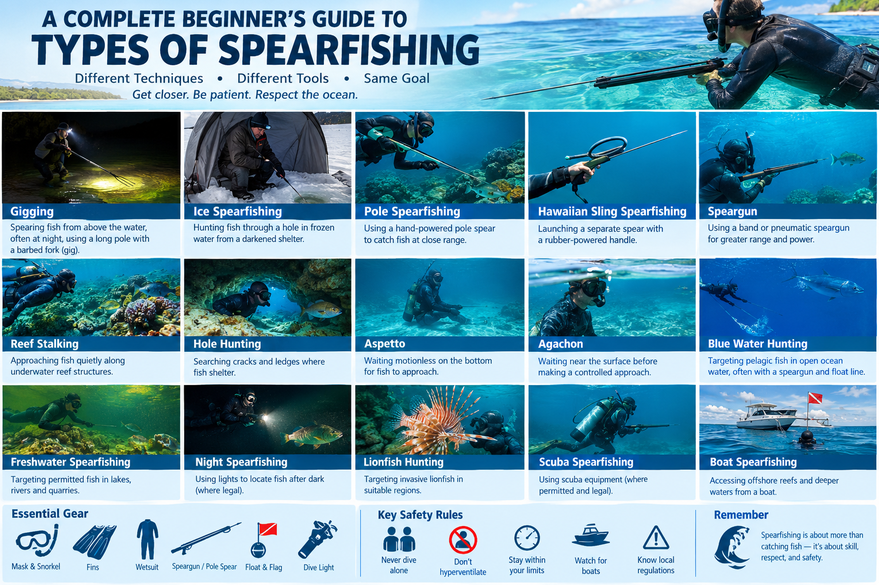
Every spearfisherman on Earth is doing one of 15 things, from wading the shallows with a gig to hunting giant tuna in blue water.
Understanding the different types of spearfishing explained in this guide will help you choose the right equipment, technique, and environment for your experience level. Some methods are suitable for beginners exploring shallow reefs, while others demand advanced freediving skills, specialized equipment, and extensive experience.
If you are new, these spearfishing types for beginners will help you pick a starting point. Each method has a clear trade-off, so you can match it to your gear, your water and your experience.
Before getting started, remember that spearfishing regulations vary by location. Always check local restrictions on species, equipment, protected areas, seasons, and permitted diving methods. Most importantly, never freedive alone. Shallow-water blackout can occur without warning, making a trained buddy and proper safety procedures essential.
1. What Are the Main Types of Spearfishing?
Spearfishing methods can be divided into two broad categories: techniques based on how you approach and catch fish, and methods based on the equipment you use. Some approaches happen above the water, while others require snorkeling, freediving, or scuba diving.
Spearfishing Methods at a Glance
- Gigging: Gigging means spearing fish from above the water, usually at night, with a long pole tipped with a barbed fork. You wade the shallows with a bright light and look for outlines, such as the oval shape and two eyes of a flounder lying on the sand. One firm push pins the fish to the bottom. It suits flounder, frogs and carp in shallow, calm, clear water. Shuffle your feet instead of stepping, because stingrays share those shallows
- Ice spearing: Ice spearing, or dark house spearing, means cutting a hole in the ice and covering it with a shack that blocks all light. The darkness lets you see down into the water like looking through a window. It is used for pike and sturgeon where it is still legal, and you usually get only one throw.
- Pole spearing: Using a hand-powered pole spear to catch fish at close range.
- Hawaiian sling spearfishing: Launching a separate spear with a rubber-powered handle.
- Reef stalking: Approaching fish quietly along underwater reef structures.
- Hole hunting: Searching underwater crevices and ledges where fish shelter.
- Aspetto: Waiting motionless underwater for curious fish to approach.
- Agachon: Waiting near the surface before making a controlled approach.
- Freshwater spearfishing: Targeting permitted fish in lakes, rivers, and quarries.
- Night spearfishing: Hunting after dark where local regulations allow it.
- Lionfish hunting: Targeting invasive lionfish in suitable regions.
- Scuba spearfishing: Spearfishing while using scuba equipment where permitted.
- Blue water hunting: Targeting pelagic fish in open ocean water.
These approaches are not mutually exclusive. For example, a diver might use a pole spear while stalking a shallow reef or use a speargun while hunting in blue water. Understanding both equipment and hunting techniques makes it easier to select a suitable approach.
2. Types of Spearfishing Equipment
Your equipment affects range, maneuverability, target selection, and the amount of practice required. For beginners, a simple setup is often more useful than buying the most powerful equipment available.
a. Pole Spearfishing
A pole spear is one of the simplest spearfishing tools. It consists of a long shaft with a rubber loop near the rear. The diver stretches the rubber, grips the shaft, aims, and releases it to propel the spear forward.
Most pole spears are approximately 5–10 feet long, although designs vary. Their effective range is relatively short, so the diver must approach the target carefully. Three-pronged tips, often called paralyzers, are commonly used for smaller fish, while single-point tips with a hinged flopper can help retain larger fish.
Learning how to use a pole spear for beginners starts with understanding the tool, practicing control in a legal and safe environment, and approaching fish without sudden movements. Pole spears can be suitable for shallow reefs, certain permitted invasive-species hunts, and locations where spearguns are prohibited.
You hook the rubber around your thumb, slide your hand up the shaft until it is stretched tight, aim and let go. Here is how to use a pole spear for beginners: stay calm, move slowly and get within arm’s reach. The shot carries only a couple of feet past the tip.
Roller vs. Standard Polespear
A standard pole spear uses a conventional rubber band, while a roller design routes the band over rollers near the spear’s front. Depending on the design, a roller pole spear may provide additional effective band stretch and a smoother acceleration profile.
- Standard pole spear: Simple construction, familiar handling, and a direct shooting feel.
- Roller pole spear: Potentially greater range and a different loading experience, depending on the design.
- Best choice: A standard model may suit close-range hunting, while a roller model may appeal to experienced divers who need additional reach.
The comparison between roller and standard polespears is based largely on equipment design and individual experience. Actual performance depends on band configuration, shaft dimensions, technique, and testing conditions. A roller system is not automatically more accurate or better for every situation. Rollers take practice to load. Pre-stretching the band and adding an intermediate grip makes it as easy as a standard band
b. Hawaiian Sling Spearfishing
A Hawaiian sling resembles a small handle with a rubber band and a separate spear shaft that slides through it. The diver draws the spear backward against the rubber and releases it toward the target.
Unlike a conventional pole spear, the shaft is launched separately and is not necessarily attached to the handle. This can provide more range, but missing a target may mean losing the spear or having to retrieve it from the seabed.
Learning how to use a Hawaiian sling spear requires practice with controlled aiming, equipment handling, and safe retrieval. It is a short handle with a rubber band and a loose spear that slides through a hole in the middle. You pull the shaft back like an arrow on a bow and release it. It reaches a few meters in good water, and it is one of the few legal options in the Bahamas. The catch is that a miss means the spear is gone.
Check local regulations before traveling with one because some destinations prohibit certain spearfishing tools even when others are permitted.
c. Band-Powered Spearguns
A band-powered speargun uses stretched rubber bands to propel a shaft. Its main components include a barrel, trigger mechanism, shaft, bands, and a shooting line that connects the shaft to the gun.
Thick latex bands stretch back to notches on a metal shaft, and the shaft is tied to the gun by a line. More bands mean more power, and a gun about 1 m long reaches roughly 3 to 4 m in clear water. Loading strong bands underwater is a workout, and a long gun is slow to swing in tight spaces.
Band spearguns are popular because they provide more range than many basic pole spears. Longer models can be useful in open water, while shorter models are easier to maneuver around rocks and other underwater structures.
How to Use a Speargun Safely
Safe operation begins before entering the water. Inspect the trigger mechanism, shaft, shooting line, and bands for damage. Follow the manufacturer’s loading instructions, and never point a loaded speargun at another person, even as a joke.
Learning how to load a band speargun should involve qualified, hands-on instruction. Use the manufacturer’s designated loading technique, keep your body clear of the shaft’s path, and never load or fire the gun outside a safe, controlled environment.
Underwater aiming also differs from aiming in air because light bends as it passes between water and the air inside your mask. This refraction changes how objects appear. When learning how to aim a speargun underwater, practice with an unloaded training setup or under qualified supervision, and follow local rules about safe target selection.
On the other side, knowing how to use a speargun safely starts with handling. Keep the gun unloaded until you are in the water, and keep the tip pointed away from people. For how to load a band speargun, hold the gun steady, stretch each band to its notch and keep your body clear of the shaft path. For how to aim a speargun underwater, line up the shaft with the fish at close range and take the shot only when you can see a clear path. Learning how to use a reel speargun follows the same principles, with the line managed carefully so it never wraps your hand or body.
d. Pneumatic Spearguns
Pneumatic spearguns use compressed air rather than conventional rubber bands. The air pressure drives an internal mechanism that propels the shaft when the trigger is activated.
A pneumatic gun uses a sealed air chamber you pump up by hand, usually to around 300 psi. It is shorter than a band gun but hits just as hard, so it works well in holes, caves and murky water. It is louder, needs a loading tool, and its seals need regular servicing.
These guns can be relatively compact, making them useful in confined spaces or areas where maneuverability matters. However, they require appropriate maintenance, including inspection of seals and other components. Follow the manufacturer’s pressure, loading, and servicing instructions rather than relying on generic pressure recommendations.
3. Spearfishing Techniques Explained
Choosing the right tool is only part of the process. Successful spearfishing also depends on understanding how fish react to movement, noise, habitat, and potential threats.
a. Reef Stalking
Reef stalking involves moving slowly along underwater structures and approaching fish without alarming them. Instead of swimming directly toward a target, a diver can use natural cover and measured movements to reduce the chance of startling the fish.
In a simple word, a diver will glide slowly along the bottom, hug the rocks and never swim straight at a fish. It works for snapper, grouper and hogfish
This approach is commonly associated with reef species such as snapper and grouper where local regulations permit their harvest. It requires patience, environmental awareness, and the ability to avoid damaging fragile coral or disturbing marine life unnecessarily.
b. Hole Hunting
Hole hunting involves searching cracks, ledges, and underwater cavities where fish shelter. Grouper and other structure-oriented species may occupy these locations, but the environment presents additional hazards.
Confined spaces can trap equipment, hide dangerous animals, and complicate an emergency ascent. Never force yourself into a cave or crevice, and never risk becoming trapped while trying to retrieve a fish or speargun. If equipment becomes stuck, prioritize your safety and abandon it if necessary.
c. Aspetto: Waiting on the Bottom
Aspetto is an Italian term commonly associated with waiting. In this technique, a freediver descends, settles into a suitable position, and remains still in the hope that fish will approach.
Its appeal lies in patience rather than pursuit. However, remaining underwater for longer is not a safe measure of skill. Breath-hold diving carries a risk of shallow-water blackout, particularly during ascent. Never extend a dive to pursue a fish, and always have a trained buddy actively monitoring you.
d. Agachon: Waiting Near the Surface
Agachon involves remaining still near the surface before making a controlled approach toward fish in suitable shallow water. It can be used around rocky shorelines and other habitats where fish patrol close to the surface.
Because divers may be exposed to boats, personal watercraft, waves, and changing currents, surface visibility is critical. Use the required dive flag and float, stay within your abilities, and avoid areas with heavy vessel traffic.
e. Freshwater Spearfishing
Freshwater spearfishing takes place in lakes, rivers, and quarries. Depending on the jurisdiction, permitted targets may include certain rough fish or invasive species. However, the rules can differ substantially between states, regions, and individual bodies of water.
Limited visibility, cold temperatures, submerged obstacles, and strong currents can make freshwater environments challenging. Research the specific waterway’s regulations and conditions before planning a trip. Never assume that a species or technique permitted in one lake is legal in another.
f. Night Spearfishing
Night spearfishing uses underwater lights to locate fish after dark. Some marine animals are less active or behave differently at night, making this approach appealing to experienced divers in locations where it is legal.
However, reduced visibility makes it harder to track a buddy, identify hazards, and navigate back to shore or a boat. Carry a reliable primary light and an appropriate backup, and establish a clear plan with your dive partner before entering the water.
g. Lionfish Hunting
Lionfish are invasive in parts of the western Atlantic and Caribbean, where they can put pressure on native reef fish. In regions with established control programs, trained divers may help manage their populations by harvesting them legally.
Their venomous spines make handling especially important. Never grab a lionfish with bare hands, and learn the correct handling, containment, and cleaning procedures before attempting a harvest. Follow local rules governing permitted equipment and capture methods.
h. Scuba Spearfishing
Scuba spearfishing involves using an underwater breathing apparatus rather than relying on breath-holding alone. Although scuba equipment allows a diver to remain underwater longer, it introduces separate risks involving gas supply, depth, buoyancy, and decompression.
Some jurisdictions prohibit spearfishing while using scuba, while others allow it under specific conditions. Confirm the law before diving and never assume that scuba certification automatically qualifies you to spearfish safely.
i. Blue Water Hunting
Blue water hunting takes place in open ocean water, away from reefs and the seabed. It targets pelagic species such as tuna, wahoo, and mahi-mahi, which may travel over deep water.
This form of spearfishing generally requires advanced experience, suitable equipment, reliable surface support, and a carefully planned recovery system. Powerful fish, changing ocean conditions, sharks, and long distances from shore create serious hazards.
Experienced divers may use long spearguns, float lines, and specialized buoy systems. Never wrap a float line around your hand or body, and do not attempt blue water hunting as a beginner without qualified guidance and appropriate support.
4. Shore Diving vs. Boat Spearfishing
How you reach your hunting location influences equipment choices, planning, and the risks you encounter.
a. Shore Diving Spearfishing for Beginners
Shore diving can provide access to suitable reefs and shallow coastal habitats without requiring a boat. Beginners should choose locations with manageable conditions, easy entry and exit points, and sufficient visibility.
Check tides, currents, surf forecasts, access restrictions, and local fishing regulations before entering the water. Never enter rough conditions simply because a location looks promising from shore.
b. Boat Spearfishing Techniques
Boat-based trips can provide access to reefs, offshore structures, and open-water locations that are difficult to reach from land. Safe boat spearfishing requires communication between divers and the vessel operator, clear entry and exit procedures, and reliable surface visibility.
Agree on the dive area, pickup plan, emergency signals, and what happens if a diver surfaces away from the boat. Keep clear of propellers and never enter the water while the vessel is moving or its propulsion system creates a hazard.
5. Float Lines, Floats, and Essential Equipment
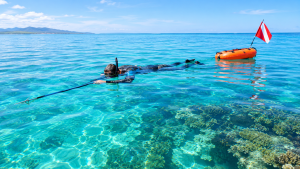
A suitable float system helps make a diver visible to other water users and can provide a way to recover equipment. It is particularly valuable in areas where boats, jet skis, and other vessels operate.
a. How to Use a Float Line Spearfishing
A float line connects a suitable surface float to the spearfishing setup using compatible clips and attachment points. Depending on the configuration, it can help keep equipment connected to the surface and provide a means of recovering it if a diver needs to release it.
Learn how to use a float line spearfishing setup by following the equipment manufacturer’s instructions. Check the line for wear, ensure the connections are secure, and manage slack carefully to reduce entanglement risks. Never attach a line in a way that could trap you underwater.
Learning how to use a float line spearfishing is the simplest safety upgrade. The basic rig is speargun, rope, then float, with a shark clip on the back of the gun. A 6 mm polypropylene rope is easy to splice, and a 6 or 8 mm ski rope also floats well. The float connects to the gun, holds a flag and gives you somewhere to keep your fish.
b. How to Use a Spearfishing Float and Flag
A bright, clearly visible float and the appropriate dive flag help alert other water users to the presence of a diver.
If you want to know how to use a spearfishing float and flag, you must choose a bright color so boats and jet skis can see you. If you shoot a fish too large to hold, let everything go and follow the float. After a long dive, you can drop the gear and retrieve it from the surface.
A flag does not guarantee that vessels will stay clear, so remain aware of boat traffic and avoid high-traffic areas whenever possible. Use a buddy system and establish a clear plan for surface support.
- T-bar stringer: thread it through the gills and out the mouth. It is easy to tow on shore dives, but you must reach the float each time.
- Speed spike: the fish slides down the float line, which is fast but heavy on long swims and risky if a shark hits.
- Flopper stopper: stops fish sinking back down the line and becoming easy prey.
c. Other Essential Gear for Your First Dive
Before choosing a hunting style, get the basics right:
- Mask and snorkel: Provide underwater visibility and surface breathing. Remove the snorkel from your mouth before diving, as appropriate to your training and equipment.
- Fins: Improve swimming efficiency. Choose a type suited to your experience and environment.
- Wetsuit: Helps manage exposure to cold water and sun.
- Weight system: Requires careful fitting and appropriate weighting instruction. Avoid excessive weight, and use a quick-release system where appropriate.
- Primary and backup lights: Important for permitted night diving and low-visibility situations.
- Float and line: Improve surface visibility and support equipment recovery.
Never hyperventilate before a breath-hold dive. Excessive ventilation can reduce the body’s warning signals for rising carbon dioxide without providing a reliable margin of safety against blackout.
6. Pole Spear vs. Speargun: Which Is Better?
When comparing pole spear vs. speargun, the best choice depends on the diver’s experience, target species, local rules, and intended environment.
- Pole spear: Simple, relatively compact, and well suited to close-range practice in appropriate shallow environments.
- Speargun: Generally offers greater range and may be more practical for larger or more distant targets, depending on its design.
- Hawaiian sling: Offers a different balance of range, handling, and spear retrieval requirements.
For many beginners, a pole spear is a sensible starting point because it encourages close approaches and straightforward equipment handling. However, simplicity does not eliminate the need for training, a dive buddy, and safe equipment use.
7. How to Start Spearfishing for Beginners
If you are learning how to start spearfishing for beginners, focus on building skills gradually rather than trying every technique immediately.
- Learn local regulations: Confirm which species, tools, locations, and diving methods are legal.
- Get qualified instruction: Learn freediving safety, equalization, equipment handling, and emergency procedures from a reputable instructor.
- Start in manageable conditions: Choose an appropriate location with good visibility, easy access, and limited current.
- Use simple equipment: Consider a suitable pole spear if it is legal for your chosen location.
- Dive with a trained buddy: Establish active supervision and clear communication procedures.
- Practice observation: Learn to recognize fish, understand their habitat, and move without damaging the environment.
- Know when to stop: End the session if conditions deteriorate, you become tired, or equipment develops a problem.
At this point, all you will have to do is to grab a pole spear and a buddy and stalk a shallow reef. Add a float and flag from day one, learn your local laws and build breath-hold skills gradually. Lionfish hunting is also beginner friendly where it is legal.
8. Spearfishing Safety Rules for Beginners
Following spearfishing safety rules for beginners is more important than choosing the perfect spear or catching a particular fish. Underwater emergencies can develop rapidly, and some hazards are difficult to recognize until it is too late.
-
- Never dive alone. Use a trained individual who actively monitors your dive and understands rescue procedures.
- Never hyperventilate. Breathe normally before a breath-hold dive. Anything more than normal breathing is too much
- Stay within your limits. Do not extend dives to reach a fish or recover equipment.
- Handle loaded spearguns carefully. Follow the manufacturer’s instructions and keep the muzzle pointed away from people.
- Use appropriate surface signaling. Carry a suitable float and flag where required and maintain awareness of vessels.
- Avoid hazardous cavities. Never risk entrapment while pursuing fish or retrieving equipment.
- Check environmental conditions. Assess weather, waves, current, temperature, and visibility before entering the water.
- Follow harvest regulations. Check species limits, minimum sizes, protected areas, seasons, and equipment restrictions.
- Carry appropriate emergency equipment. Plan for communication, first aid, and emergency assistance suited to the location.
- Fly a dive flag. It is caused by boats and swell are the real danger.
- Think your safety. If a shot fish is stuck in a hole, let go and come back up.
- Check local laws. Always check exact water before loading a gun.
The most important lesson is that a fish is never worth risking your life. A safe dive is one in which you and your buddy return to the surface without incident.
Frequently Asked Questions
What are the best spearfishing types for beginners?
Pole spearfishing and simple shallow-water approaches can be suitable starting points when the method is legal and conditions are appropriate. Beginners should first learn freediving safety and practice with qualified supervision before attempting to harvest fish.
What fish can you spearfish for beginners?
Suitable species depend on local laws, habitat, equipment, and the diver’s experience. Some beginners may encounter permitted small reef fish or invasive lionfish in regions where their harvest is legal. Always confirm identification, size limits, seasons, and protected-species rules before taking a fish.
The most common beginner targets are snapper, grouper and hogfish on shallow reefs, plus lionfish where hunting is encouraged. Always check local rules on species and sizes.
Is a pole spear better than a speargun?
A pole spear is often simpler and more appropriate for close-range practice, while a speargun generally offers greater range. Neither is universally better. Your experience, target, environment, and local regulations should guide your decision.
Can you spearfish while scuba diving?
Some places permit scuba spearfishing, while others prohibit it or restrict it to particular circumstances. Check the regulations for your exact destination and ensure you have the necessary training and equipment.
Do you need a float and flag for spearfishing?
Requirements vary by location, but a suitable float and dive flag can improve visibility to other water users and help support equipment recovery. Follow local signaling rules and remember that a flag cannot guarantee protection from boat traffic.
Anyway, it is highly recommended since it makes you visible to boats and lets you drop your gear if a fish is too big.
What is the biggest danger in spearfishing?
Breath-hold diving can lead to shallow-water blackout, which may occur with little or no warning. Other hazards include entanglement, currents, cold exposure, boat traffic, and dangerous underwater structures. Never dive alone, and prioritize safety over extending a dive.
Moreover, shallow water blackout, which can happen on the way up with no warning.
Is spearfishing legal everywhere?
No. Rules vary widely. Spearguns are banned in the Bahamas, scuba spearfishing is banned in much of the Mediterranean, and freshwater laws change from state to state.
What is the best first spearfishing tool?
A pole spear is the classic beginner tool because it teaches you to approach fish calmly and works where spearguns are banned.
Conclusion: Choose the Right Type of Spearfishing Method
Spearfishing offers a wide range of experiences, from gigging in shallow water to stalking reef fish and exploring the open ocean. Each technique has its own advantages, equipment requirements, and risks. Understanding those differences helps you choose a method that fits your skill level and environment.
For beginners, the best approach is to start simply, learn from qualified instructors, understand local regulations, and build strong safety habits before attempting more demanding techniques. A pole spear and a suitable shallow-water environment may be a reasonable introduction, but training and active buddy supervision remain essential.
Key Takeaways
-
- Learn the differences between spearfishing equipment and hunting techniques before choosing your setup.
- Consider a pole spear for close-range practice where permitted.
- Always use a bright float and flag. Understand how floats, flags, and float lines support visibility and equipment recovery.
- Check local rules before targeting any species or using a particular method.
- Never hyperventilate or freedive alone.
- Build experience gradually and never sacrifice safety to catch a fish.
- There are 15 types of spearfishing, split between tools and hunting styles.
- Beginners should start with a pole spear on a shallow reef with a buddy.
- Roller and standard polespears each have strengths; choose by range or close-range impact.
Ultimately, responsible spearfishing is about more than accuracy. It combines knowledge of marine life, respect for the environment, careful equipment handling, and sound decisions underwater. Master those fundamentals first, and you will be better prepared to explore the many types of spearfishing safely and responsibly.
Spearfishing offers something for everyone, from dry-land gigging to blue water hunting. Start simple, respect the water and the law, and let experience guide you toward more advanced methods.
