Why Fish Stop Biting: Causes, Mistakes and Proven Fixes
You have been catching fish consistently for an hour. Your rod has been bending, your lure is producing strikes, and everything seems perfect. Suddenly, the action stops. You continue casting the same lure into the same spot, but nothing happens.
Sound familiar?
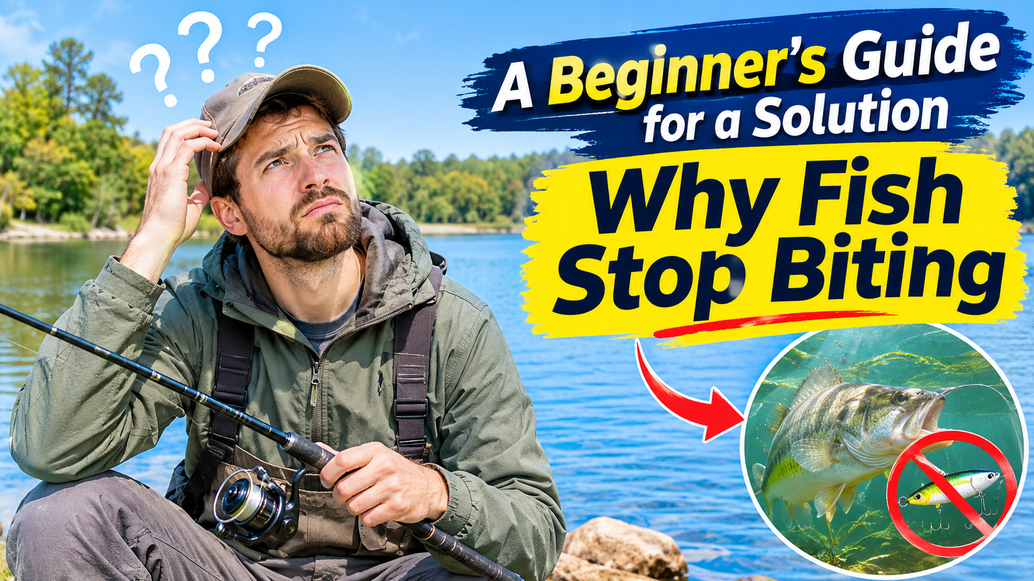
Understanding why fish stop biting is one of the most important skills an angler can develop. Fish rarely become uncatchable without a reason. Changes in light intensity, water temperature, barometric pressure, fishing pressure, and natural feeding cycles can all influence their willingness to feed.
The good news is that fish often remain in the same general area even after the bite slows down. They may simply have moved deeper, become less active, or started avoiding familiar presentations.
The fish that were hammering your lure are usually still there. They have simply stopped feeding, and your job is to work out what changed. Every angler learns how to do when fish stop biting the hard way, by repeating the same cast with growing desperation. That is the worst response, because fish that have shut down will not restart for more of the same stimulus.
In this guide, we will explore the science behind changing fish behavior and explain practical techniques for getting bites again.
We will also cover how to read beach structure like an experienced surf angler, identify productive gutters and sandbars, and choose better fishing locations.
1. Changes in Light Conditions and Feeding Windows
Light intensity is one of the major environmental factors controlling fish feeding activity. Many freshwater predator species rely heavily on vision when hunting prey, particularly during low-to-moderate light conditions.
This explains why dawn and dusk frequently produce excellent fishing.
Why Fish Become Less Active in Bright Sunlight
As the sun rises, increasing light penetration can make fish more cautious in shallow, clear water. Predators may become more visible to birds and other threats, while baitfish can also detect approaching predators more easily.
As a result, fish often leave exposed shallow areas and move toward deeper water, vegetation, docks, submerged structures, and shaded locations.
This is why fish that aggressively chased lures early in the morning may become difficult to catch around midday.
How Weather and Water Clarity Affect the Bite
Cloud cover acts as a natural light diffuser. Overcast conditions can reduce intense sunlight and extend productive feeding periods.
Water clarity also matters:
- Clear water: Light penetrates deeper, making fish more sensitive to bright conditions.
- Stained water: Reduced light penetration can help extend shallow-water feeding activity.
- Murky water: Fish may rely more heavily on vibration, movement, and other sensory signals when locating prey.
Seasonal sun angle also changes the feeding window. During fall and winter, the sun generally travels lower across the horizon, potentially allowing fish to remain active during midday compared with similar summer conditions.
Best Time of Day to Fish When They Stop Biting
If the bite slows down during bright afternoon conditions, consider returning during these periods:
- Early morning, when light levels are lower.
- Late afternoon, when sunlight becomes less intense.
- Dusk, when predators often become more comfortable feeding in shallow water.
- Overcast periods, when reduced sunlight can extend feeding opportunities.
2. Water Temperature and Fish Metabolism
Fish are cold-blooded, so water temperature directly controls how often they need to eat. Largemouth bass feed most aggressively roughly between 65 and 75°F. Rainbow trout prefer cooler water and become sluggish as it warms. Too warm, and fish burn more energy while the water holds less oxygen. Too cold, and metabolism slows so much that they eat rarely and will not chase.
Water temperature is another major reason fish suddenly stop biting. Fish are ectothermic, meaning their body temperature is regulated by the surrounding water. Their metabolism, digestion, oxygen requirements, and feeding motivation are strongly influenced by temperature.
How Warm Water Affects Fish
As water temperatures rise beyond a species’ preferred range, fish can experience increased physiological stress. Warm water holds less dissolved oxygen, while maintaining metabolic activity can require more oxygen.
Fish may respond by reducing movement and seeking cooler water.
Instead of aggressively chasing a fast-moving lure, they may remain near shaded structures, deeper areas, springs, tributaries, or cooler water inflows.
Why Cold Water Slows Feeding Activity
Cold water generally slows fish metabolism. Fish require fewer calories, digest food more slowly, and may become less willing to chase prey.
This is why winter fishing often requires slower presentations and greater patience.
Different species also have different temperature preferences. For example, largemouth bass and rainbow trout do not share the same optimal temperature range.
How to Adjust Your Fishing Strategy
When temperature changes affect fish activity:
- Move deeper when shallow water becomes excessively warm.
- Look for cooler water near shaded banks, springs, and tributaries.
- Slow down your retrieve when fish become lethargic.
- Use smaller presentations that require less commitment from inactive fish.
- Adjust fishing depth as seasonal temperature patterns change.
3. Barometric Pressure and Weather Changes
Barometric pressure is frequently discussed among anglers because changing weather can coincide with noticeable changes in fish activity.
Fish have sensory systems that detect movement and pressure changes in their surroundings. Their swim bladder also responds to external pressure.
Although the exact influence of atmospheric pressure on feeding behavior is not completely settled, weather patterns can provide useful clues.
Fishing Before and After a Cold Front
Many anglers experience strong feeding activity before an approaching weather front.
As pressure falls and weather conditions change, fish may become more aggressive and feed actively.
However, after a cold front passes, fishing can become considerably more difficult. Bright skies, changing temperatures, and shifting conditions can cause fish to become less active and hold closer to cover.
A cold front stacks several changes at once: a pressure swing, a temperature drop, bright clear skies with heavy light penetration, and a wind shift that rearranges bait. The practical rule is to watch the trend over 24 to 48 hours, not the single number on the barometer. Stable weather, high or low, lets fish settle into routines.
Post-Front Adjustments
- Slow everything down and fish tight to cover.
- Downsize your lure and line.
- Be patient and expect fewer, subtler bites.
Watch Pressure Trends Instead of One Reading
Pressure is one of the most debated variables. Fish sense pressure changes through the lateral line and swim bladder. Some research suggests the effect is smaller than fishing culture claims, since a fish moving ten feet deeper experiences a larger pressure change than most weather events. Still, anglers consistently report a pattern worth using: feeding often picks up as pressure falls before a front, then slows for one to three days after the front passes.
A single barometer reading does not tell the complete story. Pay attention to whether pressure has been rising, falling, or remaining stable.
Practical adjustments include:
- Falling pressure: Try more active presentations and cover productive water.
- Immediately after a cold front: Slow down, downsize lures, and target protected cover.
- Stable weather: Establish a consistent pattern by testing different depths and presentations.
4. Fishing Pressure and How Fish Learn to Stop Biting
One overlooked explanation for why fish stop biting is fishing pressure.
Fish can develop conditioned avoidance responses after repeatedly encountering lures, hooks, and other negative experiences.
On heavily fished lakes and rivers, some fish become more cautious around familiar presentations.
Why Fish Follow Your Lure and Don’t Bite
Why fish follow your lure and don’t bite usually comes down to a lure that moves in a perfectly straight line at one speed. Nothing alive swims that way. The fish gets a long, slow look and turns away as the water shallows near the bank
And, have you ever watched a bass follow your lure all the way to the boat before turning away?
This behavior can indicate that the fish is interested but unwilling to commit.
Possible reasons include:
- The lure resembles something the fish has previously encountered.
- The retrieve is too fast or unnatural.
- The fish has experienced previous hook-and-release encounters.
- The presentation is landing outside its preferred strike zone.
On the other hand, when you see a follow, stop the retrieve. Let a crankbait float up like an injured baitfish, then give it one sharp twitch as if it is trying to escape. That sudden change often triggers a reaction strike. Then rotate lure types, colors, and retrieves rather than repeating whatever stopped working.
How Fish Learn to Stop Biting
A fish that has been hooked, fought, and released ties that experience to certain lures, line sizes, and retrieve speeds. On busy public water, that caution spreads across the whole population. Fish caught repeatedly through a season tend to need slower presentations, smaller lures, and lighter line each time
This does not mean every fish remembers every encounter. However, fishing pressure can influence catchability, particularly in popular public waters.
How to Catch Pressured Fish
Try these adjustments:
- Downsize your lure to create a more subtle presentation.
- Slow your retrieve and avoid excessive movement.
- Change your casting angle to approach fish from a different direction.
- Use lighter fluorocarbon and longer leaders.
- Fish early in the morning, late in the evening, or during quieter weekdays.
- Allow heavily pressured locations time to rest.
5. Forage Availability and Natural Feeding Cycles
Fish do not feed continuously throughout the day. Their feeding behavior follows natural cycles of active foraging, digestion, and rest.
This explains why a productive fishing location can suddenly become quiet even when the fish have not moved away.
Fish May Have Already Eaten
When baitfish move through an area, predators often gather around nearby structures and feeding opportunities.
The resulting feeding activity can be intense but short-lived.
After the baitfish school moves away, predators may return to their holding positions and become less interested in artificial presentations.
You might arrive just after the feeding opportunity has ended.
Learn to Identify Forage Activity
Look for these signs:
- Baitfish jumping or scattering near the surface.
- Birds diving into the water to catch baitfish.
- Nervous water indicating baitfish movement below the surface.
- Visible surface disturbances caused by feeding predators.
- Silver flashes from baitfish or larger fish turning in the water.
Match Your Lure to Available Forage
If predators have been feeding on small shad or minnows, a large swimbait may not be the best choice.
Observe the size, color, and depth of available baitfish. Then choose a lure that resembles the prey fish are already targeting.
Position yourself ahead of moving baitfish rather than repeatedly casting where feeding activity has already finished.
6. How to Get Fish Biting Again: Practical Solutions
One of the biggest mistakes anglers make is continuing to use the same lure, retrieve, and fishing depth after the bite disappears.
More casts do not necessarily mean more opportunities. The better approach is to identify what has changed and adapt your presentation.
Step 1: Slow Down Your Retrieve
When fish become inactive because of temperature, weather, or fishing pressure, a slower presentation can make your lure easier to approach.
Try a slower soft plastic retrieve, gentle jigging movement, or a pause between retrieves.
Step 2: Downsize Your Lure
Smaller lures can be effective when fish are cautious or feeding on small baitfish.
Experiment with smaller soft plastics, compact jigs, and natural-looking presentations.
Step 3: Change Your Fishing Depth
If fish move away from shallow water because of light or temperature, continuing to fish the surface may produce very few results.
Explore:
- Deeper weed edges.
- Submerged vegetation.
- Shaded docks and structures.
- Drop-offs and depth transitions.
- Cooler water near tributaries or springs.
Step 4: Change Location When Necessary
If baitfish have moved or predators have finished feeding, look for another productive area.
Target locations where food is likely to concentrate rather than repeatedly fishing an empty feeding zone.
7. How to Read Beach Like a Pro When Surf Fishing
The same principle of adapting to fish behavior applies to saltwater fishing. Understanding beach structure can help you locate fish even when the surf appears featureless.
Instead of casting randomly as far as possible, learn to identify sandbars, gutters, holes, points, and runouts.
Breaking, white, aerated water marks shallow sandbars. Smooth, dark green or blue water marks deeper troughs and gutters. Fish want deep water for safety next to shallow bars that stir up food
Look for the following:
- Points where waves crash close together, which hold bait.
- Runouts and rips where water flows back to sea like a bait buffet.
- Troughs between bars, which act as highways for fish.
Scout at low tide from a dune or headland, ideally with polarized sunglasses, and note how far you must cast at high tide. Spread rods at different distances, and move down the beach if nothing bites.
Understand Breaking Waves and Water Depth
One of the easiest ways to read a beach is by watching incoming waves.
- Breaking waves: Usually indicate relatively shallow water where waves interact with the seabed.
- Unbroken swells: Often indicate deeper water compared with surrounding breaking areas.
- Dark green or blue water: Can indicate deeper sections.
- White aerated water: Usually identifies shallow areas where waves have broken.
These visual clues help identify changes in underwater structure.
Find Sandbars, Gutters, and Holes
Sandbars are shallow underwater formations where incoming waves often break.
Behind or between sandbars, deeper sections called gutters or holes can form.
These areas are productive because waves can stir up worms, shellfish, pippies, and other food sources around the sandbar. Currents then carry these organisms into nearby deeper water.
Fish can use gutters as feeding areas and travel routes.
Identify Points and Runouts
Points are areas where waves converge or break close together. They can concentrate baitfish and help direct fish movement.
Runouts are channels where water flows back toward the ocean after waves wash onto the beach.
These currents can transport food into deeper water, attracting fish that wait nearby for an easy meal.
The area where a strong rip begins to lose its power can be particularly productive because food may collect there.
Scout the Beach at Low Tide
Low tide is an excellent opportunity to inspect beach structure.
Look for:
- Sandbar formations and gaps.
- Deep troughs and holes.
- Points and runouts.
- The high-tide waterline.
- Areas where shallow water meets deeper channels.
If possible, observe the beach from a high sand dune or nearby headland. Polarized sunglasses can help reveal underwater features.
Remember where these structures are located because they may be submerged when the tide rises.
Choose Casting Locations Based on the Tide
At high tide, productive casting locations may include the shore break, deeper troughs, sandbar edges, and runouts.
At low tide, some inner troughs may become too shallow to hold fish. Look toward deeper outer troughs and channels instead.
On steep, high-impact beaches, the first shore break may provide productive depth at higher tide. On gently sloping, low-impact beaches, deeper water may require longer casts.
8. What to Do When Bass Stop Biting
When bass stop biting, it depends on the temperature trend. In summer heat, go deeper or find cooler inflows, shaded channels, or the band of water just above the thermocline, where oxygen and temperature overlap.
In cold water, slow down and use smaller baits. Bass in cold water will take an easy meal but rarely chase one. A cheap thermometer on a string can show you where the water changes.
And, bass fishing can become frustrating when fish suddenly stop chasing your favorite lures.
Instead of abandoning the location immediately, consider these adjustments:
- Move from exposed shallow water into shaded cover.
- Try smaller soft plastics or compact jigs.
- Slow down your retrieve and allow pauses.
- Target deeper weed edges and submerged structures.
- Look for baitfish activity and match the available forage.
- Return during early morning or evening feeding periods.
If bass are following your lure without striking, experiment with a different retrieve speed, presentation size, or approach angle.
Hook-Ups: When the Bite Is Real but You Miss It
Sometimes fish are biting and you are not converting. Check these first:
- Hook size: a hook far wider than the mouth will not penetrate. Match it to the species.
- Sharpness: drag the point across your thumbnail. If it glides, sharpen or replace it.
- Timing: bass often need roughly three seconds to position a lure, so avoid swinging too early. Fast species like trout and perch need an instant reaction.
- Line: thick mono stretches. Braid shows bites sooner.
Frequently Asked Questions
Why do fish suddenly stop biting in the same spot?
Fish may stop feeding because of changing light, water temperature, weather conditions, fishing pressure, or natural feeding cycles. They may remain in the area but become less willing to strike.
Usually a change in light, temperature, pressure, or food supply, or fish becoming wary after repeated catches. Fish rarely leave. They stop feeding.
How do you make fish bite when they are not hungry?
You cannot force a fish to feed, but you can improve your chances by using smaller lures, slowing down your presentation, matching available forage, and targeting its preferred holding depth.
Why do fish follow a lure but refuse to strike?
Fish may be investigating the lure without committing because of fishing pressure, unnatural movement, incorrect lure size, or a presentation that does not match their current feeding behavior.
What is the best time to fish when fish stop biting?
Early morning and late afternoon are often productive because light intensity is lower. Overcast conditions can also extend feeding activity. However, the best window depends on species, water temperature, and local conditions.
Also, you can try at dawn, dusk, and overcast periods, plus moving-tide windows in salt water.
What should I change first when fish stop biting?
Start by slowing down your retrieve, downsizing your lure, and changing fishing depth. These three adjustments address several common reasons for reduced feeding activity.
How can I find fish on a featureless beach?
Look for breaking waves, dark deeper-water sections, sandbars, gutters, points, and runouts. Scouting during low tide makes underwater structure easier to identify.
Do fish stop biting after a cold front?
Typically yes, for one to three days. Slow down, downsize, and fish near cover while the water stabilizes.
Fishing can become more difficult for one or two days after a cold front. Fish may become less active and hold closer to cover. Slow presentations and deeper locations can help.
Why do bass follow a lure but not strike?
The retrieve looks unnatural or the bass has learned caution. Try a pause and sharp twitch near the bank, or vary speed and size.
Can I make full fish bite?
Not reliably. Use small, easy meals that match the local forage, fish slowly, or return when the next feeding window opens.
Is barometric pressure really important?
Its effect is debated and likely smaller than popular belief, but the trend over 24 to 48 hours is a useful signal, especially around fronts.
Conclusion: Understanding Fish Behavior Is the Key to Consistent Fishing
When fish stop biting, the solution is not simply to cast more often or change lures randomly. Successful anglers learn to recognize the environmental and biological factors that influence feeding behavior.
Light intensity, water temperature, barometric pressure, fishing pressure, and natural forage cycles all help explain why fish become less active.
The same adaptive thinking applies to surf fishing. Learning how to identify sandbars, gutters, points, troughs, and runouts helps you place your bait where fish naturally travel and feed.
Key Takeaways:
-
- Fish often remain nearby even after feeding activity slows down.
- Dawn, dusk, and overcast conditions can provide longer feeding opportunities.
- Water temperature influences metabolism and feeding motivation.
- Fishing pressure can make fish more cautious around familiar presentations.
- Match lure size and movement to the available forage.
- When the bite stops, slow down, downsize, and change depth.
- Read beach structure, bait, birds and tidal movement to find fish again.
- Observe changing conditions and keep a fishing journal to recognize productive patterns.
- Fish usually stay put. They stop feeding for a reason.
- Light, temperature, pressure trend, forage cycles, and fishing pressure drive most shutdowns.
- Low-light windows and overcast days stretch the bite.
- Slow down, downsize, and change depth when the cause is unclear.
- Follows without strikes call for a pause-and-twitch or a new presentation.
- Check hook size, sharpness, and strike timing before blaming the fish.
When fish go quiet, treat it as a puzzle, not a curse. Identify what changed, adapt your depth, speed, size, or timing, and give the fish a reason to commit. The anglers who catch the most are the ones who adapt instead of persist.
Ultimately, the best anglers are not simply the ones who know how to catch fish when they are feeding aggressively. They are the ones who understand how to adapt when conditions change. Learn to recognize those changes, and you will have a much better chance of getting fish biting again.
