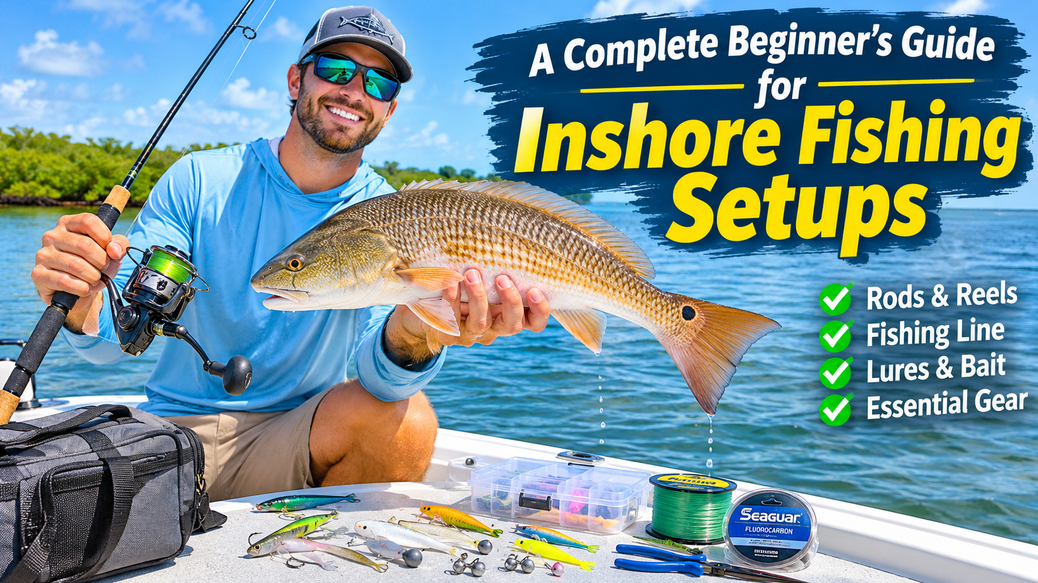
Best Rod and Reel Combos for Inshore Fishing Setups to Catch Redfish & Trout
Getting started with inshore saltwater fishing can feel overwhelming. Walk into any tackle shop, and you’ll find hundreds of fishing rods, spinning reels, braided lines, artificial lures, hooks, and accessories. With so many choices, figuring out what equipment you actually need can be difficult.
The good news is that you don’t need an expensive collection of fishing gear to start catching inshore species. A well-balanced rod and reel, reliable fishing line, a few proven lures, and some basic terminal tackle are enough to cover most situations.
The right inshore fishing setups should help you target popular saltwater species such as redfish, speckled trout, snook, flounder, sheepshead, and mangrove snapper without spending a fortune.
In this beginner’s guide, we’ll break down everything from choosing the right rod and reel to selecting braided line, fluorocarbon leaders, artificial lures, and live bait rigs.
1. How to Choose the Right Inshore Fishing Rod
Your fishing rod is the foundation of your entire setup. Before purchasing one, pay attention to three important specifications: length, power, and action.
Rod Length: Start Around 7 Feet
For general inshore fishing, a 7-foot rod is an excellent starting point. It offers a practical balance between casting distance, accuracy, and control.
A rod between 6 feet 9 inches and 7 feet 6 inches can also work, depending on your fishing environment.
- 7-foot rod: Versatile for beginners fishing different inshore locations.
- 7-foot 6-inch rod: Useful when longer casting distance is important.
- 6-foot 6-inch rod: Easier to maneuver around docks, mangroves, and narrow creeks.
Rod Power: Medium Is a Great All-Around Choice
Rod power describes how much force is required to bend the rod. For most beginners, a medium-power rod provides enough strength for common inshore species without feeling unnecessarily heavy.
- Medium-light: Suitable for speckled trout, flounder, and smaller fish.
- Medium: A versatile option for redfish, trout, and general inshore fishing.
- Medium-heavy: Better suited to larger redfish, black drum, and heavier fishing conditions.
- Heavy: Useful when targeting larger fish around demanding structure.
Rod Action: Choose Fast Action
Fast-action rods bend primarily near the tip. This design helps detect subtle bites, control artificial lures, and deliver responsive hooksets.
A 7-foot medium-power fast-action spinning rod is an excellent all-purpose recommendation for beginners.
2. Choosing the Right Inshore Spinning Reel
A spinning reel is generally one of the easiest reel types for beginners to learn. It is relatively simple to operate and works well with lightweight artificial lures and live bait.
What Spinning Reel Size Should You Choose?
A 3000-size spinning reel is a versatile option for most inshore fishing situations.
- 2500 size: Great for smaller trout, flounder, and lighter presentations.
- 3000 size: A dependable all-around choice for redfish, trout, and general inshore fishing.
- 4000 size: Useful for live bait fishing, larger fish, and situations requiring additional line capacity and drag.
Recommended Spinning Reel Options
The following three Shimano spinning reels offer options at different price levels.
Budget Option: Shimano Nasci
Around $100 for the Shimano Nasci offers smooth operation and durability. It is a practical starting point for anglers who want quality without spending too much.
Remember to rinse and maintain your reel after saltwater fishing to help prevent corrosion.
Mid-Range Option: Shimano Miravel
The Shimano Miravel, presented at approximately $140, provides another option for anglers wanting a lightweight, smooth-performing reel.
Higher-End Option: Shimano Vanford
At approximately $230 for the Shimano Vanford is recommended for its lightweight construction, smooth operation, and saltwater performance.
The best inshore spinning reel combo isn’t necessarily the most expensive one. Choose a reel that balances properly with your rod and matches the size of fish you intend to catch.
3. Best Fishing Line for Inshore Fishing
Your fishing line affects casting distance, sensitivity, strength, and your ability to control fish around underwater structure.
For most artificial-lure applications, braided main line paired with a fluorocarbon leader is an effective combination.
Best Braided Line for Inshore Fishing
Braided line offers several advantages over traditional monofilament.
- Greater casting distance because of its thinner diameter.
- More line capacity on your spinning reel.
- Minimal stretch for improved sensitivity.
- Better detection of light trout and flounder bites.
Try Sufix 832, an eight-strand braided line. The important feature is its smooth, slick construction, which helps improve casting performance.
For general-purpose fishing, consider these line strengths:
- Speckled trout and flounder 10 lb
- General inshore fishing 15 lb
- Redfish and larger sheepshead 20 lb
- Heavy structure and larger fish 20–30 lb
For beginners who want one versatile setup, 15-pound braid is a good starting recommendation.
Best Fluorocarbon Leader for Inshore Fishing
The best fluorocarbon leader for inshore fishing comes down to abrasion resistance and a slim, low-bulk spool. One guide prefers a thin, streamlined fluorocarbon because it keeps his rig compact. Choose a reliable brand and match the leader strength to your braid.
A fluorocarbon leader provides additional abrasion resistance around oysters, barnacles, shells, and other underwater structures.
It is also less visible underwater than many traditional fishing lines, making it useful in clear water.
Try using approximately 15-pound fluorocarbon for an all-purpose setup.
- 10 lb: Lighter presentations for trout and flounder.
- 15 lb: General-purpose inshore fishing.
- 20–30 lb: Larger redfish, black drum, and heavier structure.
A Seaguar Inshore 25-pound leader is another example mentioned in the beginner tackle selection.
How Long Should Your Fluorocarbon Leader Be?
A leader measuring approximately 4 feet is a practical working length, although the original setup started with around 6–7 feet.
You can use a longer leader if needed, but make sure the leader connection knot does not sit inside the reel spool when preparing to cast.
For connecting braid to fluorocarbon, the double uni knot is a reliable option. Practice tying it correctly and check your knots before fishing.
4. Choosing a Species-Specific Inshore Setup
Although an all-purpose setup works for many situations, experienced anglers often adjust their equipment according to the fish and fishing environment.
Inshore Spinning Setup for Redfish and Trout
For sight fishing on shallow flats, casting accuracy and distance are especially important.
A specialized setup includes:
- 7-foot 6-inch rod rated for 6–12 lb line.
- 2500-size spinning reel.
- 10-pound braided line.
- A lightweight artificial shrimp presentation.
This combination is designed for making accurate casts toward visible redfish and trout.
When visibility is poor or you need to cover more water with larger search baits, move toward a 3000-size reel, 15-pound braid, and a 7-foot 6-inch rod rated for 8–17 lb line.
Inshore Redfish and Snook Setup Around Mangroves
Fishing near mangrove shorelines, docks, and creek structures requires more control.
Try this recommendation:
- 4000-size spinning reel.
- 20-pound braided line.
- 7-foot 6-inch rod rated for 10–20 lb line.
This setup provides additional strength for turning larger fish away from structure.
For narrow creeks and tight fishing areas, consider shortening the rod to around 7 feet or even 6 feet 6 inches. A shorter rod is easier to maneuver around branches, docks, and confined spaces.
Live Bait Setup for Redfish and Snook
When fishing live bait around docks and mangroves, try moving up to a 4000-size saltwater spinning reel with 30-pound braid.
The additional strength helps when fishing larger baits and trying to pull fish away from heavy structure.
The main lesson is simple: match your equipment to your fishing conditions instead of using one setup for every situation.
5. What Inshore Fishing Lures for Beginners Should You Buy?
You don’t need dozens of artificial lures to start catching inshore fish. Three basic lure categories can cover a wide range of situations: bottom jigs, suspending hard baits, and topwater lures.
1. Soft Plastic Jigs
Soft plastic paddle tails and shrimp imitations are excellent beginner choices.
Pair a soft plastic with a 1/8-ounce or 1/4-ounce jig head to work the bottom and attract flounder and redfish.
For shallow water and heavy grass, a weedless Texas Eye-style jig head can help reduce snags.
2. Suspending Hard Baits
A suspending bait such as the MirrOlure MirrOdine 17MR is useful when fish are feeding in the middle of the water column.
It is particularly effective for speckled trout, although redfish and other inshore species may also strike it.
This type of lure is a good choice when fish are holding around 3–4 feet below the surface.
3. Topwater Lures
Topwater lures create surface disturbance and attract aggressive fish.
You can try with these lures:
- Heddon Super Spook.
- Heddon One Knocker.
- Yo-Zuri Pencil TopKnock.
Use these lures during early morning periods, especially around sunrise, or when you notice fish attacking bait near the surface.
4. Artificial Shrimp
A 3-inch DOA shrimp is another versatile option for beginners.
It provides a natural shrimp presentation and can be fished slowly or suspended beneath a popping cork.
Z-Man 3-inch Minnows are also useful soft plastics. Electric chicken and pinfish are two colors here.
6. Essential Live Bait Rigs for Inshore Fishing
Artificial lures are not the only way to catch inshore fish. Live shrimp, pinfish, and other natural baits can be extremely effective.
Circle Hooks and Kahle Hooks
You can start with Kahle hooks, which is particularly around size 1 for many live shrimp applications.
The most important rule is to match the hook to your bait rather than simply choosing a hook based on the size of the fish.
- Smaller live shrimp: Size 1 or 2 hooks.
- Larger baitfish: Choose a hook appropriate for the bait’s size.
- Open-water live bait fishing: Consider a circle hook.
A 1/0 circle hook is another versatile option mentioned for shrimp, pinfish, and whitebait.
Circle hooks generally require a steady reeling motion rather than an aggressive hookset.
Freeline Live Shrimp
Freelining is one of the simplest live bait presentations.
Tie an appropriately sized hook directly to your fluorocarbon leader and allow the shrimp to swim naturally. This works well when fish are feeding in the upper water column.
Popping Cork Setup
A popping cork allows you to suspend live shrimp or artificial shrimp at a particular depth.
Attach the main line to the top of the cork, then connect a leader of approximately 3 feet to the bottom and attach your bait.
When popped, the cork creates a sound that can attract nearby fish and draw attention to the bait below.
Look for a popping cork with a cupped top that produces a noticeable gulping sound.
7. Essential Inshore Fishing Accessories
Beyond your rod, reel, and tackle, a few simple accessories can make fishing easier and safer.
Fishing Pliers
A good pair of corrosion-resistant fishing pliers is essential.
Look for features such as:
- Strong jaws for removing hooks.
- Sharp cutters for braided line and leaders.
- Replaceable cutting components.
- A protective sheath and safety lanyard.
Aluminum pliers are a practical option, while titanium models offer excellent corrosion resistance.
Polarized Sunglasses
Polarized sunglasses reduce surface glare and help you see beneath the water.
This is particularly useful when sight fishing for redfish on shallow flats. Choose a comfortable, well-fitting pair that limits sunlight entering from the sides.
Organized Tackle Bag
A compact tackle bag with adjustable trays makes it easier to carry your essential gear.
A Plano 3600-series tackle bag is one example here.
Organize your tackle into separate compartments for hooks, jig heads, weights, hard baits, soft plastics, and leader material.
8. How to Build a Budget-Friendly Inshore Setup
You don’t have to purchase every piece of equipment immediately. Start with the essentials and gradually add specialized equipment as your fishing experience improves.
A practical beginner shopping list includes:
- A 7-foot medium-power fast-action spinning rod.
- A 3000-size spinning reel.
- 15-pound braided main line.
- 15-pound fluorocarbon leader.
- A selection of soft plastic minnows and shrimp.
- 1/8-ounce and 1/4-ounce jig heads.
- One suspending hard bait.
- One topwater lure.
- A selection of appropriately sized hooks.
- Fishing pliers and polarized sunglasses.
One important recommendation is to avoid extremely cheap pre-made combos that sacrifice rod quality to keep the package price low. A balanced rod and reel purchased separately can provide better long-term value.
Frequently Asked Questions
1. What is the best rod length for inshore fishing?
A 7-foot rod is an excellent all-purpose choice. Choose a longer 7-foot 6-inch rod when casting distance is important or a shorter rod when fishing tight creeks and mangroves.
2. What size spinning reel is best for beginners?
A 3000-size spinning reel is a versatile starting point for redfish, speckled trout, and flounder. A 2500-size reel suits lighter applications, while a 4000-size reel provides additional capacity for heavier fishing.
3. What pound braid should I use for inshore fishing?
For general-purpose fishing, 15-pound braid is a good starting point. Use 10-pound for lighter trout and flounder presentations or 20–30-pound braid around heavier structure.
4. What leader size should I use for redfish?
The most common inshore fishing leader size for redfish is 15 lb, matched to 15 lb braid. Go up to 20 or 30 lb for larger fish or heavy cover, and down to 10 lb for trout and flounder. If you want a ready-made option, a 25 lb inshore leader on a 100-yard spool is a handy all-around size.
5. What are the best beginner inshore fishing lures?
Start with soft plastic shrimp, paddle-tail minnows, a suspending hard bait, a popping cork and a topwater lure. These options cover different water depths and feeding situations.
6. Is braided line better than monofilament for inshore fishing?
Braided line offers longer casting potential, greater sensitivity, and more line capacity. Pairing it with a fluorocarbon leader provides additional abrasion resistance and a less visible connection near the bait.
7. Can one setup catch redfish, trout, and flounder?
Yes. A 7-foot medium-power fast-action rod, 3000-size spinning reel, 15-pound braid, and 15-pound fluorocarbon leader can handle many common inshore fishing situations.
8. What is the best all-around inshore fishing setup?
A 7-foot medium-power, fast-action spinning rod, a 3000-size reel, 15 lb eight-strand braid and a 15 lb fluorocarbon leader will handle most species.
9. What size reel do I need for inshore fishing?
A 3000 reel does nearly everything. Use a 2500 for light trout and flounder work, or a 4000 for live bait and heavier cover.
10. What line should I use for redfish and trout?
Use 10 to 15 lb braid for flats trout and redfish. Add a 15 lb fluorocarbon leader, and go heavier around structure.
11. Are cheap rod and reel combos worth it?
Usually not. The rod in a very cheap package tends to be the weakest link. A separately purchased quality rod and reel lasts longer and performs better.
Conclusion: Build the Right Inshore Fishing Setup
Choosing the right inshore fishing setup doesn’t have to be complicated. Start with versatile equipment that can handle multiple species, then adjust your rod power, reel size, and line strength as your fishing techniques develop.
For most beginners, a 7-foot medium-power fast-action rod paired with a 3000-size spinning reel, 15-pound braided line, and 15-pound fluorocarbon leader is an excellent foundation.
Add a few soft plastic jigs, suspending hard baits, topwater lures, and basic live bait rigs, and you’ll have the essential equipment to pursue redfish, speckled trout, flounder, and snook.
Key Takeaways
- Choose a 7-foot medium-power fast-action rod for versatility.
- Start with a 3000-size spinning reel.
- Use eight-strand braided line for smooth casting and sensitivity.
- Pair braid with a fluorocarbon leader for abrasion resistance.
- Carry soft plastics, suspending lures, and topwater baits.
- Match your hook size to your live bait.
- Adjust your setup when fishing heavy structure or tight waterways.
- Invest in quality equipment rather than buying the cheapest available combo.
- Choose your gear around the species and the water you fish.
- A 7-foot medium, fast-action rod with a 3000 reel is the best all-around start.
- Use eight-strand braid, typically 10 to 20 lb, plus a fluorocarbon leader.
- Keep the leader knot out of the spool when casting.
- Start with six lure types, and match hook size to the bait.
- Invest in pliers and polarized glasses.
Most importantly, get out on the water, experiment with different presentations, and learn what works in your local fishery. Experience is what turns a basic setup into a dependable inshore fishing system.
You do not need a garage full of gear to enjoy inshore fishing. A balanced rod and reel, strong braid, the right leader and a short list of proven lures will put you on fish quickly. Build from this foundation, learn how your local fish behave, and refine your setups as your skills grow.
