Types of Fishing Line Pro Tips: When & How to Use Each
You might have the right rod, the perfect lure, and a well-tied knot, but if your line does not match your fishing technique, you can still lose fish.
Choosing the right fishing line can make the difference between landing a trophy fish and watching it swim away. With so many options available, understanding the types of fishing line and when to use them is essential for anglers of every experience level.
Fishing lines differ in stretch, strength, visibility, diameter, abrasion resistance, and buoyancy. Some are ideal for topwater lures, while others excel in clear water, heavy vegetation, deep-water presentations, or situations involving sharp teeth.
Well, choosing the correct line also means considering your rod action, reel capacity, target species, and the structure you are fishing around.
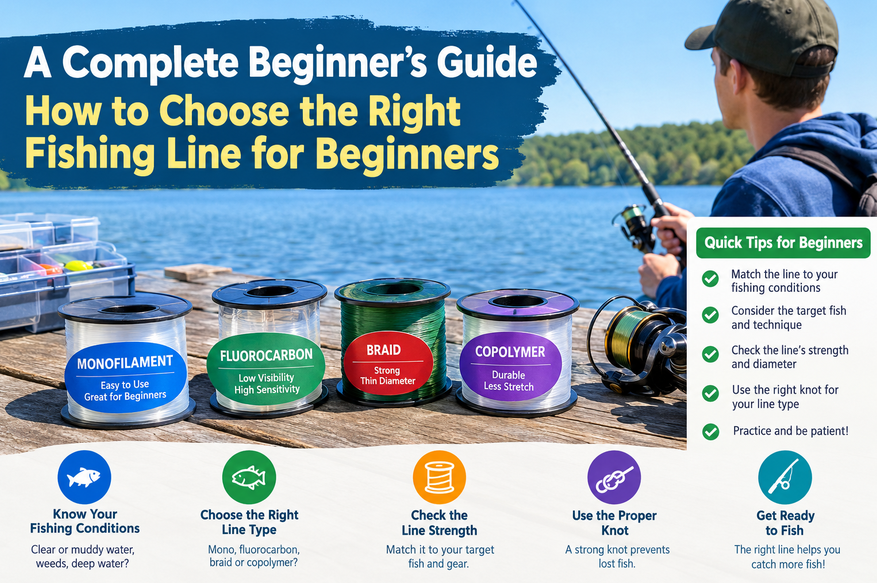
This guide explains eight important fishing line types: monofilament, fluorocarbon, braid, copolymer, fused, lead core, wire, and fly line, where all of them will be compared based on their advantages and disadvantages, as well as providing practical recommendations to help you choose the right line for your next fishing trip.
1. Monofilament Fishing Line: The Best Starting Point
Monofilament, commonly called mono, is a single strand of nylon. It remains one of the most popular choices because it is affordable, widely available, and easy to handle. Many beginner fishing combos come pre-spooled with mono because it works well for everyday fishing.
Why Use Monofilament?
One of mono’s biggest advantages is its stretch. Depending on the line, it can stretch considerably under pressure, absorbing sudden head shakes and reducing the risk of pulling hooks from a fish’s mouth. It also floats or sinks very slowly compared with denser fluorocarbon, making it particularly useful for surface presentations.
Monofilament works well for bobber fishing, live bait, treble-hook lures, and many general freshwater applications.
On the other side, because monofilament is a single strand of nylon, it can stretch up to 25% before breaking, so it absorbs head shakes and hard hook sets like a shock absorber. It’s also barely heavier than water, so it floats or sinks very slowly and won’t drag a topwater lure’s nose down.
That stretch can swallow your hook set on long casts, and nylon absorbs water and breaks down in sunlight. Leave it on the reel for two seasons and it will cost you a fish
When to Use Monofilament Fishing Line
When to use monofilament fishing line depends on whether you need affordability, manageable handling, and some stretch. It is an excellent all-around choice for beginners and anglers who use surface lures or moving baits.
Mono also offers a useful advantage when controlling crankbait depth. A thicker-diameter line creates more resistance in the water, which can keep a crankbait running shallower than a thinner line of the same general type.
Knowing when to use monofilament fishing line comes down to a few situations:
- Topwater fishing: Poppers, walk-the-dog baits, and buzzbaits stay on the surface.
- Bobber fishing: The line sits on top and your bait hangs below without tangling in which it is suitable for presenting bait beneath a floating bobber
- Depth control: A thicker, floating mono keeps a crankbait a couple of feet shallower than thin, sinking line.
- Backing or leaders: A common choice when spooling spinning reels and it can fill the bottom of a reel spool before adding braided line.
- Beginner fishing: Affordable and easy to manage.
- Treble-hook lures: Stretch helps prevent hooks from tearing free during a fight.
Pros and Cons
- Pros: Affordable, easy to tie, versatile, and relatively forgiving under sudden pressure.
- Cons: More stretch, larger diameter than comparable-strength braid, and gradual deterioration from sunlight and use.
Inspect mono regularly and replace it when it becomes damaged, rough, brittle, or excessively coiled. How often you replace it depends on usage, storage conditions, and exposure to sunlight.
2. Copolymer Fishing Line: A Step Beyond Mono
Copolymer line uses two or more polymer materials blended into a single strand. Many copolymer lines are designed to retain the easy handling associated with monofilament while improving selected characteristics, such as abrasion resistance, sensitivity, or diameter-to-strength performance.
When Should You Choose Copolymer?
Copolymer is worth considering when you like the feel of mono but want a little more performance for techniques involving jigs and soft plastic lures. Depending on the formulation, it may provide less stretch or better resistance to scraping against underwater obstacles than standard mono.
- Best for: Anglers who want familiar handling with some performance improvements.
- Advantages: Often offers a useful balance of manageability, strength, and abrasion resistance.
- Disadvantages: Still stretches, and its benefits vary by product and may not justify the higher price for every angler.
Copolymer is not essential for beginners, but it can be a practical intermediate option when standard monofilament no longer meets your needs.
3. Fluorocarbon Fishing Line: For Clear Water and Bottom Fishing
Fluorocarbon is made from polyvinylidene fluoride, commonly abbreviated as PVDF. It bends light differently from nylon monofilament, giving it a refractive index closer to water. As a result, it is generally less visible underwater than many other fishing lines, although it does not become completely invisible.
Fluorocarbon is denser than water, so it tends to sink. It also offers good abrasion resistance and generally less stretch than monofilament, depending on the product and how much force is applied.
When to Use Fluorocarbon Fishing Line
Understanding when to use fluorocarbon fishing line is especially important when targeting cautious fish in clear water or presenting baits close to the bottom. Its lower visibility and sinking characteristics make it useful for finesse techniques and lures designed to reach specific depths.
If you’re asking when to use fluorocarbon fishing line, think clear water, line-shy fish, and baits that need depth or feel:
- Crankbaits: A thin, sinking line helps a bait reach its maximum dive depth.
- Bottom baits: jigs, Texas rigs, and worms benefit from low stretch and sensitivity.
- Leaders: It’s the go-to leader material for braided mainlines and it is often paired with braid to reduce visibility near the lure.
- Clear-water fishing: A useful option when fish are wary of visible line.
- Finesse fishing: Works well with drop-shot rigs, Ned rigs, and soft plastics pair well with a fluoro leader
- Jigs and Texas rigs: Provides sensitivity and abrasion resistance around underwater structure.
Fluorocarbon Limitations
Fluorocarbon can be stiff and develop memory, causing coils that make casting more difficult, especially on spinning reels. It can also lose strength when knots are poorly tied or damaged. Follow the manufacturer’s knot recommendations and lubricate knots before tightening them.
Because fluorocarbon sinks, it is generally not the first choice for stationary topwater presentations. A sinking line can pull down the nose of a floating lure and interfere with its action.
Fluoro is stiff, coils off the spool, and can jump off spinning reels. Always wet your knots before cinching them, since a dry knot can lose a big chunk of its strength. Avoid it for topwater, because it sinks and drags the lure’s nose down.
4. Braided Fishing Line: Strength and Sensitivity
Braided line is made by weaving high-strength synthetic fibers, commonly polyethylene, into a single line. It has a relatively small diameter for its breaking strength and very little stretch under normal fishing loads.
These properties allow anglers to feel subtle bites, maintain better contact with their lures, and drive hooks home at greater distances. Braid also holds up well under normal sunlight exposure, although abrasion, fraying, and damage can still weaken it.
When to Use Braided Fishing Line
Braid is particularly effective when fishing heavy cover, making long casts, or working lures that require a strong hookset. It is also popular on spinning reels because its small diameter allows more line capacity than thicker monofilament of comparable breaking strength.
Best Applications for Braid
- Heavy vegetation: Helps pull fish through weeds and lily pads.
- Frog fishing: Provides the strength and low stretch needed for surface lures around thick cover.
- Deep-water fishing: Improves sensitivity when a long length of line is out.
- Long casts: Its small diameter can reduce line resistance.
- Spinning reels: Offers high line capacity and can reduce problems associated with line memory.
Fish can see it, it can slip on smooth spools, and with no stretch it can tear hooks from soft mouths. That’s why many anglers tie on a fluorocarbon leader. Some bass anglers also avoid braid around wood, because it can dig into a branch and refuse to let go
Is Braided Line Good for Muddy Water Bass Fishing?
Yes, braided line can be an excellent choice for muddy-water bass fishing, especially around submerged vegetation, brush piles, and thick cover. In stained or muddy water, visibility concerns may be less important than strength, control, and getting a fish away from obstacles.
However, muddy water does not automatically mean braid is the best choice. Match the line to the cover and technique. For open-water fishing or situations where fish are line-shy, a fluorocarbon leader may still be useful.
Choosing Braid for Heavy Cover and Weeds
Fishing line for heavy cover and weeds must provide enough strength to manage fish around vegetation without exceeding the rod’s intended line rating. Heavy braided line is commonly used for flipping, pitching, and frog fishing in dense vegetation. The appropriate breaking strength depends on the cover, target species, rod, and reel.
Advantages and Disadvantages
- Advantages: High strength for its diameter, minimal stretch, excellent sensitivity, and long service life when maintained properly.
- Disadvantages: Can be highly visible, may dig into itself on the spool, and offers little stretch to cushion sudden runs.
To reduce these problems, use a suitable backing or secure the braid to the spool according to the reel manufacturer’s instructions. Consider a leader when visibility or abrasion resistance near the lure matters.
5. Fused Fishing Line: A Stiffer Alternative to Braid
Fused line uses braid’s fibers, but heat bonds them into one stiff strand. It lies flat on spinning spools, tangles less than braid, and keeps low stretch. It shines on light spinning gear, drop shots, and ice fishing. The coating wears off over time, and it’s weaker than true braid of the same diameter. This construction can create a stiffer line that handles differently on the reel.
When Is Fused Line Useful?
Fused line can be helpful for anglers who want low stretch but prefer a line that is less limp than traditional braid. It may be useful on light spinning setups, for certain finesse presentations, or during ice fishing.
- Advantages: Relatively low stretch and a firmer feel that can make handling easier in some situations.
- Disadvantages: The coating can wear with use, and performance varies by product.
Fused line is a specialized option rather than a necessity. If you are new to fishing, monofilament or conventional braid is usually a simpler starting point.
6. Lead-Core Line: For Controlled Trolling Depth
Lead-core line contains a lead wire core covered by a braided sheath. Its added weight helps pull a lure deeper while trolling. Many lead-core lines change color at regular intervals, allowing anglers to estimate how much line has been released.
On the other hand, lead core can be said as a soft lead wire inside a braided sheath, and it changes color every 10 yards. A common rule is about 5 feet of depth per color at trolling speed. It’s a trolling tool and useless for casting, ideal for walleye, salmon, and lake trout without downriggers.
What Line to Use for Trolling Walleye With Crankbaits
Lead-core line can be useful when trolling walleye with crankbaits, especially when fish are holding deeper than a lure can consistently reach on conventional line alone. Anglers can use the amount of line released, trolling speed, lure design, and other variables to manage depth.
However, there is no universal depth-per-color rule. A common estimate may be used as a starting point, but actual running depth changes with line diameter, lure resistance, boat speed, and how much line is deployed. Consult line-specific guidance and verify depth using reliable fishing electronics or controlled testing.
Best Applications
- Trolling for walleye in deeper water.
- Targeting salmon and lake trout.
- Presenting lures at relatively consistent depths without relying exclusively on downriggers.
Lead-core line is heavy and bulky, making it unsuitable for ordinary casting. Use it as a specialized trolling tool and follow local regulations regarding permitted fishing tackle.
7. Wire Fishing Line: Protection Against Sharp Teeth
Wire line and wire leaders are designed for situations where fish can cut through conventional fishing line with their teeth. They may be made from stainless steel or titanium, with construction ranging from single-strand wire to multiple strands.
Because of being made with stainless steel or titanium, this wire line can handle toothy fish like pike, muskie, bluefish, and wahoo. Steel kinks permanently; titanium springs back. Fish can see it and it kills small-lure action, so most anglers use it only as a short leader.
When Should You Use Wire?
Wire leaders are useful when targeting toothy species such as northern pike, muskellunge, sharks, bluefish, and wahoo. A suitable wire leader can reduce bite-offs when ordinary monofilament or fluorocarbon would be vulnerable.
Stainless Steel vs. Titanium
- Stainless steel: Often affordable and strong, but it can kink permanently when bent.
- Titanium: Typically more flexible and able to return toward its original shape after bending, depending on its construction.
Wire is often used as a short leader rather than as the entire main line. It can be more visible than other materials and may interfere with the action of small lures. Inspect wire regularly and replace it if it becomes kinked, damaged, or weakened.
8. Fly Fishing Line: The Weight Behind the Cast
Fly fishing works differently from conventional lure fishing. Instead of relying primarily on a weighted lure to carry the line through the air, anglers use the weight of the fly line itself to load the rod and deliver a lightweight fly.
Fly line is typically thicker than conventional fishing line and has a specialized coating and tapered profile. Its weight rating must match the intended fly rod and fishing application.
In fly fishing you cast the line, not the fly. Fly line is a tapered, plastic-coated line about 90 feet long, rated by the weight of its first 30 feet. A five-weight is roughly 140 grains. Floating, sinking, and sink-tip versions control fly depth, and the line weight must match your rod
Floating vs. Sinking Fly Line
- Floating fly line: Keeps the line near the surface and is useful for dry flies and many surface presentations.
- Sinking fly line: Helps deliver flies below the surface.
- Sink-tip fly line: Combines a floating section with a sinking tip for more controlled subsurface presentations.
Fly line is used for species such as trout and bass, but it requires compatible fly-fishing equipment. A leader and tippet are normally added between the fly line and the fly.
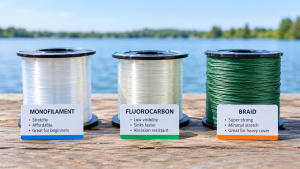
Monofilament vs. Fluorocarbon vs. Braid: When to Use Each
The choice between these three main fishing lines depends on the conditions and technique. There is no single line that is best for every situation.
| Feature | Monofilament | Fluorocarbon | Braid |
|---|---|---|---|
| Stretch | Higher | Generally moderate to low | Very low |
| Buoyancy | Generally floats or sinks slowly | Generally sinks | Generally floats |
| Visibility underwater | Varies by color and conditions | Generally less visible than mono | Often more visible |
| Diameter for a given strength | Generally thicker | Varies by product | Generally thinner |
| Topwater lures | Excellent choice | Often less suitable | Useful for some techniques |
| Clear-water finesse fishing | Usable | Excellent choice | Often paired with a leader |
| Heavy vegetation | Depends on cover | Useful in some situations | Excellent choice |
| Beginner-friendly | Excellent | Can be challenging due to stiffness | Requires attention to knots and spool setup |
How to Choose the Right Fishing Line for Your Conditions
Fishing Line for Clear Water vs. Muddy Water
When selecting fishing line for clear water vs. muddy water, consider how visible the line may be to your target species. Fluorocarbon is often a good option in clear water when fish are wary. In muddy water, line visibility may be less important, so strength and presentation can take priority. Braid is particularly useful around heavy cover, while mono remains versatile for general fishing and topwater lures.
For fishing line for clear water vs muddy water, visibility is the deciding factor. Clear water calls for fluorocarbon or a fluoro leader. In stained or muddy water, fish see line far less.
So is braided line good for muddy water bass fishing? Generally yes, since visibility matters little there and you gain strength and sensitivity
What Fishing Line to Use for Freshwater Fishing
For most freshwater fishing, monofilament is a reliable starting point. It is affordable and works with many baits and rigs. Fluorocarbon is useful for finesse presentations and clear water, while braid excels in vegetation, deep water, and situations requiring high sensitivity.
For catfish, select line based on the size of the fish, current, snags, and fishing location. If you are choosing the best fishing line type for night fishing catfish, durable monofilament is a practical general-purpose option, while braid may be better around heavy cover or when extra sensitivity is needed. Use a suitable breaking strength for the conditions rather than assuming nighttime fishing requires a particular line.
Fishing Line for Saltwater Beginners
Fishing line for saltwater beginners should be selected according to the target species, water depth, current, and tackle. Monofilament is forgiving and easy to handle, while braid offers a thin diameter and useful sensitivity. A fluorocarbon or abrasion-resistant leader can help when fishing around rocks or targeting cautious fish.
For fishing line for inshore saltwater, braid paired with an appropriately sized leader is a popular setup for spinning tackle. However, monofilament can still be an effective choice for bait fishing and situations where stretch is beneficial. Rinse reels and tackle with fresh water after saltwater use and inspect line regularly for damage.
Practical Tips for Better Fishing Line Performance
1. Match Line Diameter to Reel Capacity
Check the line-capacity information printed on your reel. Diameter often determines how much line fits on the spool. This is especially important with braid because different products can have substantially different breaking strengths at similar diameters.
2. Check PE Ratings When Buying Braid
Some braided lines use PE ratings to indicate a standardized size category. When your reel lists a compatible PE rating, use it as a guide to choosing line diameter and spool capacity. Breaking strength still matters, but it should not be the only factor.
Braids are now so strong and thin that breaking strength is a poor way to pick them. A 30-lb eight-strand, a 40-lb eight-strand, and a 55-lb twelve-strand can all share the same diameter. Instead, choose by diameter or PE rating. A reel rated for 300 meters of PE3 will hold any PE3 braid, regardless of breaking strain. As a rule of thumb, moving up one PE rating fits roughly 25 to 30% less line, and moving down fits roughly 25 to 30% more. Also check that your braid’s strength is compatible with your rod’s line class.
3. Match Line to Rod Specifications
Always check your rod’s recommended line rating. Braided line can be much thinner than monofilament of similar strength, so choosing by diameter alone can lead to a line that exceeds the rod’s intended breaking-strength range.
4. Consider Rod Action and Line Stretch Together
Rod action and line stretch work together. A softer rod already provides some cushioning, so pairing it with highly stretchy mono during long-distance bottom fishing may make hooksets less effective. Low-stretch braid or fluorocarbon can improve contact with the lure in these situations.
Conversely, mono can complement a stiffer rod when using moving baits or treble hooks because its stretch provides a little forgiveness. Adjust your setup to the technique rather than choosing line in isolation.
5. Tie and Inspect Knots Carefully
Every fishing line can fail at a damaged or poorly tied knot. Use a knot appropriate for the material, lubricate knots where recommended, tighten them carefully, and inspect the finished connection. Check for fraying, abrasions, kinks, and other signs of damage before fishing.
Frequently Asked Questions
What are the main types of fishing line for beginners?
Monofilament, fluorocarbon, and braid are the three main types most beginners should understand. It’s cheap, forgiving, easy to knot, and handles bobbers and topwater well.
Monofilament is the easiest general-purpose starting point, fluorocarbon is useful for clear water and bottom presentations, and braid offers high strength and sensitivity.
Is braided line better than monofilament?
Neither is universally better. Braid has very little stretch and a smaller diameter for its strength, making it useful for heavy cover and long casts. Monofilament is more forgiving, usually less expensive, and excellent for many topwater applications.
When should I use fluorocarbon instead of braid?
Choose fluorocarbon when reduced underwater visibility, sinking behavior, or abrasion resistance near the lure is important. Braid is often preferable when you need high sensitivity, a thin line, and strength around heavy vegetation. Many anglers combine the two with a fluorocarbon leader attached to braid.
What fishing line is best for topwater lures?
Monofilament is a popular choice because it floats or sinks slowly and helps maintain a surface lure’s action. Braid also works well for certain topwater techniques, particularly frog fishing around heavy vegetation.
What line should I use for crankbait fishing?
Fluorocarbon is useful when you want a crankbait to reach depth and maintain good contact with the lure. Monofilament can help keep a crankbait running shallower because of its larger diameter and floating characteristics. The best choice depends on the lure’s design and the depth you want to reach.
How often should I replace fishing line?
Replacement frequency depends on line material, fishing frequency, sunlight exposure, storage, and damage. Inspect your line regularly and replace it when it becomes brittle, abraded, frayed, or unreliable. Monofilament often needs replacement more frequently than braid under comparable conditions.
Does thicker fishing line always mean more strength?
No. Material and construction matter. Braided line can have a much smaller diameter than monofilament at a similar breaking strength. Compare actual diameter, breaking-strength ratings, reel capacity, and rod specifications when choosing line.
Can I use braid without a leader?
Yes, especially in heavy cover or stained water. In clear water or finesse situations, add a fluorocarbon leader.
How often should I replace fishing line?
Mono wears out fastest, so replace it at least every season. Fluorocarbon lasts longer, and braid can stay on a reel for a year or more.
Which line is best for topwater?
Mono or braid, because both float. Fluorocarbon sinks and pulls the lure’s nose down.
Does line color matter?
It can. Low-visibility or clear lines suit pressured, clear water, while high-visibility lines help you watch for bites.
Conclusion: Choose Your Fishing Line With Confidence
Understanding the types of fishing line and when to use them helps you build a more effective fishing setup. Monofilament remains an excellent all-around option for beginners, topwater lures, and everyday fishing.
Copolymer offers an alternative for anglers seeking a different balance of handling and performance. Fluorocarbon is valuable for clear water, finesse presentations, and sinking applications, while braid excels in heavy cover and situations requiring sensitivity.
Lead-core line helps anglers control trolling depth, wire protects against sharp teeth, fused line offers a stiffer alternative to braid, and fly line provides the weight needed to cast lightweight flies.
Key Takeaways
-
- Start with monofilament if you want affordable, versatile, easy-to-use fishing line.
- Use fluorocarbon when reduced visibility, sinking behavior, and sensitivity are priorities.
- Choose braid by diameter or PE rating, not breaking strength for heavy vegetation, long casts, and techniques that benefit from minimal stretch.
- Consider lead-core line for specialized deep-water trolling and wire leaders for toothy fish.
- Match line diameter and breaking strength to your reel, rod, target species, and fishing conditions.
- Inspect your line and knots regularly to reduce avoidable break-offs.
- Mono: stretchy, floating, cheap; best for topwater, bobbers, and it is suitable for beginners.
- Fluorocarbon: nearly invisible and sinking; best for clear water, crankbaits, and bottom baits.
- Braid: no stretch and thin; best for heavy cover, long casts, and deep water.
- Specialty lines such as fused, lead core, wire, fly each solve one problem.
- Pair stiff rods with stretchy line and soft rods with low-stretch line.
The best fishing line is not necessarily the strongest or most expensive. It is the one that matches your technique, environment, and target fish. Once you understand how each material behaves, you can spend less time worrying about your equipment and more time catching fish.
Anyway, there is no single best line here, only the best line for the job. Now that you know the type of fishing line when and where to use them, you can stop guessing at the line wall. If you’re just starting, spool mono. When you’re ready to upgrade, braid with a fluorocarbon leader covers almost everything
