A Complete Beginner’s Guide to Types of Fishing Rods: When and How to Use Each
Choosing the right fishing rod can feel overwhelming when you see the dozens of styles, lengths, and strength ratings available. However, understanding the basics makes the decision much easier. Different rods are designed for different fishing techniques, target species, casting distances, and environments.
Some rods excel at casting lightweight lures for trout, while others are built to launch heavy bait beyond breaking surf or handle powerful carp in weedy lakes. The key is finding a rod that matches the fishing you actually plan to do rather than buying the most expensive model on the shelf.
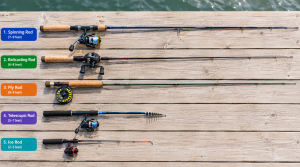
This guide explains the major types of fishing rods and their uses, including spinning, baitcasting, fly, surf, feeder, carp, and specialized rods.
Moreover, you will also learn how rod length, power, action, casting weight, and construction influence performance, helping you make a practical choice without spending more than necessary.
1. Understanding Fishing Rod Basics
Before comparing rod types, it helps to understand what a fishing rod does. A rod transfers energy during casting, helps control the bait or lure, absorbs a hooked fish’s sudden movements, and can indicate bites through its tip. Choosing the correct rod makes casting easier and helps you maintain control when fighting fish.
A rod does three jobs.
- It launches your bait or lure at the right distance and accuracy.
- It bends to absorb a fish’s lunges, so the hook stays in.
- On many rods it also works as a bite indicator, with the tip tapping when a fish takes the bait.
Different rods balance those jobs differently, which is why one rod can do everything but cannot do it all well.
Rod Length
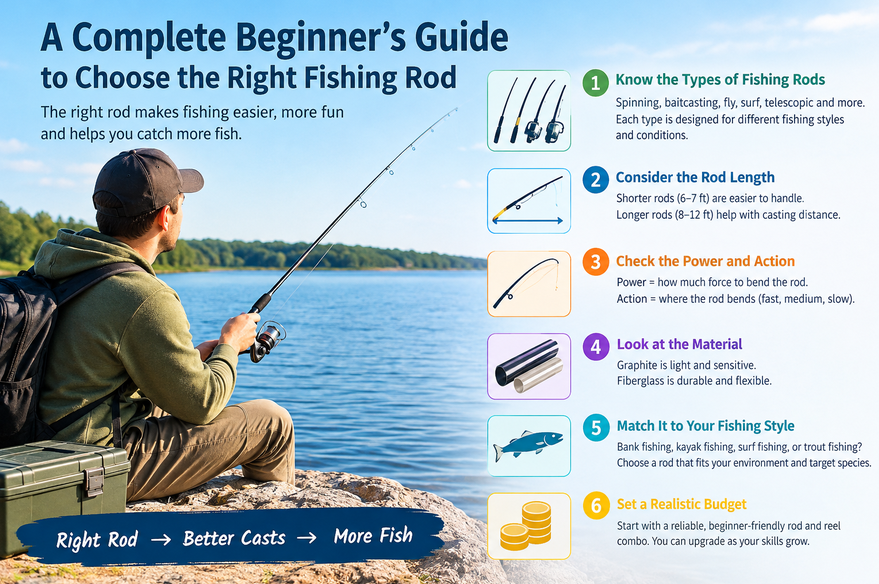
Rod length affects casting distance, accuracy, leverage, and maneuverability. Shorter rods are generally easier to control in tight spaces, beneath overhanging trees, or aboard small boats. Longer rods can help you cast farther and keep line above waves or shoreline obstacles.
- Short rods: Useful for ice fishing, confined areas, and close-range techniques.
- Medium-length rods: Versatile choices for freshwater fishing, boats, and everyday lure fishing.
- Long rods: Helpful for surf fishing, long-distance casting, and certain specialized techniques.
Rod Power and Action Explained
Understanding fishing rod power and action is essential when selecting equipment. These terms describe different characteristics, even though beginners sometimes confuse them.
Rod Power
Power describes how much force is required to bend the rod. Ratings commonly range from ultralight to extra-heavy. Ultralight and light rods suit smaller fish in open water with one- to six-pound line and lighter presentations, while medium-heavy and heavy rods provide more backbone for heavier lures, stronger line, and powerful fish such as catfish, striped bass, muskie and thick vegetation.
Rod Action
Action describes where and how quickly the rod bends under load. Fast-action rods generally bend closer to the tip, while moderate and slow-action rods bend farther down the blank. Fast action can provide responsive lure control, whereas moderate or slower action can help load the rod during casting and cushion sudden runs.
If you’re wondering how to pick a casting rod with fast action versus slow action, consider the lure and technique first. Fast action is often useful for techniques that require quick contact and precise hook-setting. Moderate action can be a better fit for certain moving lures that benefit from a more forgiving bend.
A fast action rod flexes mainly in the tip and has plenty of backbone, so it suits heavy jigs, spinnerbaits, chatterbaits and crankbaits. A moderate action rod bends deeper into a parabolic arc, which suits spinners, crappie jigs and finesse baits and helps prevent torn hooks.
How to Pick a Casting Rod: Fast Action vs Slow Action
When you work out how to pick a casting rod fast action vs slow action, think about the hooks and the lure. Stout hooks and heavy baits like fast action. Big swimbaits and treble-hook lures, particularly crankbaits, are easier to cast accurately on a rod with a slightly softer tip. A very fast tip can also snap line on a hard cast.
Casting Lure Weight and Line Rating
Casting weight indicates the lure or rig weight range the manufacturer recommends for a rod. A rod designed for lightweight lures may struggle to load properly with a heavy rig, while an oversized lure can overstress a lighter blank.
Line rating indicates the recommended line strength range. Always check both specifications rather than assuming two rods with the same power rating are interchangeable. Staying within the manufacturer’s recommendations helps protect your equipment.
Look for the lure weight and line rating printed near the handle. A rod rated for 10 lb line is meant for roughly 10 lb fish.
Two seven-foot medium heavy rods can have very different line ratings, so they are not the same tool. Overloading a rod is one of the main reasons rods break. If the rod carries no specs at all, treat that as a red flag.
2. The Main Types of Fishing Rods and Their Uses
a. Spinning Rods: The Best Starting Point for Many Anglers
Spinning rods are among the most versatile fishing rods available and are a common recommendation for beginners. They pair with spinning reels mounted beneath the rod, with guides positioned on the underside. During a cast, line leaves the fixed spool in loose coils, allowing lightweight lures and baits to travel with relatively little resistance.
Spinning setups work well for trout, panfish, bass, and many everyday freshwater applications. They are also useful for light saltwater fishing when the rod, reel, and line are designed for that environment.
Advantages
- Easy to learn and operate.
- Effective with lightweight lures and bait.
- Versatile enough for many freshwater species.
- Generally less prone to severe casting backlashes than baitcasting setups.
Limitations
- Line twist can develop over time.
- Heavy-duty applications may be better suited to specialized equipment.
- Rod power and line capacity still limit the size of lures and fish you can handle.
For trout fishing, a light or ultralight spinning rod is often a sensible starting point. If you’re asking what size spinning rod to use for beginner trout fishing, consider a rod around 6 to 7 feet long for general-purpose use. A shorter rod can be easier to manage in narrow streams, while a longer model may help with casting distance on open banks.
b. Baitcasting Rods: Precision and Power
Baitcasting rods are designed for baitcasting reels, which sit on top of the rod. They typically feature upward-facing guides and a trigger grip beneath the handle. Unlike a spinning reel, the baitcasting spool rotates during the cast, so the angler must control its speed to prevent excess line from overrunning.
This design offers excellent casting control, particularly when placing lures around weeds, submerged timber, docks, and other cover. Baitcasting setups are popular for bass fishing and for heavier lures that benefit from a powerful rod and suitable reel.
The main disadvantage is the learning curve. Incorrect spool tension or poor thumb control can produce a backlash, sometimes called a bird’s nest. Beginners should practice with a manageable lure weight and gradually adjust the reel settings.
For a beginner topwater baitcasting setup, look for a rod and reel that comfortably match the weight of the intended topwater lure. A medium or medium-heavy rod with a suitable action can be a practical starting point for many bass applications, although the ideal setup depends on the lure and cover.
c. Spincast Rods: Simple and Beginner-Friendly
Spincast rods pair with closed-face reels that cover the spool and typically use a push-button casting mechanism. Pressing the button releases the line for casting, making the setup relatively simple to learn.
These rods are particularly suitable for children and new anglers who want to learn basic casting without immediately dealing with more complicated reel controls.
The trade-offs include shorter casting distances, limited drag performance on many models, and less sensitivity than more specialized setups. Anglers often move to spinning gear as their skills and fishing goals develop.
d. Fly Rods: Accurate Presentations with Fly Line
Fly rods operate differently from conventional spinning and casting setups. Because artificial flies are often too light to pull ordinary fishing line through the guides, the weight of the fly line provides the casting energy.
A fly rod must be matched with the appropriate fly line, reel, and leader system. This makes the entire setup work together to deliver delicate presentations, particularly when imitating insects or small baitfish.
Fly rods are strongly associated with trout fishing but can also be used for bass, panfish, and saltwater species. Learning the casting technique takes practice, especially when managing line loops and presenting a fly accurately.
For beginners asking about the best fly rod weight for trout, a 5-weight outfit is a widely used all-around starting point for many trout fisheries. Smaller streams and tiny flies may call for a lighter outfit, while larger rivers, wind, or bigger fish may favor a different weight.
e. Telescopic Rods: Convenient for Travel
Telescopic rods collapse into compact sections that extend when you’re ready to fish. Their portability makes them useful for hiking, camping, travel, and keeping fishing equipment in a vehicle.
The trade-off is that some telescopic rods feel less refined than conventional one-piece or two-piece rods. Their joints, guide arrangements, and construction can affect sensitivity and overall handling, depending on the model.
When comparing a telescopic versus a two-piece fishing rod for travel, consider packed length, durability, setup time, and the kind of fishing you intend to do. A telescopic model is attractive when compact storage is the priority, while a quality two-piece rod can provide a good balance between portability and fishing performance.
f. Surf Rods: Casting Beyond the Breaking Waves
Surf rods are long, powerful rods designed for fishing from beaches and other open shorelines. Many fall within the 9- to 15-foot range, although the best length depends on local conditions, casting technique, bait weight, and target species.
The extra length can improve casting leverage and help keep more line above incoming waves. Surf rods are commonly paired with rigs that carry sinkers and bait into areas where fish feed beyond the shoreline break.
For beginners, the best surf fishing rod length depends on your physical comfort and the beach you’re fishing. A rod around 9 to 10 feet can be manageable for many general surf applications, while longer rods may help when greater casting distance or line clearance is important.
If you’re using light lures rather than heavy bait rigs, don’t automatically choose the longest surf rod available. Check the rod’s lure-weight rating and choose a length and power that allow you to cast comfortably and work the lure effectively.
g. Trolling Rods: Designed for Fishing from a Moving Boat
Trolling rods are built for dragging bait or lures behind a moving boat. They are generally stronger than ordinary casting rods and are designed to handle sustained pressure from line, terminal tackle, and hard-fighting fish.
Many trolling setups use conventional reels with substantial line capacity, and the rods often rest in boat-mounted holders. They are useful for covering water while targeting species such as salmon and tuna, with the exact setup depending on the fishery.
Because trolling rods are specialized for sustained loads rather than repeated casting, they are usually not the best choice for general-purpose lure fishing.
h. Ice Fishing Rods: Sensitivity at Close Range
Ice fishing rods are short, often around 2 to 3 feet long, because anglers fish vertically through a hole in the ice. Instead of providing long casting distance, these rods prioritize control and bite detection.
Many feature sensitive tips that reveal subtle bites from fish such as perch and walleye. Their compact size also makes them convenient inside ice shelters or when fishing in restricted spaces.
When to Use a Spinning Rod vs Casting Rod
Knowing when to use a spinning rod vs casting rod comes down to lure weight and precision.
- Choose spinning for light lures, finesse presentations and easy casting.
- Choose casting when you need accuracy, heavier line and the power to pull fish out of cover.
The two are not interchangeable. A casting rod works with baitcasting or spincast reels, and a spinning rod works only with a spinning reel. Put a spinning reel on a casting rod and the trigger gets in your way, and the smaller guides hurt casting accuracy. A quick check is the first guide. On a spinning rod it is noticeably larger.
3. Specialized Rods for Specific Fishing Techniques
a. Float Rods
Float rods are designed to present bait beneath a float or waggler. They commonly feature relatively soft tips that help cast floats and manage lighter terminal tackle.
For beginners, a 10- to 11-foot float rod can be easier to manage than a longer model in many situations. Longer rods can provide useful line control on large lakes and rivers, but they may be awkward around trees and confined swims.
b. Feeder Rods
Feeder rods are designed for fishing with a feeder filled with groundbait or other loose feed. Their stronger lower sections help cast the loaded feeder, while sensitive tips indicate bites.
Some models include interchangeable tips of different strengths. A softer tip can help reveal gentle bites, while a stronger tip may be more suitable for heavier feeders or conditions where a delicate indication is less important.
c. Carp Rods
Carp rods are designed to handle powerful fish, heavier rigs, and demanding conditions. Their stronger blanks and suitable test curves help anglers cast substantial leads and control fish near weed beds or snags.
A shorter carp rod can be practical on small or medium-sized lakes and in tight spaces. Longer rods are useful when long-distance casting is a priority. Choose the test curve and casting specifications to match your rigs and fishing conditions.
d. Drop-Shot Rods
Drop-shot rods often feature sensitive tips for detecting subtle contact with small lures worked slowly near the bottom. They can be useful for species such as perch and other fish that respond to finesse presentations.
When selecting the best rod power and action for a drop-shot setup, prioritize sensitivity and control over unnecessary strength. A light or medium-light rod with a responsive tip is a common starting point, but the final choice should match the weight of the rig, line, cover, and target species.
e. Spod and Marker Rods
Spod and marker rods are specialized carp-fishing tools designed to cast bait-filled spods or marker floats. Their stronger, stiffer construction helps manage heavier loads and accurately deliver bait to a chosen area.
They are not essential for every carp angler. Beginners can often start with simpler equipment and consider a dedicated spod or marker rod when their fishing technique requires one.
4. Choosing the Right Rod Length for Your Fishing Style
Rod length should match both the fishing environment and the distance you need to cover. There is no single length that works best for every angler.
a. Rod Length for Bank Fishing
People often ask what length fishing rod for bank fishing works best. For freshwater, 7 to 8 ft is plenty, and shorter rods cast more accurately. Longer rods of 9 to 10 ft add distance but become cumbersome, especially under overhanging trees.
b. Best Kayak Fishing Rod Length
The best kayak fishing rod length is usually seven feet or shorter, because anything longer is difficult to handle from a seated position. Between medium heavy vs medium rod for kayak fishing, choose medium for general use and light baits. Choose medium heavy when you throw heavier lures or fish near cover. A two-piece rod also slides into a kayak far more easily.
c. Trout and Fly Fishing
For what size spinning rod for beginner trout fishing, a light or ultralight spinning rod around 6.5 to 7 ft with a sensitive tip is a good starting point. If you move to fly fishing, remember that fly rods are matched to line weight, and a rod, reel and line must match. The best fly rod weight for trout beginners is generally in the 4 to 6 weight range, with 5 weight the common all-rounder. Light numbers suit delicate streams and larger numbers suit big saltwater fish. Fly casting has the steepest learning curve in fishing, so expect to practice.
d. Crappie and Panfish
For the best crappie rod 10 foot vs 12 foot question, a light or ultralight rod with a moderate action tip suits crappie jigs. A 10 ft rod is easier to manage and more accurate. A 12 ft rod reaches farther and suits dipping or fishing from a bank. Go longer only if you need the reach.
e. Drop Shot and Finesse Fishing
The best rod power and action for drop shot setup is a lighter, softer rod with a very sensitive tip. You work small lures slowly across the bottom and need to feel the tiny tap when a perch, pike or zander takes it. Light to medium-light power with a fast-recovering tip is the typical choice. Handle these rods with care, because the soft tip is easy to snap.
e. Topwater Bass
For the best baitcasting rod setup for beginner topwater, many anglers start with a 7 ft medium or medium heavy casting rod with a moderate action tip. The softer tip lets you cast accurately and gives a bass a moment to take the lure before the hook set. Practice thumbing the spool in open water before you fish near cover.
f. Surf Fishing Rods
Surf rods usually run 9 to 15 ft. The length gives a longer casting arc and lifts your line over incoming waves. For the best surf fishing rod length for beginners, a 10 to 12 ft rod is manageable. It casts heavy rigs past the breakers without being tiring. For surf fishing rod length for light lures, 9 to 10 ft with a lighter power works better, because a 15 ft stick is overkill for small baits. Surf rods nearly always come in two pieces, since a 15 ft one-piece rod is hard to transport.
Specialty Rods
- Trolling rods: stiff and strong, often with roller guides, built for rod holders and big fish like salmon and tuna.
- Ice fishing rods: two to three feet long, with a soft tip that shows tiny bites through a hole.
- Float, feeder and carp rods: UK coarse fishing favorites. A 10 to 11 ft float rod is easier for beginners than a 12 ft model. Carp rods use heavier test curves for big weights and strong fish.
5. One-Piece, Two-Piece, and Telescopic Rods
a. One Piece vs Two Piece Fishing Rod
When you compare a one piece vs two piece fishing rod, the one-piece is often considered slightly more sensitive. Modern two-piece rods are very good, and for most anglers the difference does not matter. The real advantage of a two-piece is transport. Check that the top section is seated firmly, as a loose joint can slip mid-cast.
b. Telescopic vs 2 Piece Fishing Rod for Travel
For telescopic vs 2 piece fishing rod for travel, a telescopic rod collapses small enough for a backpack or carry-on and is usually affordable. The trade-off is sensitivity and durability, because the joints add stiffness and the guides are often small. Think of it as a convenience pick. A good two-piece rod gives better feel and still packs down easily.
c. Graphite vs. Fiberglass Fishing Rods
Rod materials influence weight, sensitivity, flexibility, and durability. Graphite rods are often lighter and more sensitive, making them useful when detecting subtle bites or working lures for long periods. Fiberglass rods are often more flexible and can be forgiving under load.
Composite rods combine materials to balance different performance characteristics. The best choice depends on the rod’s construction and intended use, not simply the material name printed on the label.
Beginners do not need to spend heavily on advanced materials immediately. A reasonably priced rod with appropriate power, action, and casting ratings can be an excellent starting point.
6. How to Choose a Fishing Rod for Beginners
If you wonder how to choose a fishing rod for beginners, it is related to three questions.
- What fish am I targeting?
- How big are they?
- What lure or bait weight will I throw?
A 7 to 8 ft medium rod handling 10 to 20 lb line and up to 2 oz lures is a solid universal pick. It covers small swimbaits and chatterbaits for bass, and it can throw several ounces of cut bait for catfish without strain.
The simplest way to choose your first rod is to start with the type of fishing you expect to do most often. You do not need a separate rod for every species or technique on your first day.
- Choose your fishing method: Decide whether you’ll fish from the bank, a boat, a kayak, a beach, or through ice.
- Identify your target species: Trout and panfish often suit lighter tackle, while powerful fish and heavy cover may require stronger equipment.
- Select the reel type: Spinning reels are a common beginner choice; baitcasters offer more control for certain techniques but require practice.
- Check power and action: Match the rod to your lure weights, line, target fish, and fishing style.
- Check the specifications: Read the manufacturer’s recommended lure-weight and line ratings.
- Consider transport: Choose one-piece, two-piece, or telescopic construction based on where you store and carry your gear.
- Set a practical budget: Prioritize a reliable, suitable rod and reel combination instead of paying extra for features you may not need.
For anglers who want one rod for several situations, a general-purpose spinning setup around 7 to 8 feet can be a useful option where local conditions and target species permit. However, a versatile rod is a compromise, not a perfect solution for every fishing technique.
People often ask what length fishing rod for bank fishing works best. For freshwater, 7 to 8 ft is plenty, and shorter rods cast more accurately. Longer rods of 9 to 10 ft add distance but become cumbersome, especially under overhanging trees.
Frequently Asked Questions
When should you use a spinning rod versus a casting rod?
Use a spinning rod for easy casting, lightweight lures, and general-purpose fishing. A baitcasting rod is useful when you want precise lure placement, heavier line, or more control around cover, provided you are comfortable operating a baitcasting reel.
What is the best fishing rod length for bank fishing?
A rod around 7 to 9 feet can work well for many bank-fishing situations. Shorter rods are easier to maneuver around vegetation, while longer rods can help when you need to cast farther or keep line above obstacles.
What is the best surf fishing rod length for beginners?
A 9- to 10-foot surf rod is a reasonable starting point for many beginners. Choose a model with a casting-weight rating that matches your bait and sinker, and consider longer rods when conditions require greater casting distance or line clearance.
Are telescopic rods better than two-piece rods for travel?
Telescopic rods generally pack into a shorter length, making them convenient for backpacks and compact storage. Two-piece rods can provide an effective balance of portability and performance. Your best option depends on the space available and the kind of fishing you plan to do.
Is graphite or fiberglass better for fishing rods?
Graphite is often preferred for light weight and sensitivity, while fiberglass is commonly associated with flexibility and a more forgiving feel. Composite rods combine characteristics of both. The best material depends on the particular rod and application.
Can one fishing rod work for every type of fishing?
One rod can cover several basic situations, especially when you’re starting out. However, specialized techniques such as surf fishing, fly fishing, ice fishing, and heavy carp fishing have different requirements. A general-purpose rod cannot perform every task equally well.
What is the best fishing rod for a complete beginner?
A 7 ft medium power spinning rod with a matching spinning reel. It is forgiving, versatile and easy to learn.
Can one rod catch every species?
One rod can do many jobs, but not all of them well. An 8 ft medium action lure rod is a sensible all-rounder if you can only buy one.
Does rod length really matter?
Yes. Short rods are more accurate and long rods cast farther. Choose by where you fish, such as trees, a kayak or the surf.
Why do fishing rods break?
The usual causes are overloading the rod beyond its rating, slamming it in a car door or tailgate, and very cheap hollow fiberglass blanks.
Should I worry about rod material?
Not much. Most modern rods are strong enough. Material mainly affects weight, sensitivity and price.
Why Rod Prices Vary and Are Combos Worth It?
Price reflects materials, length, guide quality, reel seat, handle design and brand. A casual angler does not need a $200 rod. If you fish weekly, a better rod reduces fatigue and often carries a stronger warranty. In my experience, rods in the $50 to $150 range offer the best value. Combos work well for occasional anglers, but frequent anglers usually do better buying the rod and reel separately.
Conclusion: Choose a Rod That Matches Your Needs
Understanding the types of fishing rods and where and how to use them helps you make a better buying decision. Spinning rods offer versatility, baitcasting rods provide precision and power, fly rods deliver lightweight presentations, and specialized models handle techniques such as surf, feeder, carp, trolling, and ice fishing.
Before buying a fishing rod, focus on the target species, fishing environment, rod length, power, action, casting weight, and line rating. Also, consider portability and material after you’ve identified the specifications that matter most for your fishing style.
Key Takeaways
-
- Choose your rod based on the fishing technique and target species.
- Understand the difference between rod power and action.
- Match casting weight and line rating to the manufacturer’s recommendations.
- Use shorter rods for maneuverability and longer rods when extra reach is beneficial.
- Choose one-piece, two-piece, or telescopic construction according to transport needs.
- Start with a practical, versatile setup and upgrade as your skills develop.
- Spinning rods suit beginners and light lures. Casting rods suit power and precision.
- Power is shaft strength. Action is tip flexibility. Always check the line and lure rating.
- A 7 to 8 ft medium rod is the best universal starting point.
- Kayak rods should be about seven feet or shorter. Surf rods run 9 to 15 ft.
- One-piece vs two-piece matters little, except for travel.
- Upgrade reels, hooks and swivels before spending heavily on a rod.
The best fishing rod isn’t necessarily the most expensive or specialized model. It’s the one that fits your needs, feels comfortable in your hands, and helps you fish with confidence.
The right rod comes from three decisions: the type such as spinning, casting, fly or specialty, the specs such as power, action, length, line and lure rating and your fishing situation.
Start with a versatile setup, learn what you want from it, and add specialized rods as your fishing grows.
