
How to Avoid & Fix Common Casting Mistakes in Fishing: Backlash, Tangles, Short Casts
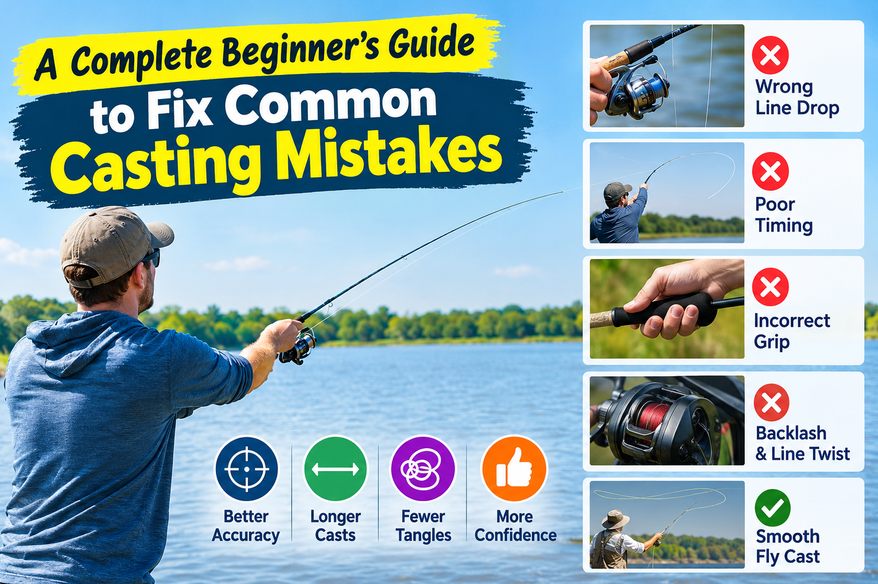
Casting is one of the most important fishing skills to master, but even experienced anglers make mistakes that reduce distance, accuracy, and consistency. From using the wrong line drop to releasing the line too early, small errors in technique can prevent your bait or lure from reaching the intended fishing spot. Usually, most problems come from a handful of repeatable errors.
The good news is that you do not need to cast harder to improve your results. You need to understand your equipment, develop proper timing, and coordinate your hands, arms, and body. Whether you use a spinning reel, baitcasting reel, spincast reel, or fly rod, learning to identify and correct common problems will help you cast with greater confidence.
This guide explains how to fix common casting fishing mistakes using practical techniques for beginners and experienced anglers alike.
Here, we also draw on tournament-style distance casting, spinning reel basics, and fly rod troubleshooting to show you how to fix common casting fishing mistakes and cast farther and more accurately
1. Using the Wrong Fishing Line Drop
A cast that lands short can drop your rig on the wrong ground, a late release can spook fish with a splash, and a sloppy presentation can tangle your leader or knock the hook point. Learning to avoid casting mistakes for beginners is the quickest way to put your bait in front of fish more often
The line drop is the distance between the rod tip and the lead or lure before casting. Getting this distance wrong is one of the most common mistakes when fishing from the bank.
Experienced casters say the optimum drop is about 50% of the rod length, so a 9 ft rod suits roughly 4.5 ft. A drop that is too short stops the weight from traveling through a big enough arc, while one that is too long bangs the lead on the ground and leaves no room to accelerate the weight.
However, the ideal distance depends on the rod, terminal tackle, casting style, and target distance.
How to Correct Your Line Drop
-
- For maximum distance: Start near half the rod’s length and adjust to suit your equipment and technique. Always stay close to the 50% mark to generate the most power
- For better accuracy: Try a slightly shorter drop if it improves control. Try to shorten the drop by 10 to 15 cm from the 50% position
- Avoid an excessively short drop: The lead or lure may not have enough room to accelerate smoothly.
- Avoid an excessively long drop: The tackle may strike the ground or become difficult to control.
- Safety limit: Never let the leader knot sit at the tip ring when you cast.
Once you find a comfortable position, use visual references on your rod rather than measuring the line before every cast. Practice with the same setup until judging the drop becomes automatic.
If you know your rod’s geometry, you can eyeball the drop using visual markers such as the bottom guides, with no tape measure needed.
A bank angler positions the drop between the bottom two guides on a parabolic rod and just above the bottom guide on a stiffer rod.
2. Releasing the Line at the Wrong Time
Timing is essential for accurate casting. Releasing the line too early can send your lure or lead high into the air, causing it to fall short. Releasing too late can produce a low trajectory that sends the tackle crashing into the water.
How to Improve Your Release Point
With an overhead cast, practice releasing the line as the rod moves forward and passes through the appropriate angle for your casting style. A forward rod position around 45 degrees is a useful reference for certain distance-casting techniques, but it is not a universal release angle for every reel and cast.
For spinning reels, begin by releasing the line as the rod moves slightly past the vertical position. Keep the rod tip pointed toward your target during the follow-through.
For fly fishing, wait until the line straightens behind you before beginning the forward cast. This helps prevent the snapping sound that occurs when the line changes direction too soon and may break the tippet or lose the fly.
3. Using Poor Hand and Arm Positioning
Your hands and arms control the rod’s movement and the transfer of energy into the cast. A weak grip, awkward finger position, or poorly coordinated arm movement can reduce both distance and accuracy.
Improve Your Grip and Body Mechanics
- Hold the rod securely without gripping it so tightly that your movement becomes restricted.
- Position your index finger comfortably when controlling the line on a spinning reel.
- Keep your arms in a position that allows a smooth, controlled casting motion.
- For two-handed distance casting, coordinate the pushing hand with the pulling hand instead of relying on one arm alone.
- Use a balanced stance that allows your hips and body weight to contribute naturally.
For many overhead distance casts, placing your feet at roughly 45 degrees to the target can improve balance and allow more body rotation. Short, accurate casts may require much less movement.
Do not force yourself to copy an advanced angler’s exact grip. Different rod designs and casting styles require different hand positions. Choose a comfortable position that gives you reliable control.
On the other side, a soft rear arm is one of the most common faults. The rod ends up close to the head and the angler punches forward with the top hand instead of pulling with the lower one. For distance, extend both arms, then pull the lower hand into the middle of your chest while the other arm drives straight toward the target.
Stop the rod at 45°
The transfer of energy only happens if the rod stops. If you release and the rod keeps moving, you released too early. Finish with the rod at about 45°.
- Release too early: the lead skies and falls short.
- Release too late: the lead flies low and “twangs” into the water.
There is no magic formula. Thousands of casts build the muscle memory that tells you when to let go.
Bail arm and line finger
Rotate the bail arm roller round to where your finger will sit, then open it from that position. This keeps the line controllable throughout the cast. Hold the line on the middle of your fingertip so it releases cleanly, because wrapping too much finger around the line produces a double “twang” on release.
Protect your finger
On a front-drag reel, lock the clutch fully before casting. If it slips under load, the line can cut your finger, so use a finger stall with braid.
Grip and hand spacing
Wrap your hand fully around the rod with your thumb around the handle, not on top. A thumb on top makes it hard to release the line without taking pressure off the rod, which hurts both accuracy and distance. Keep the rear hand at the butt cap for leverage, since all of the power comes from pulling with the lower hand. Stand with your feet open at about 45° to the cast line for stability and to bring your hips into the cast.
4. Moving the Rod in the Wrong Direction
Your rod tip strongly influences the direction your tackle travels. If the rod sweeps sideways during the forward stroke, the lure or lead will tend to follow that movement rather than traveling directly toward the target.
Casting Accuracy Tips for Fishing Beginners
One of the most useful casting accuracy tips fishing beginners can practice is to keep the rod moving along a consistent path toward the intended target.
These casting accuracy tips fishing beginners benefit from are simple but effective:
-
- Choose a clear target on the water or opposite bank.
- Align your body and rod with the target.
- Make a controlled backcast or backswing.
- Move the rod forward along the same intended casting line.
- Finish with the rod pointing toward the target.
- Keep the rod tip traveling in a straight vertical and forward line.
- Point the rod tip at the landing spot.
- Use a consistent drop every time.
- Line up your target with a part of the rod so your directional hand finishes on it.
- Go back slowly. The faster you go back, the bigger the trouble you make.
Practice at short distances before attempting long casts. This makes it easier to recognize sideways movement and correct it before it becomes a habit.
5. Trying to Cast Too Hard
Applying maximum force on every cast is a common beginner mistake. Excessive effort can upset your timing, create line problems, and make it harder to control where your tackle lands.
Distance casting depends on a smooth acceleration, appropriate equipment, correct timing, and efficient transfer of energy. The goal is to make the rod load and recover effectively rather than simply swinging as hard as possible.
How to Cast Further With a Spinning Reel
To learn how to cast further with a spinning reel, begin with a properly matched rod, reel, line, and lure weight. Fill the spool to the manufacturer’s recommended level, avoiding both underfilling and overfilling.
- Use a smooth, progressive casting motion.
- Keep the line free from tangles and wind knots.
- Choose a lure weight within the rod’s recommended casting range.
- Point the rod toward the target as the lure travels.
- Practice consistent release timing before adding power.
For experienced distance casters, improving hand speed and coordinating body movement may produce further gains. However, beginners should prioritize control and safety before attempting powerful casting techniques.
6. Spinning Reel Casting Mistakes Beginners Should Avoid
Spinning reels are popular because they are relatively easy to learn. Nevertheless, spinning reel casting mistakes beginners commonly make include holding the line incorrectly, leaving too much line hanging from the rod tip, and forgetting to close the bail after the cast.
Moreover, most spinning reel casting mistakes beginners make come down to line length and release timing. Leave only 2 to 4 ft of line hanging from the tip, hook the line with your index finger, and flip the bail open. On an overhead cast, release just past vertical, with the rod tip pointing where you want the lure to land.
Early and late release
- Release too early and the lure goes straight up and lands beside you.
- Release too late and it slams into the water in front of you with a lot of noise.
Once the lure lands, close the bail by hand before reeling.
How to Cast a Spinning Reel Correctly
The principle is the same. If you want to know how to cast a spincast reel correctly, hold the button down, bring the rod back past vertical, and release the button just past vertical while pointing the tip at your target.
Follow these instruction to practice the technique:
- Adjust the lure or sinker so the line drop is manageable, often around 2 to 4 feet depending on the setup.
- Hold the rod comfortably and catch the line against the rod with your index finger.
- Open the bail while maintaining control of the line.
- Bring the rod back into a comfortable casting position.
- Move the rod forward and release the line at the appropriate moment.
- Point the rod toward the target as the lure travels.
- Close the bail by hand after the lure lands, then begin retrieving.
Learning how to stop line slapping rod when casting starts with checking your line path, spool condition, and line management. Ensure the line runs cleanly through the guides and is not catching on a loose loop or tangled section.
Alternatively, you can keep a straight wrist and a clean stop so the line does not wrap or flap against the blank. If you cross-wind cast, follow the line through the tip by moving the rod to the side so the line leaves parallel to the rod and friction is reduced.
How to Cast Further With Spinning Reel Gear
If you wonder how to cast further with spinning reel setups, the answer is hand speed. Rod tip speed drives lead speed, so how fast you pull the lower hand into your chest limits your distance. Practice that pulling motion at home. Combine it with body weight by leaning back and striding through with your front foot, and a tester in one tutorial improved from 126 yards to 150 yards in a few casts.
Equipment that helps
- A longer, lighter rod such as a 13 ft model creates more tip speed.
- A big-pit style reel with a large spool keeps the line level higher and reduces friction.
- Thin, supple line with a shock leader runs through the guides more freely.
- Aerodynamic leads carry farther than flat ones.
7. How to Cast a Baitcaster Without Backlash
Baitcasting reels require more spool control than spinning reels because the spool rotates as line leaves it. If the spool continues spinning faster than the line travels, loose line can accumulate and form a backlash or bird’s nest.
Backlash happens when the spool spins faster than the line leaves it. If you want how to fix casting backlash baitcaster advice that works, start with spool tension: tighten the knob until the lure falls slowly, then add braking.
Here is how to cast a baitcaster without backlash: thumb the spool, smooth out your acceleration, and finish the cast with a controlled follow-through instead of a violent snap.
How to Adjust Baitcaster Brakes for Casting
Start with the reel manufacturer’s recommended settings. Adjust the braking system and spool tension according to the reel design, lure weight, and casting conditions. Magnetic and centrifugal brakes help control spool rotation, while spool tension serves a different mechanical purpose on many reels.
- Begin with a relatively conservative braking setting.
- Use a lure weight appropriate for the rod and reel.
- Make smooth casts rather than sudden, forceful swings.
- Practice controlling the spool with your thumb.
- Reduce braking gradually only after casts become consistent.
When learning how to fix casting backlash baitcaster problems, stop the spool when the lure lands and inspect any loose line before making another cast. To fix baitcasting reel birdnesting for beginners, gently remove the loose loops without pulling hard against buried line. Persistent tangles may require loosening the spool and carefully working out the line. Or, you can slow down your cast, set the spool tension knob so the lure barely drops, and thumb the spool the moment the lure lands.
There is no single best baitcasting reel brake system for beginners in every situation. A reel with predictable, adjustable braking and straightforward controls is usually easier to learn than one that requires extensive tuning.
If you are learning how to fix casting left with baitcaster, check your stance, rod path, release timing, and thumb pressure. A consistent sideways casting motion can send the lure left, while uneven spool control may also affect the result. Or, you can check that your rod travels in a straight line toward the target, because the lead goes wherever the rod tip pushes it. Releasing the spool too late or letting the rod swing off line sends the cast sideways.
On the other hand, for how to adjust baitcaster brakes for casting, begin with brakes set high, then reduce them gradually as your thumb control improves. The best baitcasting reel brake system for beginners is generally a magnetic or externally adjustable one, because it can be fine-tuned without opening the reel.
8. Common Spincast Reel Problems
Spincast reels use an enclosed spool and a push-button release, making them a popular choice for new anglers. Their simple operation does not eliminate casting errors, however.
How to Cast a Spincast Reel Correctly
- Attach a suitable lure and check that the line moves freely.
- Press and hold the release button as instructed for your reel.
- Bring the rod into a comfortable overhead or side-casting position.
- Move the rod forward and release the button at the appropriate point.
- Keep the rod aimed toward the target and retrieve smoothly.
If the line stops unexpectedly, inspect the reel for tangled line, an incorrectly seated spool cover, or a damaged line guide. Avoid forcing the handle when the mechanism feels jammed.
9. Prevent Line Twist, Overlapping Line and Tangles
Line twist and uneven line lay can cause frustrating casting problems. Twisted line may form loops or wind knots, while loose or poorly arranged line can catch during the next cast.
Two habits keep tangles down. First, spool the line tight and even and keep your line level just below the spool lip. Second, wet the line and guides before casting to lubricate them and stop wind knots.
To prevent fishing reel line overlap casting problems, make sure the line sits evenly on the spool and the leader knot is not left near the top of the spool where it can flick over the lip.
If you notice coils building up, here is how to fix line twist when casting: remove your terminal tackle, let the line trail behind a slowly moving boat or a long, steady retrieve, and respool if the twist persists.
How to Fix Line Twist When Casting
First, check that the lure is not spinning continuously during retrieval. Some lures naturally rotate when retrieved incorrectly, transferring twist to the line. Use an appropriate swivel when your rig requires one, and replace badly damaged or excessively twisted line.
How to Prevent Fishing Reel Line Overlap During Casting
- Retrieve line under light tension when appropriate.
- Check that the spool is filled within the recommended limits.
- Remove loose loops before casting again.
- Inspect the line guides for damage or obstruction.
- Use the reel’s recommended line type and diameter.
For long-distance casting, clean guides and properly managed line can reduce friction. Some anglers lightly wet their line and guides to improve smoothness, but avoid immersing a reel that is not designed for submersion. Follow the manufacturer’s maintenance instructions.
10. Avoid Common Fly-Casting Mistakes
Fly casting depends on timing and the movement of the rod tip rather than the weight of a conventional sinker. Two frequent errors are beginning the forward cast before the backcast straightens and moving the rod tip through an excessively wide arc.
a. Snapping on the back cast
That crack behind you is a timing issue. Wait for the line to straighten before you start forward, and turn around to watch it if you need to.
b. Line piles up in front of you
The line follows the rod tip, so avoid breaking the wrist or dropping the tip too low. Keep the tip traveling in a straight line.
c. Leader will not straighten
Speed up, then stop the rod sharply, like flicking mashed potatoes off a spoon. A shorter, thicker leader also helps. Here is how to stop slapping water when fly casting: finish with a crisp stop and keep your loop tight so the line lands softly.
d. Tailing loops
A tailing loop forms when the top of the loop dips below the bottom, usually from over-powering the rod. Cast with technique, not strength.
What To Do When a Cast Goes Wrong
If you know a cast will fall short, close the bail while the lead is in flight. You will not break the line or damage the rod, and you avoid dragging the rig across the bottom. If you cast too hard, feather the line to slow the lead so it kisses the clip instead of slamming into it.
Practice Drills That Work
- Drill each part separately: footwork, the pull, and the stopping point, 10 casts each.
- Use a marker or clip to check distance honestly.
- Film your cast, because slow motion shows bent spines and short arm extension.
How to Stop Slapping Water When Fly Casting
If your fly or line repeatedly hits the water with a loud slap, review your casting timing and rod-tip path. An overly abrupt forward stroke, a poorly controlled loop, or an incorrect trajectory can cause the line to collapse onto the water.
- Allow the backcast to straighten before starting the forward stroke.
- Keep the rod-tip path controlled and appropriate for the desired loop.
- Use smooth acceleration followed by a well-timed stop.
- Practice at short distances until the line unrolls cleanly.
Wind, fly size, leader length, and casting direction can also affect presentation. Change one variable at a time so you can identify the cause of the problem.
11. Match Your Fishing Line, Rod, and Lead
Even excellent technique cannot fully compensate for an unsuitable combination of tackle. A heavy lead paired with line that is too light can create dangerous casting loads, while thick line and poorly matched tackle can reduce casting distance.
Choose a lead or lure within the rod’s recommended casting range. Match the line to the target species, fishing environment, and reel specifications. If a heavy lead and thin mainline are used for distance casting, a suitable shock leader may be necessary to withstand the casting force.
Aerodynamic leads can improve distance in appropriate fishing situations, but the safest and most effective setup depends on the rod, rig, line, and local conditions. Never exceed the manufacturer’s ratings simply to reach a distant target.
12. Build Better Casting Technique Through Practice
Learning to avoid casting mistakes for beginners becomes easier when you break the movement into smaller parts. Instead of trying to correct everything at once, practice one element during each session.
A Simple Casting Practice Routine
- Practice your stance: Repeat the same balanced foot position for ten casts.
- Work on your line drop: Find a comfortable starting distance and keep it consistent.
- Improve your release: Focus on sending the tackle toward one clear target.
- Check your rod path: Watch for sideways movement or unnecessary wrist action.
- Measure your results: Record approximate distance and accuracy to track progress.
- Increase power gradually: Add speed only when your technique remains consistent.
If you repeatedly struggle with distance casting, consider getting instruction from a qualified casting coach. Advanced techniques involving heavy leads, powerful two-handed casts, or specialized casting equipment should be learned under appropriate supervision.
Frequently Asked Questions
What is the most common fishing casting mistake?
Common mistakes include using the wrong line drop, releasing the line at the wrong time, moving the rod sideways, and applying too much force. The most important correction depends on your equipment and casting style.
Getting the drop wrong and releasing at the wrong point are two of the most common faults.
Why does my fishing line keep tangling when I cast?
Possible causes include loose line, line twist, overfilled spools, damaged guides, and incorrect reel settings. On a baitcaster, excessive spool rotation is a common cause of backlash.
How can I cast farther without using more power?
Improve your timing, rod loading, line management, and equipment compatibility. A smooth, well-coordinated cast often travels farther than a forceful cast with poor timing.
Why does my spinning reel cast inaccurately?
Check your release timing, line drop, finger control, and rod direction. Practice pointing the rod toward the target and releasing the line consistently.
How do I stop a baitcaster from backlashing?
Use appropriate brake settings, select a suitable lure weight, cast smoothly, and learn to control spool rotation with your thumb. Adjust the settings gradually as your technique improves.
How often should beginners practice casting?
Short, regular practice sessions are useful for building muscle memory. Focus on one technique at a time and increase difficulty as your control improves.
How long should my drop be?
About 50% of the rod length for maximum distance, and slightly shorter for accuracy.
Why does my cast go too high?
You are probably releasing too early, before the rod reaches about 45°.
Does mono or braid change where my lead lands?
Mono stretches during the cast but arrives unstretched, so one caster sets his fishing rod to the same distance as his braid marker rod.
How can I improve my casting quickly?
Break the cast into parts, add body weight and hand speed, and practice consistently.
Conclusion: Make Every Cast More Consistent
Learning to fix common casting fishing mistakes is about developing reliable habits rather than chasing maximum distance on every cast. Start with the correct line drop, improve your grip and stance, keep the rod moving along the intended path, and learn to release the line at the right moment.
For spinning reels, focus on finger control and proper bail management.
For baitcasters, develop smooth spool control and suitable brake settings.
For fly fishing, concentrate on timing and a controlled rod-tip path. Across all reel types, well-matched tackle and consistent practice make a measurable difference.
Great casting is built on small details done correctly every time. Set the right drop, control the line with your finger, stop the rod at 45°, and release on time. Do that, practice patiently, and you will fix common casting fishing mistakes for good.
Key Takeaways
-
- Set an appropriate line drop for your rod and casting style.
- Prioritize accurate release timing and a consistent rod path.
- Use smooth acceleration instead of forcing every cast.
- Keep your line, guides, and reel properly maintained.
- Practice individual movements before combining them into a complete cast.
- Increase casting distance only when you can maintain control and safety.
- Set the drop to about 50% of rod length, a bit shorter for accuracy.
- Pull with the lower hand and keep the rod path straight.
- Stop the rod at 45° and refine your release point.
- Wet the line, spool it tight, and keep the line level below the spool lip.
- Use braking and thumb control on baitcasters.
- Stop fly rods sharply and wait for the line to straighten.
With patience and deliberate practice, you can improve your casting accuracy, reduce tangles, and reach your fishing spots more consistently.
