Types of Fishing Sinkers: When to Use Each for Bass, Catfish, and Heavy Current.
The wrong sinker can put perfect bait in the wrong place. Whether you’re fishing a quiet freshwater pond, drifting a river, targeting catfish in strong current, or casting into ocean surf, choosing the right fishing weight can make a significant difference in your results.
Fishing sinkers come in different shapes, sizes, and materials, and each design serves a specific purpose. Some allow your bait to move naturally along the bottom, while others anchor your rig in one spot. Understanding these differences helps you present bait effectively, reduce snags, and catch more fish.
This guide covers the types of fishing sinkers and when to use them, from the tiny split shot to the 10-pound downrigger ball. It is also including a saltwater aquarium test of how each weight behaves on sand.
Moreover, it also explains how different sinkers designs perform, and show you how to choose the right weight for your fishing conditions.
Why the Right Fishing Sinker Matters
Mostly, sinkers comes along with Weight that will help you cast farther, keep your bait in the strike zone, and adapt to wind, current and depth. Think of a sinker as a stealthy tool that puts your bait exactly where fish are feeding. Learning the different types of fishing weights is the fastest way to stop losing rigs and start getting bites.
One rule from experienced anglers applies to every sinker: use the lightest weight you can. If you can fish weightless, do it, because a natural fall is often what fish want to see. Add weight only for strong wind, heavy current or deep water.
Understanding Mobile vs. Stationary Sinkers
Before exploring individual sinkers, understand the two main categories: mobile and stationary weights.
1. Mobile Sinkers
Mobile sinkers move or slide along the bottom as current, waves, or your retrieve moves them. They work well when you want bait to drift naturally and cover more water. Egg sinkers, coin sinkers, and walking sinkers are common examples.
It includes egg, coin, drop-style that can move with the current. They keep a bait near the bottom while giving it natural motion.
2. Stationary Sinkers
Stationary sinkers are designed to grip the bottom and keep bait near a selected location. Their shapes help them dig into sand or resist moving in current. Pyramid, Sputnik, and no-roll sinkers are useful examples.
It includes pyramid, storm, sputnik that can dig in and hold your bait in one spot.
The key is to match your sinker to your presentation. Live bait often benefits from natural movement, while stationary presentations with cut bait can help maintain a consistent scent trail for bottom-feeding fish.
Just select mobile sinkers for live bait, because a static sinker lets the current batter the bait.
You can choose static sinkers for dead bait, cut bait and shrimp, where a scavenging fish only has to find the scent.
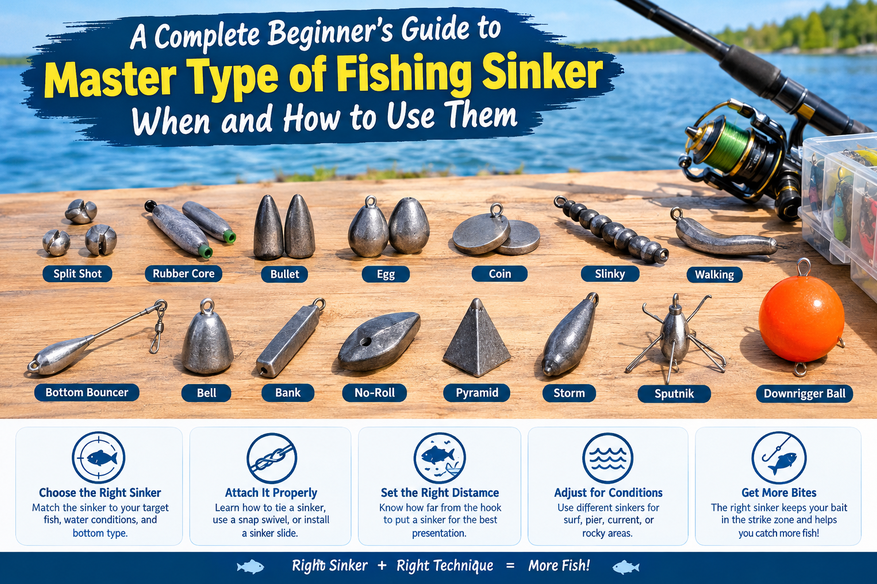
18 Types of Fishing Sinkers and When to Use Them
a. Light-Tackle and Finesse Sinkers
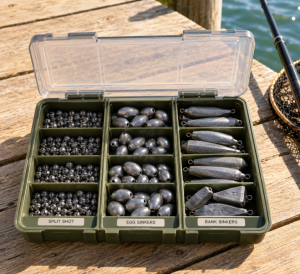
1. Split Shot Sinkers
Split shots are small, rounded weights with a slit that clamps onto your fishing line. They’re inexpensive, easy to use, and ideal for beginners fishing with worms, small live bait, and bobbers.
Place one or two split shots approximately 12 inches above your hook to help a worm sink naturally. Avoid squeezing them too tightly because excessive pressure can damage your line. Never clamp lead sinkers with your teeth.
Pinch too hard and you crush the line where it will break. Never close one with your teeth, because it is lead. Most split shot can be reopened by squeezing the wings with pliers.
2. Rubber Core Sinkers
Rubber core sinkers feature a slot containing rubber that grips the line when you twist the attached ears. They can be installed or removed without completely rebuilding your rig.
These weights are useful when frequently adjusting your presentation depth. However, they may slip on thin braided line, and their rubber components can collect weeds.
It is good for anglers who change depth all day, but it can slide on thin braid
3. Bullet Weights or Worm Weight
Bullet weights are cone-shaped sinkers with a hole through the center. Their pointed ends slide through vegetation, branches, and other cover more easily than rounded weights.
They’re commonly used with Texas-rigged plastic worms, creature baits, and other soft plastics. Use lighter weights in open water and heavier options when fishing thick vegetation.
Put a bead in front of it to protect your knot, and peg it with a rubber stopper or toothpick in heavy cover so the weight and bait sink together
A rubber stopper can peg the weight close to the bait, helping both move through heavy cover together. Without a stopper, the weight can slide independently along the line.
4. Tungsten Weights
Tungsten weights perform similar jobs to lead weights but are considerably about 70% denser than lead. Their smaller size helps them pass through cover, while their hardness transmits bottom contact more clearly.
They’re particularly useful for bass fishing around weeds, rocks, and submerged structures so you feel the bottom. The main disadvantage is their higher price, especially if you’re fishing areas where sinkers are easily lost.
5. Drop Shot Weights
Drop shot weights hang below the hook on a drop shot rig and keeps your bait suspended off the bottom for finicky bass, perch and walleye. Their narrow shapes can move through rocky areas more easily than many rounded sinkers, and their clips make depth adjustments convenient.
Use them when targeting bass, perch, and walleye that respond to subtle bait movements. Adjust the distance between the hook and weight to keep your bait at the desired height above the bottom.
A small clip lets you adjust the height, and the line usually pulls free if it snags, so you lose a cheap weight instead of the whole rig.
6. Nail Weights
Nail or Neko weights push directly into a soft plastic to change its fall rate or tip it face-down. They suit finesse rigs, Ned rigs and fluke fishing.
b. Mobile Bottom Sinkers
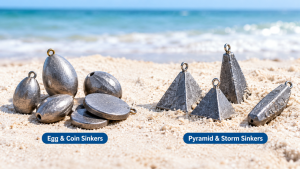
1. Egg Sinkers
Egg sinkers are oval weights with a hole through the center, allowing the line to slide through freely. They’re among the most versatile and affordable options for freshwater and saltwater fishing.
They’re excellent for Carolina rigs, live bait, and bottom presentations where you want bait to move with the current. Adding a bead between the sinker and swivel can create a clicking sound as the components contact each other.
Moreover, it rolls with the current and bounces off rocks without sticking. Add a glass bead in front of it and the click sounds like a shrimp, which attracts redfish, drum and trout. In strong current it never stops rolling, so your bait drifts off the spot.
The drawback is that egg sinkers can roll too far in strong current, moving your bait away from the intended fishing spot.
2. Coin or Disc Sinkers
Coin sinkers are flat, rounded weights with a wire eye. Their shape allows water to flow over them, helping them slide across sand rather than tumble like an egg sinker.
They’re particularly useful for drifting or trolling for flounder and fluke. They can also help maintain bottom contact in some current conditions, although sufficiently strong water can still drag them away. It can still wedge in rocks
3. Slinky Weights
A slinky weight is parachute cord filled with lead shot which bends over boulders instead of wedging and conform to uneven surfaces.
They’re useful for drift fishing in rocky rivers when targeting steelhead and salmon. However, sharp rocks can wear through the cord, and their flexible construction isn’t intended to hold bait stationary.
c. Rocky-Bottom and Walleye Sinkers
1. Walking Sinkers
Walking sinkers feature a curved design and a line attachment that allows the line to slide freely. Their shape helps them move over rocky bottoms while reducing the resistance a fish feels when taking bait.
They’re popular for walleye fishing with live bait. Slowly drag the sinker across rocky points and adjust the leader length to control how far the bait trails behind.
2. Bottom Bouncers
A bottom bouncer uses an L-shaped wire frame with a weight attached to one arm. The wire touches the bottom and deflects off rocks while keeping the bait slightly above the lakebed.
They’re commonly used for drifting or slow trolling for walleye. A starting guideline is approximately one ounce of weight per 10 feet of depth, but adjust for current, boat speed, and bottom conditions.
d. Static Bottom Sinkers
1. Bank Sinkers
Bank sinkers have a tapered, often six-sided shape with an attachment loop at the narrow end. Their design can help them slide out of certain rocky gaps when retrieved.
They’re versatile choices for fishing from bridges, piers, boats, and riverbanks. They work well in moderate conditions, but heavy current may still move them along the bottom.
2. No-Roll Sinkers
No-roll sinkers have a broad, flattened body with a hole running through the middle. Their low profile helps resist rolling when water pushes against the line.
They’re especially effective for catfish fishing in rivers, where keeping cut bait in one location can help establish a consistent scent trail.
Their wide shape can snag between rocks, so they’re generally better suited to suitable bottom areas than extremely rocky locations.
3. Bell Sinkers
Bell sinkers have a rounded, teardrop-like body and a line attachment near the top. Their aerodynamic shape helps them cast efficiently, making them useful for reaching distant fishing spots.
Use them for bottom fishing from shore, lakes, or piers when casting distance matters. However, their rounded bodies may roll in current and generally provide less grip than specialized stationary sinkers.
e. Surf Sinkers
1. Pyramid Sinkers
Pyramid sinkers have four flat sides that taper to a point. Their edges dig into sandy bottoms, helping keep bait in position despite waves and moderate surf.
They’re a popular choice for surf fishing with shrimp, cut bait, and sand fleas. Common sizes range from a few ounces upward, depending on casting distance, surf strength, and the tackle being used.
For anglers wondering how to use a pyramid sinker for surf fishing, attach it to an appropriate surf rig, cast beyond the breaking waves when conditions allow, and check whether it holds position. Increase the weight only when necessary.
2. Storm Sinkers
Storm sinkers combine a tapered body with gripping surfaces designed to help them anchor in sand. They offer a useful balance between casting performance and holding power.
They’re worth considering when surf conditions are rougher and an ordinary pyramid sinker keeps moving. However, exceptionally strong waves can still dislodge them.
3. Sputnik Sinkers
Sputnik sinkers feature a streamlined body and projecting wire legs that dig into the sand. The legs provide strong holding power, and breakaway designs allow them to release during retrieval.
They’re particularly useful for heavy surf, strong tides, and situations where bait needs to remain in one place for extended periods.
To understand how to use a Sputnik sinker, attach it to a compatible surf rig, cast carefully, and allow the wire legs to engage with the sandy bottom. During retrieval, a firm pull may release the legs on breakaway models.
Their disadvantages include higher cost and the possibility of the wire legs tangling with your fishing line.
f. Trolling Sinkers
1. Inline Trolling Sinkers
Inline trolling sinkers typically feature a keel-shaped body and swivels at both ends. The swivels help reduce line twist caused by spinning lures, spoons, and worm harnesses.
Attach one between your main line and leader when trolling for trout, salmon, or walleye. The added weight also helps your lure reach deeper water, although the extra hardware makes casting less convenient.
2. Downrigger Balls
Downrigger balls are heavy weights, commonly weighing several pounds, suspended from a boat-mounted cable and winch rather than directly tied to your fishing line.
A release clip connects your fishing line to the downrigger cable. Lower the weight to a selected depth, and when a fish strikes, the line releases so you can fight the fish without the heavy weight attached.
An 8 to 15 pound lead ball on a steel cable. It never touches your fishing line, and the line pops free when a fish hits
They’re useful for trolling deep for salmon and lake trout, but require a suitable boat and downrigger setup.
How to Choose the Right Fishing Sinker for Beginner
Knowing how to use fishing sinkers for beginners starts with understanding your fishing conditions rather than simply choosing the heaviest weight available.
- Fishing in vegetation: Choose a bullet weight that can move through weeds and cover.
- Fishing with live bait: Try split shots or an egg sinker when a natural presentation is important.
- Fishing for catfish: Consider a no-roll sinker when you need bait to remain stationary in river current.
- Fishing in surf: Start with a pyramid sinker and consider a storm or Sputnik design if more holding power is needed.
- Fishing rocky rivers: Try a slinky weight or walking sinker, depending on whether you’re drifting or slowly dragging bait.
- Trolling: Use an inline trolling sinker or bottom bouncer when appropriate for your target species and presentation.
The best sinker to use in strong current depends on the bottom and whether your bait should drift. A no-roll sinker is a strong option for stationary catfish bait, while a suitable bank sinker may work in less demanding conditions.
Likewise, the best sinker for bottom fishing depends on your location. Bank sinkers are versatile, egg sinkers allow movement, and pyramid sinkers provide better grip on sandy beaches.
How to Attach a Fishing Sinker
1. How to Tie a Sinker on a Fishing Line
The attachment method depends on the sinker design. Split shots clamp onto the line, while egg and bullet weights generally slide over the line before the terminal tackle is tied on. Sinkers with wire eyes can be connected using an appropriate knot or clip.
2. How to Use a Snap Swivel With a Sinker
Tie a snap swivel securely to your main line using a suitable fishing knot, then attach a compatible sinker with an eye or loop. This makes changing weights easier without repeatedly cutting and retying the line. Make sure the swivel and snap are rated for the load and conditions.
3. How to Use Sinker Slides
A sinker slide attaches to your fishing line and provides a clip for a removable sinker. They’re particularly useful in surf fishing and bottom rigs because you can change sinker sizes without rebuilding the entire rig.
4. How Far From the Hook to Put a Sinker
There is no single correct distance. For a simple split-shot rig, start around 12 inches above the hook. In a drop shot rig, the weight sits below the hook, and the separation determines how high the bait is presented. Carolina rigs commonly use a sliding weight above a swivel and leader.
Adjust the distance according to the bait, current, bottom structure, and behavior of the target fish.
Frequently Asked Questions
What Is the Best Fishing Sinker for Surf Fishing?
A pyramid sinker is a reliable starting point for sandy beaches. In rougher surf, a storm or Sputnik sinker may provide better holding power.
The best fishing sinker for surf fishing is a static sinker that digs into sand. Start with a pyramid in 2 to 6 ounces.
Learning how to use a pyramid sinker for surf fishing is straightforward: cast it, let it settle, and tighten up so its edges bite in. Move to a storm sinker in rough surf and to a sputnik for the longest hold. A tongue-style open-face sinker casts far and suits pompano
What Is the Best Sinker for Catfish Fishing?
The best sinker for catfish fishing is the no-roll sinker, because catfish in strong river current follow a scent trail and need the bait to stay put.
How to use a sinker for catfish is simple: choose a bank or no-roll sinker, use only as much weight as you need, and keep the bait in one place. Too much weight can spook fish on the cast and means more hardware lost to snags
An egg sinker is useful when you want a sliding presentation that allows bait to move naturally.
How to Use a Sinker for Pier Fishing?
Knowing how to use a sinker for pier fishing starts with the bank sinker. Its teardrop shape drops straight down and pulls free from cracks.
Choose a sinker that reaches the desired depth and remains manageable in the current. Bank sinkers work well for many bottom rigs, while pyramid sinkers sits over sand and surf and helps hold position over sandy bottoms. Follow local pier regulations and use tackle appropriate for the conditions.
How to Use a Walking Sinker for Walleye?
Thread the line through the walking sinker’s attachment, connect your leader and hook according to the rig design, and slowly drag the weight across the bottom. Its curved shape helps it travel over rocky terrain while allowing walleye to take the bait with less resistance.
Can I Use the Same Sinker for Every Fishing Situation?
No. Different sinkers are designed for different conditions. A split shot is excellent for light presentations, but it won’t hold a surf rig in heavy waves. Carrying several shapes and sizes gives you more flexibility.
Best Sinker to Use in Strong Current
The best sinker to use in strong current is a no-roll, bank or sputnik sinker, which resist being pushed along. Egg sinkers keep rolling and drift away from your spot.
Best Sinker for Bottom Fishing
For the best sinker for bottom fishing, choose by bottom type. Use a bank sinker for rocks, a pyramid for sand, a coin sinker for drifting and an egg sinker for rigs that cover ground.
What is the most versatile fishing sinker?
The egg sinker is one of the most universal and cheapest, used inshore and offshore. Bank sinkers are the all-rounder for static fishing.
Should I use a static sinker with live bait?
No. The current can brush a live bait against the bottom and kill it. Use a mobile sinker such as an egg sinker.
Why use tungsten instead of lead?
Tungsten is denser, so it is smaller for the same weight, and it transmits bottom contact better. It also avoids lead restrictions.
What size sinker should I start with?
Start with the lightest weight that holds bottom, then go up if wind, current or depth demand it. In the surf, 2 to 6 ounces is common.
Is split shot safe to use?
Yes, with care. Do not close it with your teeth, and do not pinch so hard that you crush the line.
Conclusion: Choose the Right Weight for Better Fishing
Understanding fishing sinker shapes explained in practical terms makes choosing tackle much easier. Mobile sinkers allow bait to drift or move along the bottom, while stationary sinkers help keep it in the strike zone.
Start with a few versatile options: split shots for light presentations, egg sinkers for sliding rigs, and bank sinkers for general bottom fishing. Add specialized options such as bullet, no-roll, pyramid, or Sputnik sinkers as your fishing conditions demand.
Choosing the right weight is one of the simplest ways to catch more fish. Match the sinker to your bait, bottom and current, and start light. If you only buy three, get split shot, egg sinkers and bank sinkers.</
Key Takeaways
-
- Match the sinker shape to your target species, current, and bottom structure.
- Use mobile weights when natural bait movement matters.
- Choose stationary weights when you need to hold bait in position.
- Use only enough weight to maintain the depth and presentation you need.
- Adjust your setup when wind, waves, current, or depth changes.
- Mobile sinkers such as egg, coin suit live bait and drifting; static sinkers such as pyramid, storm, sputnik suit dead bait and surf.
- Use the lightest weight that works.
- Bank and no-roll sinkers are strong choices for catfish and current.
- Pyramid, storm and sputnik sinkers cover the surf in order of increasing hold.
- Snap swivels and sinker slides let you swap weights quickly.
Ultimately, the best sinker is the lightest practical option that keeps your bait where you want it. Experiment with different weights, pay attention to how your rig behaves, and make adjustments as conditions change. With experience, selecting the right sinker becomes second nature.
