Easy Guide & Tips to Use Type of Fishing Bait or Lures for Any Season
Choosing the right fishing bait or lure can make the difference between a productive day on the water and hours without a bite. With so many options available, beginners often struggle to understand which bait works best for different fish species, water conditions, and seasons.
The real question is not which lure looks best, but how and when to use type of fishing bait or lures so they match the water, the season and the fish in front of you.
The secret is understanding how fish locate prey and how each bait or lure imitates natural food. Live bait attracts fish through movement, scent, and texture, while artificial lures give anglers greater control over presentation, depth, and retrieve speed. Whether you are fishing for bass in thick vegetation, trout in a flowing river, or catfish along the bottom, matching your presentation to the situation is essential.
This beginner fishing lure guide by season and species explains the major bait categories, when to use them, and practical techniques for improving your results.
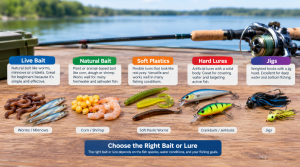
1. Live Bait: The Natural Choice for Beginners
Live bait remains one of the most reliable options because it offers natural movement, scent, and texture. Since the bait moves independently, anglers do not need advanced retrieval skills to make it appear convincing.
Best Live Baits and Their Uses
- Nightcrawlers: Effective for bass, bluegill, catfish, and trout.
- Live minnows: Excellent for crappie, walleye, and predatory fish. It gives predators a true baitfish profile, which makes them deadly for walleye, crappie and cool-water bass
- Leeches: Useful for walleye, particularly when fish prefer a slower presentation. Leeches are more durable and pulse naturally, making them a favorite for walleye and smallmouth in spring and fall
- Crickets and grasshoppers: Productive choices for trout and bluegill when insects are part of their diet.
- Crayfish: It ill work best when fish hold tight to rock, riprap and hard bottom
- Shrimp: A versatile option for numerous saltwater species. Shrimp is the all-around inshore saltwater bait
- Worms: The most universal bait because they catch panfish, trout, catfish, carp, perch and bass. They shine when fish are pressured or feeding on the bottom. Thread the hook about an inch from the head so the rest wiggles freely, and keep them cool so they stay lively.
- Cut bait: It is made from oily fish like shad or herring, leaves a strong scent trail.
Knowing when to use cut bait vs live bait for catfish is simple: choose cut bait when scent and distance matter, and live bait when fish are actively chasing prey
Match the bait to the forage. If fish are feeding on baitfish, use minnows. If they are feeding on bottom invertebrates, use worms, leeches or crayfish
How and When to Use Live Minnows vs Artificial Lures
Live and natural baits win on scent, realism and instinct with very little technique.
Live minnows are particularly useful when fish are feeding cautiously or responding to natural prey. Their swimming action can be effective during cooler periods when bass and other predators become less aggressive.
Artificial lures win on precision, durability and control over where and how fast the bait moves.
Also, artificial lures are more convenient, reusable, and adaptable when you need to search large areas quickly.
Understanding how and when to use live minnows vs artificial lures is the foundation for everything else
Choose live bait when natural movement and scent are important.
Use artificial lures when you want to cover water, control depth precisely, or repeatedly target specific structures.
2. Soft Plastic Worms, Tubes, and Swimbaits
Soft plastics imitate worms, crayfish, insects, and baitfish. Their flexibility allows anglers to change the action by adjusting the rig, weight, and retrieve.
Soft plastics imitate live prey without the hassle of keeping anything alive. They require more angler skill than live bait, because a poorly worked plastic just sits there looking like plastic.
However, success depends on presentation rather than simply casting the lure into the water.
When to Use Soft Plastic Worms for Bass
Use soft plastic worms when bass are holding around submerged vegetation, rocks, docks, brush piles, or other cover. A Texas rig is a strong choice around vegetation because the hook can be positioned to reduce snags. Carolina rigs help cover bottom areas, while drop-shot rigs suspend the bait near fish that are holding at a particular depth.
Slowly lifting and dropping a worm can trigger bites from pressured bass that ignore faster-moving lures. In clear water, natural colors such as green pumpkin and watermelon are useful starting points.
How and When to Use Soft Plastic Tubes for Smallmouth
Soft plastic tubes are effective for smallmouth bass around rocky shorelines, gravel flats, current seams, and submerged structure. Rig a tube on a suitable jig head, cast toward likely holding areas, and allow it to sink before gently dragging or hopping it across the bottom.
Use a lighter jig head in shallow water or mild current and increase the weight when you need better bottom contact. Natural baitfish or crayfish colors are sensible starting points in clear water.
How to Use Scented Plastics in Clear Water
Scented plastics combine artificial movement with an added attractant. In clear water, choose realistic colors and avoid unnecessarily aggressive presentations when fish are wary. Work the bait slowly around cover, allowing fish time to inspect it. Scent can encourage a fish to hold the bait longer, although results depend on the species and conditions.
Just choose natural colors, go lighter on line, and fish them slowly. Scent infused baits like Gulp leave a trail that often outfishes live bait on pressured waters.
When to Use Swimbaits for Bass
Swimbaits imitate swimming baitfish and are particularly useful when bass are feeding on shad or other small fish. Retrieve them steadily around points, drop-offs, weed edges, and open-water baitfish schools.
Smaller models suit a wide range of situations, while larger swimbaits can help target trophy bass at the expense of fewer bites.
When to use swimbaits for bass: when fish are chasing baitfish or when big bass have seen every other lure. Soft swimbaits can be rigged on a jig head for bottom contact. Match the size to the local forage, and go bigger when targeting trophy fish
3. Crankbaits: Cover Water and Find Active Fish
Crankbaits are hard-bodied lures with a diving lip that produces a wobbling action during retrieval. The lip determines how deeply the lure runs, allowing anglers to target fish holding at specific depths without adding extra weight.
How and When to Use Crankbaits for Bass
Use shallow-running crankbaits over shallow flats, above vegetation, and along shorelines. Deep-diving models are better suited to drop-offs, ledges, and deeper structure. Match the lure’s running depth to the depth where bass are feeding.
Begin with a steady retrieve, then experiment with changes in speed, pauses, and occasional twitches. Crankbaits are excellent search lures because they help anglers locate active fish across large areas.
You can use crankbaits to cover water and find active fish. The bill length controls depth, so a short bill runs a few feet down while a long bill digs 10 to 12 feet or more. Bump them off rock, stumps and edges of vegetation, and vary your retrieve with occasional pauses
When to Use Crankbaits vs Spinnerbaits
Choose crankbaits when you want to target a specific depth and imitate a swimming baitfish.
Use crankbaits along open edges, rock piles and defined depth.
Choose spinnerbaits in vegetation, around wood, and in stained water, since the wire frame deflects weeds away from the hook
Use spinnerbaits when flash, vibration, and maneuverability around vegetation or woody cover are more important.
Both can catch bass in stained water, but spinnerbaits often have an advantage when visibility is limited and fish rely heavily on vibration to locate prey.
Crankbaits with rattles can also help attract fish in murky conditions.
4. Spinnerbaits: Flash and Vibration in Murky Water
Spinnerbaits use a wire frame and rotating metal blades to create flash and vibration. Their design helps deflect vegetation away from the hook, making them useful around weed edges, docks, stumps, and submerged timber.
On the other words, spinnerbaits has the spinning blades create flash and vibration the lateral line can detect, which helps fish find the bait where visibility is poor. Colorado blades add thump for slow retrieves, while willow leaf blades suit faster retrieves
How and When to Use Spinnerbaits in Murky Water
Cast a spinnerbait along vegetation edges or retrieve it past submerged cover where bass, pike, and other predators may be waiting. A Colorado blade creates stronger vibration, making it a useful choice in muddy water or low light. Willow-leaf blades produce more flash with less resistance and can work well when fish respond to a faster presentation.
Maintain a steady retrieve initially, then vary the speed or briefly pause the lure to trigger reaction strikes.
What Lure to Use in Muddy Water
Start with a spinnerbait featuring a Colorado blade, a rattling crankbait, or a soft plastic in a high-contrast color. Dark silhouettes and bright shades such as chartreuse can improve visibility depending on the available light and water color. Increase vibration and slow the retrieve if fish struggle to locate the lure.
Pick lures that make noise and vibration: a rattling crankbait, a Colorado blade spinnerbait or a chatterbait in bright or dark colors fished at a slow pace
5. Jigs: A Versatile Bottom-Fishing Option
A jig consists of a weighted hook that may be dressed with a skirt, feathers, hair, or soft plastic. Its weight helps it sink quickly and maintain contact with the bottom, where many fish feed on crayfish and other prey.
How and When to Use Jigs for Walleye
Jigs are productive for walleye around rocky bottoms, river channels, points, and submerged structure. Attach a suitable soft plastic or live-bait trailer, allow the jig to reach the bottom, and gently lift and drop it while maintaining contact with the structure.
In rivers, choose enough weight to control the jig without making it unnecessarily heavy. During spring, a small swimbait on a jig head can be effective when slowly bounced along the bottom.
How and When to Use Jigs for Panfish Ice Fishing
Small jigs are useful for crappie, bluegill, and perch during ice fishing. Tip the jig with a small plastic, larva imitation, or permitted live bait. Lower it to the fish’s depth and use subtle lifts and pauses rather than aggressive movements.
What Bait to Use in Cold Water for Panfish
Try small live minnows, worms, insect larvae, or tiny soft plastics. Fish often respond better to smaller offerings and slower movements when their feeding activity decreases. Experiment with the depth and allow the bait to remain in the strike zone longer.
6. Spoons and Inline Spinners
Metal spoons wobble and flash as they move through the water, imitating injured or disoriented baitfish. They can be cast, trolled, or jigged vertically, making them useful in both open water and deep-water situations.
How and When to Use Spoons for Freshwater Trout
Cast a small spoon into open water, allow it to sink to the desired depth, and retrieve it steadily. Occasional changes in speed or direction can create an irregular wobble that attracts trout. Spoons are also useful when fishing from shore because their weight often allows long casts.
When to Use Spoons vs Spinners for Trout
Use spoons when you need casting distance, a wider wobbling action, or a lure that can be fished at different depths. Inline spinners are excellent for searching streams and rivers because their rotating blades generate flash and vibration during a steady retrieve.
How and When to Use Inline Spinners for River Trout
Cast an inline spinner across or slightly upstream of a current seam, then retrieve it fast enough to keep the blade rotating. Target pools, riffle edges, and the deeper sides of current breaks. Silver blades are a useful starting point in clear water and bright conditions, while gold can be worth trying in stained water or lower light.
7. Topwater Lures and Frogs
Topwater lures create surface disturbance through splashing, popping, buzzing, or side-to-side movement. They can provoke explosive strikes when predators are feeding near the surface.
How and When to Use Topwater Frogs for Summer Bass
Hollow-body frogs excel over thick vegetation, lily pads, matted weeds, and shallow cover. Twitch the frog across openings and pause occasionally to imitate a struggling animal. Frog lures are particularly useful when submerged vegetation makes conventional treble-hook lures difficult to fish.
When a bass strikes, resist setting the hook immediately. Wait until you feel the weight of the fish, then pull firmly to drive the hooks home.
When to Use Topwater Lures
Dawn, dusk, overcast conditions, and warm periods can create productive topwater opportunities. Poppers work well with sharp twitches followed by pauses, while prop-style lures and buzzbaits create continuous surface commotion. Adjust the presentation to the activity of the fish rather than assuming every topwater lure works best in the same conditions.
8. Cut Bait, Shrimp, and Other Natural Options
When to Use Cut Bait vs Live Bait for Catfish
Cut bait consists of pieces of fish that release scent into the water. Oily species such as shad or herring can be useful for channel catfish and other scent-oriented predators. Use appropriately sized pieces and keep the bait fresh.
Live bait offers movement and may appeal to fish hunting active prey, while cut bait provides a concentrated scent trail. The better choice depends on the catfish species, local forage, current, and fishing regulations.
When to Use Shrimp vs Sand Fleas for Surf Fishing
Shrimp is a versatile surf-fishing bait that can attract a range of saltwater species. Sand fleas, also called mole crabs, can be particularly effective for surf-zone species that naturally feed on them, including pompano in suitable locations.
Use fresh or properly stored shrimp when you want a broadly appealing bait. Choose sand fleas when they are part of the target species’ natural diet and local conditions favor them. Check local rules before collecting or using either bait.
PowerBait and Scented Artificial Baits
Scented dough bait can be effective for stocked trout, particularly when presented near the bottom on a suitable rig. Some floating formulas suspend above the bottom, placing the bait within the feeding zone. Follow the product instructions and use hook sizes appropriate for the fish and applicable regulations.
9. Choosing Lure Colors and Adapting to Conditions
When to Use Dark vs Bright Lure Colors
In low light or stained water, dark colors can provide a recognizable silhouette, while bright colors can improve visibility. In clear water, natural shades that resemble local forage are often a sensible starting point.
- Clear water: Try green pumpkin, watermelon, silver, or natural baitfish patterns.
- Stained water: Experiment with black and blue, gold blades, or contrasting patterns.
- Muddy water: Consider chartreuse, other bright colors, or dark silhouettes with strong vibration.
- Low light: Test contrasting colors and lures that create noticeable vibration or surface disturbance.
These are starting points rather than universal rules. Water clarity, light penetration, local forage, and fish behavior should guide your final selection.
10. Seasonal Lure Selection and Troubleshooting
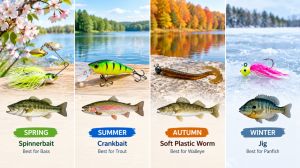
Water temperature and seasonal feeding patterns affect how actively fish pursue prey. In spring, try jigs, small swimbaits, and natural bait around spawning areas or nearby structure. In summer, topwater frogs, crankbaits, and spinnerbaits can target active predators. During fall, baitfish imitations may be effective as predators feed heavily. In winter, slow-moving jigs and smaller presentations can be useful.
How and When to Use Jerkbaits in Cold Water
Jerkbaits are useful when predators are feeding on baitfish but respond poorly to a continuous retrieve. In cold water, twitch the lure and allow longer pauses so fish have time to strike. Adjust the pause length and running depth until you find a productive presentation.
When to Use Jerkbaits for Pike and Musky
Use appropriately sized jerkbaits around weed edges, points, and baitfish concentrations where pike or musky may hunt. Work the lure with deliberate rod movements, alternating pulls and pauses. Use suitable tackle and a strong leader to handle these toothy predators safely.
When to Use Metal Jigs vs Soft Plastics Saltwater
Metal jigs are useful when you need casting distance, rapid depth changes, or a fast presentation around schooling fish. Soft plastics are often better when a slower, more natural swimming action is needed near structure. Match the jig weight to current and depth, and use tackle suitable for the target species.
Best Bait to Use When Fish Aren’t Biting
When fish stop responding, first change one variable at a time. Slow your retrieve, downsize the lure, adjust the depth, or move to nearby cover. Try a natural bait or scented plastic if fish appear reluctant to chase artificial lures. If visibility is poor, test a lure with stronger vibration or a more contrasting color.
Sometimes, it is caused by the bait is usually something smaller, slower and more natural. Switch to live bait, scented plastics or an ultralight jig, and downsize your line and hooks. Big fish will often eat a small lure
Beginner Fishing Lure Guide by Season and Species
This beginner fishing lure guide by season and species gives you a simple starting point:
- Spring: jigs and leeches for walleye, spinnerbaits for bass.
- Summer: topwater frogs, swimbaits and soft plastic worms for bass.
- Fall: crankbaits, minnows and spoons for active predators.
- Winter: small jigs, live bait and slow jerkbaits.
Frequently Asked Questions
1. What is the best fishing bait for beginners?
Nightcrawlers are an excellent starting point because many freshwater species eat them and they require little retrieval technique. Small inline spinners and simple soft plastics are also useful for learning artificial-lure fishing.
Soft plastics and inline spinners are easy to use and catch many species.
2. Are live bait or artificial lures better?
Neither is always better. Live bait provides natural scent and movement, while artificial lures offer convenience, reusability, and precise control over presentation. The best choice depends on the target species and conditions.
Live bait triggers instinct with little skill. Lures give more control and cover more water. Neither is always better.
3. Which lure works best in muddy water?
Spinnerbaits, rattling crankbaits, and high-contrast soft plastics are good options to test. Strong vibration and visible silhouettes may help fish locate the lure when visibility is limited.
4. How do I choose the right lure depth?
Estimate where the fish are holding and select a lure designed to reach that depth. Shallow crankbaits suit flats and vegetation, while deep divers and weighted jigs can target ledges and deeper structure.
5. Should I change lures when fish stop biting?
Yes, but make deliberate adjustments. Try a slower retrieve, smaller profile, different depth, alternative color, or natural bait. Move to another location if fish remain inactive after several reasonable changes.
6. How deep will a crankbait dive?
Depth is based on bill length and is often printed on the package.
7. Do lure colors really matter?
Yes, especially water clarity and light. Natural colors suit clear water, and bright or dark colors suit stained water.
8. Can I use lures in cold water?
Yes. Slow down, downsize and use pauses.
Conclusion: Match Your Bait to the Fishing Situation
Learning how and when to use type of fishing bait or lures starts with understanding the strengths of each category.
Live bait offers natural movement and scent, soft plastics reward controlled presentation, crankbaits cover water efficiently, spinnerbaits create flash and vibration, and jigs provide excellent bottom contact. Spoons, inline spinners, and topwater lures each fill specific roles.
Every bait has earned its place through decades of results. Once you understand how and when to use each type, you stop guessing and start adapting to the conditions in front of you.
Key Takeaways
- Match lure depth and size to the target fish and water conditions.
- Use natural bait when scent and realistic movement are important.
- Choose moving lures to locate active fish across larger areas.
- Adjust color, speed, and presentation to water clarity and light.
- Experiment patiently, observe fish behavior, and follow local fishing regulations.
- Live bait wins on scent and instinct; lures win on control.
- Use crankbaits and spinnerbaits to cover water.
- Use vibration lures in muddy water.
- Slow down and downsize in cold water.
- Match lure color to water clarity and light.
The more you understand your bait, the less you need to rely on luck. Start with a few versatile options, learn how they move through the water, and adapt your approach until you discover what the fish respond to on that particular day.
