
Mastering Fishing Reel Drag Setting: Step-by-Step Guide for Spinning & Baitcasting Reels
Getting your fishing reel drag setting right takes only a minute, yet it is one of the most important skills in fishing.
Fishing reel drag setting is one of the simplest adjustments on your reel, yet it can make a major difference when a powerful fish takes off. Few things cost anglers more fish than a badly adjusted drag.
Setting the drag too tight can break the line, damage a knot, straighten a hook, or put unnecessary stress on the rod.
Setting it too loose and a fish may take too much line before you gain control that make a strong fish run straight into the weeds.
The goal here is not simply to make the drag tight or loose.
It is to create a controlled amount of resistance so the fish can take line when necessary without overpowering your tackle. Here, you can use the drag as a safety cushion and adjust it according to the fish, fishing environment, and amount of time you have to react.
This guide covers how drag works, how to set it on spinning and baitcasting reels, how to adjust it for different fish and lines, and how to fix a drag that has stopped working properly.
What Is Fishing Reel Drag?
Drag is the reel mechanism that controls how much resistance a fish feels when it pulls line from the spool. A properly adjusted drag allows line to leave the reel under heavy pressure instead of forcing the line to break immediately.
On most spinning reels, the drag adjustment is located on the front of the spool. Some reels use a rear-mounted drag, while baitcasting reels commonly use a star-shaped drag control. The basic principle remains the same: turning the adjustment one direction increases resistance, while turning it the other direction decreases resistance.
On the other side, drag is the adjustable friction system inside your reel that lets a strong fish pull line off the spool instead of breaking it. Think of it as a safety cushion between the fish and your line. When you pull line from the reel and hear it clicking or humming, that is the drag releasing line under tension.
What a Properly Set Drag Protects
- Your line and knots: smooth release prevents sudden shock that causes break-offs.
- Your rod: the drag takes the strain when a fish makes a hard run or you snag an obstacle, so the rod tip is far less likely to break.
- Your hook-up: too much pressure can tear the hook out, especially with thin-jawed fish.
- Your control: a good drag lets you tighten or loosen pressure during the fight.
Some anglers, particularly those who fish with baitcasters, call this the reel “brake.” If you have ever wondered how to adjust the reel brake, the answer is the same as setting the drag: turn the adjustment clockwise to tighten it and counterclockwise to loosen it, then test it with a pull of the line.
How Tight Should Fishing Reel Drag Be?
So, how tight should fishing reel drag be?
It should generally be tight enough to maintain control but loose enough to let line leave the spool before the line, knot, hook, or rod becomes overloaded.
A simple hands-on test is useful.
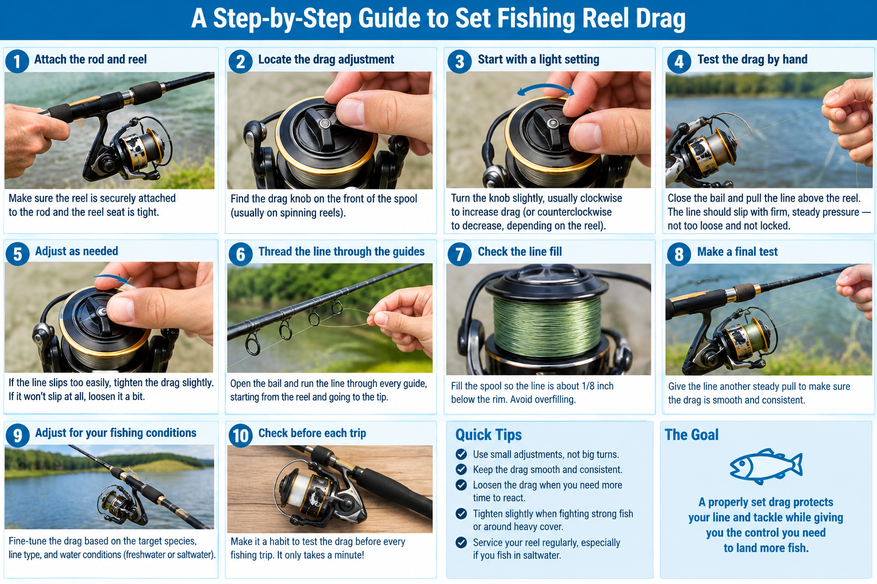
Close the bail on a spinning reel and pull the line above the reel. The line should come out with a firm, steady pull. When it slips too easily, increase the drag slightly.
When it will not slip at all, decrease the drag. When uncertain, set a little loose rather than excessively tight.
On the other hand, the widely used rule of thumb is to set the drag at roughly one-third, or about 30%, of your line’s breaking strength. The goal is for the drag to start releasing line before the line, knot, or hook length gives way.
The 30% Rule in Practice
If your line is rated to hold 10 kg, the drag should begin slipping at around 3 kg of pull. You can test this once by tying a known weight to the line and lifting it.
The weight should gradually pull line off the reel. Doing this experiment a single time teaches your hand what the correct resistance feels like.
Quick Examples by Line Type
- Drag setting for 10 lb mono: about 3 lb of pull before the drag slips.
- Drag setting for 20 lb braid: about 6 lb of pull as a starting point.
- Best drag setting for braided line: braid has very little stretch, so many anglers stay at the lower end of the range and rely on the rod’s bend to absorb shock.
The Quick Hand Test
Close the bail or engage the reel, grab the line just above the reel, and pull. It should slip with a firm, steady pull. If it comes out too easily, tighten the drag a few clicks. If it will not move at all, loosen it. When in doubt, go a little loose. It is better to fight a fish a little longer than to set the drag too tight and break off a big one.
How to Adjust Spinning Reel Drag Correctly
1. Find the Drag Adjustment
On a typical spinning reel, look for the small knob on top of the spool. This is the primary control for your fishing reel drag setting.
2. Start With a Controlled Setting
Turn the knob gradually rather than making a large adjustment. Small movements can have a noticeable effect, especially on inexpensive reels where the adjustment step may be less precise.
3. Pull the Line by Hand
With the bail closed, pull the line steadily. You are looking for resistance that is noticeable but controlled. The line should not fly off the spool with almost no effort, but it also should not feel completely locked.
4. Recheck Before Fishing
Transportation, previous adjustments, and storage can change the setting you expect. A useful habit is to check the drag before each fishing trip instead of assuming it is still correctly adjusted. Do it as a routine activity before fishing.
Fishing Reel Drag Setting by Fishing Situation
The base rule gets you in the right range, but experienced anglers adjust the drag for the fish and the water they are fishing.
Smaller fish in open water allow a slightly tighter drag, while bigger fish and snaggy water call for a looser one.
How to Set Drag on Spinning Reel for Bass
When learning how to set drag on spinning reel for bass, avoid simply tightening the drag as much as possible. A moderate setting gives a bass enough resistance to maintain pressure while still allowing it to take line during a hard run. This approach is especially useful when fishing lighter line.
On the other side, you can start with the one-third rule for whatever line you have spooled. Because bass often live near weeds, timber, and docks, keep the drag firm enough to turn the fish but loose enough that a hard surge does not snap your line. Re-check it at the start of every trip
Fishing Reel Drag Setting for Catfish
Catfish are powerful and often fought near cover, so keep the drag set within the one-third range and loosen it slightly if you are fishing around snags.
For a fishing reel drag setting for catfish, the right balance depends heavily on line strength, hook size, cover, and the size of fish you expect.
In open water, allowing additional line can provide a useful cushion. Around heavy obstacles, more control may be necessary.
Reel Drag Setting for Walleye
Walleye bites can be subtle and their mouths are delicate, so a smooth, moderately light drag helps keep the hook pinned
A reel drag setting for walleye should provide enough resistance for a controlled fight without eliminating the drag’s ability to protect lighter tackle.
In related to this, some fish have harder jaws and may require different control during the hook set.
Reel Drag Setting for Trout
Trout are often caught on light line, so use a light, silky drag so sudden runs do not break fine line
For a reel drag setting for trout, smoothness is particularly important when using lighter line. A drag that starts and stops abruptly can create sudden pressure and increase the risk of a break-off. The key is consistent resistance rather than simply maximum tightness.
Spinning Reel Drag Settings for Striper
Stripers run hard and long, so use a smooth drag that can release line steadily during repeated runs
Spinning reel drag settings for striper should account for both the power of the fish and the strength of your line and leader.
Rather than relying on a single setting for every situation, check the drag manually and make small adjustments when conditions change.
Surf Fishing Reel Drag Setting
A surf fishing reel drag setting needs to provide enough control for strong runs while still protecting the line. Wind, current, structure, casting distance, and the size of the target fish can all affect how much resistance is useful.
Here, you can use enough drag to turn the fish and handle long runs, while staying loose enough that big surges do not snap your line
Saltwater Spinning Reel Drag Setting
At this point, you can start with the one-third rule, make sure the drag is smooth, and plan on more frequent maintenance, since salt shortens the life of drag washers.
With a saltwater spinning reel drag setting, maintenance becomes particularly important. Have more frequent service for reels used in saltwater or under heavy pressure, suggesting inspection every three to six months in those conditions.
Choosing Drag for Different Fishing Lines
Best Drag Setting for Braided Line
The best drag setting for braided line is not determined by the braid’s label alone. Your knots, leader, rod, hook, and fishing conditions also matter. Because braid can be strong and relatively unforgiving, a controlled drag can help prevent sudden shock from being transferred directly to the rest of the system.
Drag Setting for 10 lb Mono
For a drag setting for 10 lb mono, it is especially important not to lock the drag down. Monofilament has a defined breaking strength, but knots and sudden impacts can reduce the practical margin. A smooth drag allows a strong fish to take line rather than forcing the weakest connection to absorb all the pressure.
Drag Setting for 20 lb Braid
A drag setting for 20 lb braid still requires a balanced approach. More line strength does not mean the drag should automatically be tightened to its maximum. The reel should release line smoothly before excessive pressure reaches the entire tackle system.
Heavy Drag vs Light Drag Fishing
The difference between heavy drag vs light drag fishing is mainly about control versus line protection.
- Heavy drag: Provides greater immediate control and can help keep a fish away from weeds, trees, rocks, or other obstacles.
- Light drag: Allows more line to leave the spool and provides more time to react when a fish makes a sudden run.
Here, a looser setting can be helpful when an angler is not immediately holding the rod, while a tighter setting can provide better control when actively playing a fish.
How to Use the Front Drag on Your Fishing Reel
Learning how to use the front drag on your fishing reel is straightforward. Adjust the front knob in small increments, then test the line by hand. During a fight, you can make minor adjustments to increase or decrease resistance as the fish changes direction or approaches cover.
Do not depend exclusively on the drag, however. Remember to apply three practical fish-fighting tools on a fixed-spool setup: the drag, the bend and action of the rod, and back winding when available.
In a simple word, treating it as an active tool, not a set-and-forget dial. As a fish pulls line, you can tighten the knob slightly to gain control, loosen it when the fish surges toward an obstacle, and keep the rod bent so the rod itself absorbs the headshakes.
Along with the rod’s bend, some reels offer a back-wind or free-spool switch as a third way to release line
Front Drag vs Rear Drag Spinning Reel
When comparing front drag vs rear drag spinning reel designs, the important point is that the adjustment process is fundamentally similar. Some spinning reels place the adjustment on the front of the spool, while others locate it at the rear.
Whatever design you use, learn exactly where the control is before the fish bites. Being familiar with the adjustment direction can prevent hesitation during a fast fight.
Well, on roughly 99% of reels the drag sits at the front of the spool and is easy to adjust mid-fight. Some reels place it at the back, which keeps the dial out of the way but makes quick changes harder. The setting process is identical for both: tighten, test with a pull, then back off to a firm slip
Baitcaster Drag Setting for Beginners
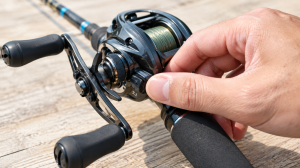
A baitcaster drag setting for beginners starts with understanding the star drag. Turn the star clockwise to tighten the drag and counterclockwise to loosen it. This is a common starting guideline of roughly one-third of the line’s breaking strength.
How to Set the Drag on a Bait Casting Reel
When learning how to set the drag on a bait casting reel, make gradual adjustments and test the line under steady pressure. The objective is the same as with a spinning reel: line should come off under significant pressure without becoming completely locked.
How to Adjust the Reel Brake
How to adjust the reel brake is another common beginner question. Try tightening the brake almost completely, then gradually loosening it until the line begins to pull with noticeable resistance.
You can set the brake at approximately 30% of line strength, giving a 10 kg line a roughly 3 kg starting point.
Fix Fishing Reel Drag That Feels Jerky and Uneven
Knowing how to fix fishing reel drag that feels jerky and uneven starts with identifying why the drag is behaving poorly.
The main cause is an over time old grease breaks down, dust and moisture getting inside, and the surfaces stop gliding smoothly.
Worn or glazed washers can also make pressure inconsistent.
A jerky drag creates sudden shock on your line and knots, which raises the chance of break-offs.
The fix is to disassemble the drag stack, clean the washers, replace any that are damaged, and apply the correct drag grease
Using old grease can break down, while dust and moisture can interfere with smooth movement.
Common Causes of Uneven Drag
- Dirty or dry drag washers
- Worn, glazed, damaged, or compressed washers
- Poor lubrication
- Incorrect assembly
- Long periods without servicing
A jerky drag can create sudden shock on line and knots. It can also reduce control when fighting strong fish, particularly with lighter tackle.
How to Fix Fishing Reel Drag Slipping
When learning how to fix fishing reel drag slipping, first check whether the drag is simply too loose. If the adjustment is appropriate but the drag continues to slip unpredictably, inspect the reel for contamination, wear, lubrication problems, or incorrect assembly. A reel showing persistent problems may need a proper service rather than repeated knob adjustments.
If your reel start slipping, you can start with checking the washers. If the drag releases line even when tightened, the washers may be worn, glazed, oily, or compressed. Clean them or replace them, and make sure the stack is reassembled in the correct order.
Fishing Reel Drag Not Working
If you find your fishing reel drag not working at all, first confirm that the knob is actually engaging and that the line is wound correctly. If it still fails, the drag stack inside needs servicing. Because the brake spring can wear when stored under pressure, it is best to loosen the drag after each trip and set it again before fishing.
Usually, the spool will not release line when it should, avoid continuing to fish aggressively with it. At this point, a drag should release line smoothly and that ongoing problems can place additional stress on internal reel components.
How Often Should You Service a Fishing Reel?
Regular maintenance is an important part of reliable drag performance. For normal use, service a reel roughly every six to twelve months.
For frequent fishing, saltwater use, or heavy tackle pressure, a three-to-six-month interval is suggested. Reels that become rough or wet, or have been stored unused for an extended period, should be inspected sooner.
Try loosening the brake before storage and readjusting it before the next trip. The stated reasoning is that releasing the brake avoids keeping the spring compressed while the reel is stored.
- Normal use: every 6 to 12 months.
- Frequent, heavy, or saltwater use: every 3 to 6 months.
- Feels rough, wet, or has been in storage a long time: inspect it sooner.
Your Pre-Trip Drag Checklist
- Pull line by hand to confirm the drag releases smoothly.
- Adjust to roughly one-third of your line’s strength.
- Loosen slightly if you are fishing around snags or targeting bigger fish.
- Tighten slightly for small fish in clean water.
- Loosen the drag when you finish fishing and store the reel.
Final Fishing Reel Drag Setting Tips
- Test the drag before every trip.
- Use small adjustments instead of large turns.
- Keep enough drag resistance to maintain control.
- Do not lock the drag so tightly that the line cannot release.
- Loosen the setting when you need more time to react.
- Tighten slightly when fish and obstacles demand more control.
- Inspect and service a rough or inconsistent drag before relying on it.
The central lesson is simple: your fishing reel drag setting should act as a safety cushion. It should protect your line and tackle while still giving you enough control to play the fish. The best setting can change with your line, target species, cover, and fishing situation, so learning to make small adjustments is more valuable than memorizing one permanent number.
FAQs About Fishing Reel Drag Setting
What is a good drag setting for beginners?
Set it to about one-third of your line’s breaking strength, then test it by hand. It should slip with a firm, steady pull.
Should fishing reel drag be tight or loose?
It should be somewhere between completely locked and excessively loose. The line should pull out under firm, controlled pressure without snapping immediately.
If nothing comes off, it is too tight.
If line pulls out with almost no effort, it is too loose
What is a good starting drag percentage?
It is approximately 30% of line strength and, for baitcasting reels, roughly one-third of breaking strength. These should be treated as starting guidelines rather than universal rules.
Can I adjust drag while fighting a fish?
Yes. It is all about tightening or loosening the drag during a fish fight as conditions change. Make small adjustments rather than dramatic turns. Small adjustments during the fight are normal and often necessary. Just move the knob a little at a time
Why does my drag feel jerky?
Dirty, dry, worn, damaged, or poorly lubricated drag washers are among the causes. Incorrect assembly and long periods without service can also contribute. Cleaning and lubricating them, or replacing them, usually solves it
Should I loosen the drag after fishing?
Yes. Releasing the drag after each fishing trip takes pressure off the spring and washers and helps them last longer then readjusting it before fishing again.
Key Takeaways
A reliable fishing reel drag setting is about controlled resistance, not maximum tightness. Start by testing how the line leaves the spool, make small adjustments, and adapt the drag to your target fish and surroundings. When the drag becomes rough, jerky, or inconsistent, inspect and service it rather than ignoring the warning signs. With regular checks and practice, drag adjustment becomes second nature and that can mean the difference between watching a trophy fish break away and successfully bringing it to the net.
- Set drag to about 30% or one-third of your line’s breaking strength.
- Test with a hand pull: it should slip with a firm, steady pull.
- When in doubt, go slightly loose.
- Turn clockwise to tighten and counterclockwise to loosen.
- Check and adjust your drag before every trip, and loosen it after.
- Service your reel every 6 to 12 months, or every 3 to 6 months for heavy or saltwater use.
- A jerky or slipping drag usually means dirty or worn washers.
Always check your local fishing license, season, size, and bag limit rules before you fish, and handle hooks carefully.
Conclusion
A correct fishing reel drag setting protects your line, rod, and hook, and it gives you far better odds of landing the fish you hook. Learn the one-third rule, practice the hand test, adjust for the species and the water, and keep your reel serviced. These habits take only minutes but save a lot of lost fish.
