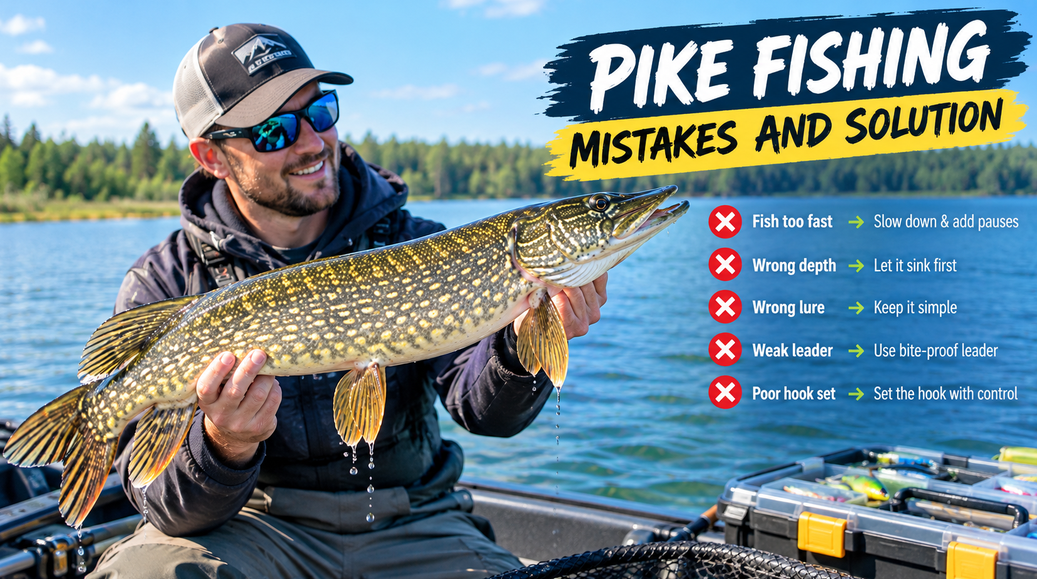
Solution of 20 Pike Fishing Mistakes: How to Catch More Trophy Fish Like a Pro
Pike fishing can be one of the most exciting forms of freshwater angling, but beginners can quickly make mistakes that cost them bites, tackle, and sometimes even their safety.
The good news is that most of these problems are easy to correct once you understand how pike behave and how your presentation affects them.
This guide breaks down the most important pike fishing mistakes beginners make, from retrieving lures too quickly to fishing the wrong depth or location.
It also covers tackle preparation, leader selection, hook setting, fish handling, seasonal behavior, and the importance of spending enough time on the water.
1. Retrieving Your Pike Lure Too Fast and Too Static
One of the most common beginner mistakes is simply fishing a lure too quickly. Most often mistakes involve how the lure is worked, not which lure is tied on.
A fast retrieve can work when pike are highly active, but it is not always the best starting point. If a pike sees a lure moving too quickly, it may decide that chasing it is not worth the effort.
Instead, experiment with a slower and more irregular retrieve. Stop the lure occasionally, speed it up, slow it down, and add a few twitches. These changes can make the lure look more like an injured or vulnerable baitfish.
A lure pulled past a pike at full speed in a dead-straight line rarely gets eaten. The pike simply decides it is not worth the chase
Use Retrieve Changes to Trigger Strikes
- Start with a moderate retrieve.
- Add short pauses.
- Occasionally increase speed.
- Slow down near likely holding areas.
- Add twitches to jerkbaits and soft baits.
The solution
- Slow down and give the pike time to choose your lure over real baitfish.
- Vary the retrieve: stop, speed up, slow down, twitch.
- Think of a cat with a toy. A toy dragged in a straight line gets ignored, but one that twitches and pauses is impossible to resist.
Speed still has a place. In early fall, when fish are active, a quick retrieve combined with short stops triggers reaction strikes. As the water gets colder, slow down and use long pauses.
2. Fishing the Wrong Depth
Another major mistake is retrieving the lure above the pike instead of bringing it into the fish’s strike zone. If a pike is holding near the bottom in several meters of water, a lure racing across the surface may never get its attention.
So, what depth to fish for pike?
There is no single depth that works everywhere because it changes with season and water type.
Here, if you are fishing two, three, or four meters of water, allow the lure to sink before beginning the retrieve. You can also count how long the lure takes to reach bottom and use that timing to estimate depth and control your presentation.
The most important mistake of all is fishing where the pike are not. A perfect cast in the wrong place will never work. Pike follow baitfish and use cover to ambush prey.
What depth to fish for pike
As a guide from early fall fishing, with water around 15 to 16°C, mid-range weed lines in about 2 to 4 m were best. Look for:
- Weed lines close to deep water
- Rocky points
- Gaps and indents in the weed line
- Late in fall, follow baitfish: some lakes see pike gather over deep holes, while others see them follow bream into shallow bays
If weed is thin outside the edge, pike may be hiding inside it. Casting along the weed line instead of across it keeps your lure in the strike zone far longer.
Match Your Lure to the Pike’s Position
Do not automatically assume deeper water is better. Pike can move between shallow weed beds, mid-depth structure, and deeper water depending on season, temperature, available prey, and local conditions.
3. Overcomplicating Lure Selection
Beginners often believe they need the latest expensive lure to catch pike. At this point, you can catch pike on straightforward jerkbaits, soft baits, spoons, and other proven lure styles.
For many anglers, the best pike lures for beginners are those that are easy to cast, easy to control, and suitable for the depth being fished. The source specifically recommends starting around the 10–20 cm lure range rather than immediately buying oversized specialist baits.
Keep Your Starter Tackle Simple
- Jerkbaits for an erratic presentation.
- Soft baits for versatile depth control.
- Spoons for simple casting and retrieving.
- Spinnerbaits when fishing around suitable cover.
4. Ignoring Polarized Sunglasses
Polarized sunglasses are more than an accessory. They reduce surface glare and can make it easier to see underwater structure, vegetation, rocks, and following pike. That extra visibility can help you place casts more accurately and recognize when a fish is tracking your lure without striking.
The different lens colors can be useful under different lighting conditions. Yellow lenses can be helpful in lower light because they allow more light through, while other lens colors can be chosen according to conditions and personal preference.
5. Fishing With Dull or Incorrect Hooks
A sharp hook is critical. Rocks, snags, and vegetation can quickly damage hook points, so inspect your hooks after contacting underwater structure.
Hook size also matters. The hook points should have enough exposure around the lure to make solid contact when a pike strikes. You can use the hook with the sizes around 1/0 to 3/0 for larger baits, while smaller lures may come with smaller hooks.
You can do everything else right and still lose fish on blunt hooks. Check your hook points every time you snag or touch a rock. A sharp hook should catch slightly on your fingertip at the lightest touch.
- Choose hooks slightly wider than the lure body so the points stick out to the side.
- On bigger baits, size 1/0 to 3/0 is typical. Smaller lures usually come with around a size 2.
- A hook that is too small lets the pike miss it entirely when it strikes.
6. Making a Poor Hook Set
Feeling a pike strike is exciting, but beginners can lose fish by making an ineffective hook set. The source recommends using the direction that gives you the most leverage, generally pulling to the side of your reeling hand or upward while ensuring there is nothing behind you that could create a safety problem.
Practice your hook-setting movement before the moment of the strike. A controlled, decisive movement is easier to execute when you have already thought through your body position and surroundings.
When you feel the electric strike, pull hard in the opposite direction of the lure. If you reel with your right hand, set the hook to the right, because your body gives you more leverage that way. Striking upward also works. Just check that no trees or friends are on that side.
7. Using the Wrong Leader
Pike have extremely sharp teeth, so fishing without suitable bite protection can result in a cut-off lure and a fish swimming away with tackle attached to it.
If you want to know how to stop pike biting through line, the fundamental solution is to use an appropriate leader. The minimum leader length is roughly 30 cm, while larger baits can benefit from a leader approximately twice the length of the bait. Thin wire can work well with smaller presentations because excessively thick leader material can interfere with lure action.
Leader Considerations
- Use adequate bite protection.
- Consider at least 30 cm as a basic starting length.
- Use longer leaders with larger baits.
- Inspect leaders regularly for damage.
- Choose leader material that protects the line without unnecessarily killing lure action.
A pike has hundreds of razor-sharp teeth and will cut ordinary line without effort.
The solution
- Always use a leader. A thin wire leader suits small baits.
- Make it at least 30 cm long, and aim for about twice the length of baits over 15 cm.
- With big baits, fluorocarbon leaders work, but they need to be around 1 mm thick. Anything thinner will break.
- Avoid very short ready-made wire leaders on big pike. Longer, thin versions are better.
One side-to-side jerkbait can swallow half your leader length when a pike takes it crosswise, which is why length matters. A proper leader also saves you from losing an expensive lure.
8. Not Preparing for the Fish
One of the most preventable pike fishing mistakes is catching a fish before realizing you do not have the tools required to handle it safely. A landing net, long pliers or hook-out tool, hook cutters, and a first-aid kit should be part of your preparation.
Knowing how to unhook a pike safely protects both you and the fish. Never put your hands in a pike’s mouth. remember that pike have sharp teeth and treble hooks can create additional hazards. Avoid putting your fingers into the fish’s mouth. Use appropriate tools and work deliberately rather than rushing to take a photograph.
Have these ready before you cast:
- A landing net
- Long pliers or a hook-out tool
- A hook cutter for deeply swallowed hooks
- A first aid kit
Consider pinching down the barbs, which helps both fish and angler. If a hook is deep, cut it rather than risk prolonged handling. Keep the pike out of the water as briefly as possible, and be ready with the camera before lifting it.
9. Poor Tackle Setup Can Cause Gut Hooking
Try to focus mainly on lure fishing rather than detailed deadbait rigs, so a complete deadbait-specific setup is not provided in the source. However, anglers using deadbait should pay particular attention to hook placement, rig design, bite indication, and safe handling.
If you fish natural bait, how to stop pike gut hooking tackle setup comes down to a few habits. Use appropriately sized, sharp hooks, strike promptly instead of letting the pike run and swallow, and consider barbless or de-barbed hooks. Always carry a hook-out tool and a hook cutter for the occasions when a fish takes the bait deep.
Also, you can use a setup that allows you to recognize a take promptly and handle the fish without unnecessary delay. Follow local rules concerning permitted hook arrangements and bait rigs, and avoid experimenting with a setup you cannot confidently manage.
The same thinking applies to float fishing. To balance a pike deadbait float rig correctly, adjust the float’s weighting so it sits upright with only its tip showing, and the bait does not drag it under. A properly balanced float gives you an early, clear bite signal, so you can strike before the pike takes the bait deep.
In order to balance pike deadbait float rig correctly, the float should be matched to the weight of the rig and bait so that the presentation behaves predictably and bite indication remains clear. Always prioritize local regulations and safe fish handling.
10. Don’t Ignore Water Safety
Pike fishing often happens from boats, docks, banks, or other potentially hazardous environments. Strong wind, cold water, slippery surfaces, and sharp hooks can turn a normal session into an emergency.
- Carry a first-aid kit.
- Consider barbless hooks where appropriate and legal.
- Wear a life vest when conditions call for one.
- Avoid going out in unsafe wind conditions.
- Tell someone where you are going fishing.
11. Ignoring Local Rules
Fishing regulations differ between locations. Before fishing, make sure you have the appropriate license or permit and understand the rules governing the water you intend to fish. Regulations can cover seasons, methods, bait, hooks, protected areas, and other requirements.
Responsible anglers should also respect swimmers, boaters, walkers, landowners, and other people using the water. Picking up litter and treating the fishing environment responsibly helps protect the sport for everyone.
12. Failing to Learn From Local Anglers
Local knowledge can shorten the learning curve dramatically. Fishing with friends, visiting a local tackle shop, and talking with experienced anglers can help you understand productive areas, seasonal patterns, and effective presentations.
However, good fishing communities work both ways. Instead of only asking for information, share useful observations when you discover a pattern. Building relationships can make fishing more enjoyable and help everyone learn.
13. Ignoring Seasonal Pike Behavior
Pike do not behave exactly the same way throughout the year. In spring, they may use warmer, shallow areas and spawning-related habitat. As conditions change, they can move toward deeper water and follow baitfish.
This means a location that produces excellent fishing in spring may not be equally productive in autumn. Learning your particular water is more valuable than memorizing one universal location or depth.
14. Making Pike Fishing Mistakes With Spinnerbaits
Among pike fishing mistakes with spinnerbaits, the most common is fishing them in the wrong place or at the wrong depth.
In early fall, spinnerbaits are one of the favorites on weed lines because they are easy to fish and effective near cover. Fish them along deeper weed lines, and pay attention to when the bite starts.
In one session, a pike took the spinnerbait only after the weed line dropped into slightly deeper water. The lure choice is only one part of successful fishing.
A spinnerbait can be productive around appropriate structure and vegetation, but its effectiveness depends on where the pike are holding, the depth of the presentation, and how you retrieve it. Here, a spinnerbait produced a pike after the anglers moved into slightly deeper water along a weed line.
Spoons are another underused option. They fish well on the pause and work in almost any situation. In heavily pressured water, a spoon can stand out simply because few anglers are throwing one.
15. Fishing Without a Plan
Randomly casting at one shallow bay after another is rarely an efficient strategy. If several similar spots produce nothing, change the type of location rather than repeating the same experiment.
Rotate Between Different Structures
- Shallow bays.
- Deep holes.
- River mouths.
- Narrow passages.
- Weed edges.
- Rocky areas.
- Structure close to deeper water.
When fishing one area, cover it methodically. Try a lure for several casts, adjust the retrieve, change depth, and then consider another lure if you believe fish are present but inactive.
16. Choosing the Wrong Time of Day
Time of day can influence pike activity. The summer fishing can be productive during early mornings and late evenings, particularly in clear water. During colder periods, the afternoon may become more productive after the water warms slightly.
There is no universal clock time that guarantees success. Weather, water temperature, clarity, season, and fishing pressure all interact, so keep notes and learn the patterns of your local water.
A spot that was great in spring may be empty in fall. Spring pike spawn in warm shallow bays, then move out to feed in deeper water. Time of day matters too.
In summer, mornings and evenings are best.
In cold fall weather, afternoons usually beat frosty mornings. Wind is another factor: above about 10°C, fishing is often better where the wind pushes onto the shoreline. In very cold water, sheltered bays can be better
17. Wearing the Wrong Fishing Clothing
Comfort is not simply about luxury. If cold, rain, or wind forces you to leave early, you lose valuable time on the water. Layering can help you stay comfortable during changing conditions.
A practical system can include a base layer, insulating layer, and protective shell so you can stay out longer. Rain gear is particularly useful when wet weather keeps you comfortable enough to continue fishing.
You should wear a life vest, especially in cold water or when fishing alone. Tell someone where you are going, avoid small boats in strong wind, and follow local licensing rules. Pick up trash, especially fishing line, which can kill birds and animals
18. Not Spending Enough Time on the Water
No amount of online research can replace actual time on the water. Fishing teaches you how a particular lake or river behaves, where fish appear under different conditions, and how your lure behaves at different speeds and depths.
Even poor fishing sessions provide information. A blank day can teach you that a particular location, depth, lure, or retrieve did not produce under those conditions.
19. Being Too Impatient
Pike fishing can involve long periods without a bite. Leaving after only a few casts can mean leaving just before a fish becomes active.
If three shallow bays produce nothing, try a different type of spot: a deep hole, a river mouth, a narrow passage or a bridge.
Cover water systematically, and change lure size or type before leaving a promising area. Patience matters, but so does adjusting. In one session, a pike bit after 15 fruitless casts, just as the angler was about to move on.
However, patience does not mean repeating the exact same approach for hours. The better approach is productive patience: stay long enough to gather information while being willing to change location, lure, depth, or presentation when the evidence suggests a change is needed.
20. Fishing Where There Are No Pike
The most important mistake of all is fishing where the pike are not. A perfect cast in the wrong place will never work. Pike follow baitfish and use cover to ambush prey.
This is perhaps the biggest lesson of all. You can have a perfect hook, excellent lure, correct retrieve, and strong leader, but none of it matters if there are no pike in the area.
Location should therefore come before lure obsession. Look for baitfish, suitable structure, vegetation, depth changes, and seasonal holding areas. The idea that finding fish is more important than simply buying a different lure.
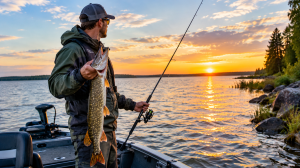
How to Fix the Most Common Pike Fishing Mistakes
The common pike fishing mistakes and how to fix them can be summarized with a simple process: locate the fish, identify their depth, choose a practical lure, control the retrieve, protect your line with a suitable leader, keep hooks sharp, and prepare for safe fish handling.
Do not become overly focused on buying the newest lure. A modest lure presented at the correct depth, speed, and location can outperform an expensive lure fished incorrectly.
Shore Fishing Mistakes to Avoid
- Walking straight to the water. A pike may be right at your feet, so make your first casts from a distance.
- Casting randomly. Fan-cast from one side to the other, or cast and move a few meters each time.
- Choosing short-casting lures. Compact hard baits and jerkbaits cast farther than unweighted soft baits.
- Skipping waders. A decent pair lets you reach spots you otherwise cannot.
- Constant snags. Use weedless lures near cover, and consider slightly thicker line when shore fishing.
Frequently Asked Questions
What is the biggest mistake beginners make when pike fishing?
The biggest mistake is fishing where there are no pike. Location comes first. After that, depth, retrieve speed, presentation, tackle, and lure choice become much easier to optimize.
Fishing too fast, using no leader, dull hooks, fishing the wrong depth and fishing where there are no fish.
What depth should beginners fish for pike?
There is no universal depth. It is usually two to four meters as a useful example when pike are holding deeper, while seasonal conditions can move fish shallower or deeper. Use depth changes, structure, and baitfish activity to identify the strike zone.
How do I stop pike from biting through my fishing line?
Use an appropriate bite-resistant leader. Use a wire leader at least 30 cm long, or a fluorocarbon leader around 1 mm thick for big baits.
It is a starting point and longer leaders for larger baits, while emphasizing that leader thickness should suit the lure and presentation.
What are the best pike lures for beginners?
Simple jerkbaits, soft baits and spoons in the 10 to 20 cm range for beginners rather than immediately using oversized specialist baits. Also, suitable spinnerbaits are practical starting choices.
How should I unhook a pike safely?
Use a landing net and long pliers or a hook-out tool rather than putting your fingers into the fish’s mouth. Keep hook cutters and a first-aid kit available, work carefully, and release the fish promptly after handling.
What depth should I fish for pike?
It depends on the season, but in early fall, 2 to 4 m along weed lines is a strong starting point.
Key Takeaways
-
- Slow down your retrieve, introduce pauses and twitches then let the lure sink to the fish.
- Get your lure into the depth where pike are actually holding.
- Keep lure selection simple instead of chasing expensive trends.
- Use polarized sunglasses to improve visibility and casting accuracy.
- Keep hooks sharp and appropriately sized.
- Use a suitable leader to protect against sharp pike teeth.
- Carry a net, long pliers, hook cutters, and first-aid supplies to unhook pike safely, and put safety first.
- Respect local fishing regulations and water safety.
- Study seasonal movements, structure, baitfish, the right season and time of day.
- Spend more time on the water and learn from both successful and unsuccessful sessions.
- Most importantly, make sure you are fishing where the pike actually are.
- Keep hooks sharp and correctly sized.
Conclusion
Every pike fishing mistake above has a straightforward fix. Pike fishing becomes much easier when you stop looking for one magic lure or secret technique and start paying attention to the fundamentals. Location, depth, retrieve, seasonal behavior, tackle preparation, and safe fish handling all work together.
Slow your retrieve, use the right leader and hooks, find the fish, and prepare to release them safely. Most of all, keep fishing: even a bad day teaches you something.
The most valuable lesson is to keep experimenting. Slow the lure down, change the depth, explore different structures, observe baitfish, and learn from every session.
Even a difficult day can make you a better angler. With enough time on the water, those beginner mistakes gradually become experience and that is when pike fishing becomes even more rewarding.
