

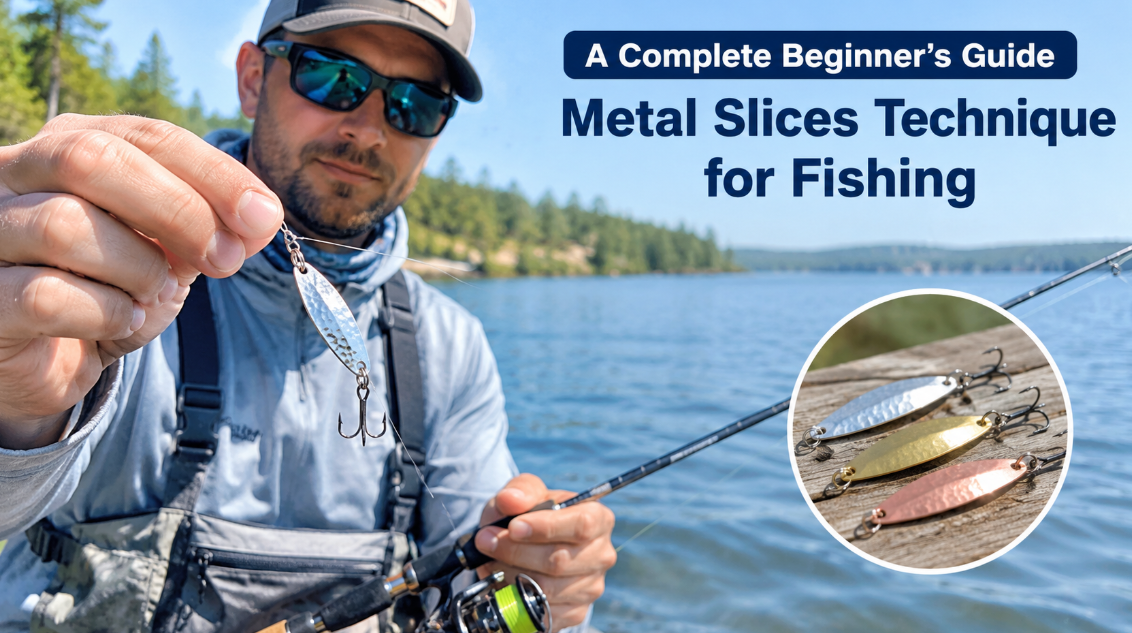
How to Fish Metal Slice Jigs for Beginner`s Anglers
Specially, this is the ultimate metal slices technique for fishing to teach you how to catch more pelagics with the expert tips on retrieve speeds, terminal tackle, sizes, weights, gear selection and common mistakes for pelagics from boat or shore.
Metal slice lures may look simple, but they can be extremely effective when predatory fish are feeding aggressively.
Their compact, weighted design allows long casts, while their reflective surfaces flash and dart through the water like fleeing baitfish.
When tuna, mackerel, salmon, or tailor are hunting, that fast-moving presentation can trigger an immediate strike.
The key to success is understanding when to retrieve quickly, when to let the lure sink, and how to choose the correct size for the fish you are targeting.
This guide explains how to fish metal slice jigs in open water and from the beach, with practical techniques for beginners and experienced anglers alike.
What Is a Metal Slice Jig?
A metal slice jig is a compact, weighted fishing lure made from metal, typically designed to imitate a small baitfish. Its weight helps it travel long distances during casting and sink quickly when fish move below the surface.
Unlike a traditional spoon that may rotate continuously, a metal slice often flashes and moves erratically from side to side. This resembles an injured or fleeing baitfish and can attract predators looking for an easy meal.
Why Use Metal Slice Lures?
The main advantages include:
- Long casting distance: The concentrated weight helps anglers cover distant feeding zones.
- Fast retrieves: Many metal slices can be retrieved quickly while remaining beneath the surface.
- Versatility: They work for surface-feeding pelagics, deeper schools, trolling, and occasional bottom-fishing applications.
- Simple operation: A straightforward cast-and-retrieve approach makes them accessible to beginners.
- Adaptability: Different lure sizes, colors, and retrieve speeds help match changing conditions.
Common targets include tuna, Spanish mackerel, smaller mackerel species, trevally, giant trevally (GT), Australian salmon, and tailor.
Some anglers also use metal slices around bottom structure for species such as coral trout and fingermark.
Why Metal Slices Catch So Many Fish
Metal slices are built for distance and speed. Three features explain most of their success:
- They cast a long way. Their weight lets you reach schools that are well out of range of lighter lures.
- They flash like a fleeing baitfish. That mimics what is happening when bait is trying to escape predators.
- They can be worked very fast. A slice stays just under the surface without constantly leaving the water, which is where you want it.
When fish are feeding aggressively or reacting quickly, they go straight onto a slice. It looks different from the rest of the bait in the school, so predators peel away from the pack and chase it instead.
How to Fish Metal Slice Jigs
The most effective technique to fish metal slice jigs depends on where the fish are feeding. Surface-feeding predators generally respond well to a fast retrieve, while fish holding deeper may require a sinking presentation followed by a rapid upward movement.
1. Fast Surface Retrieve Technique
When predators are visibly chasing baitfish near the surface, speed is your friend.
Follow these steps:
-
- Watch for splashing fish, jumping baitfish, diving seabirds, or other signs of feeding activity.
- Cast beyond the school when possible, or land the lure among the feeding fish.
- Retrieve rapidly and consistently.
- Avoid unnecessary pauses while fish are actively chasing baitfish.
- Keep the rod tip down so the lure does not skip across the surface. Aim to keep it a couple of feet under.
- Let the lure sink, give it a jig or two off the bottom, then retrieve steadily.
- If hits are coming, adjust the speed. In one session, a slower retrieve produced more strikes.
- Fish also grab lures on the drop, so stay alert while it sinks.
- Dawn and dusk are prime, though fish can still be caught in bright midday conditions.
- Carry a light spinning outfit on every beach walk so you are ready when fish show up.
This is one of the simplest metal slice jig retrieve techniques because the lure’s flash and speed create the action. You do not need complicated rod movements when predators are aggressively feeding.
A common mistake is retrieving too slowly and allowing the lure to rise excessively or lose the fleeing-baitfish effect. Practice a fast, controlled retrieve while maintaining contact with the lure.
On the other side, when casting at busting fish, pelagics that are crashing baitfish on the surface will respond. Fish that have gone down a little and are no longer visible usually will not, so get the lure to the school while it is actively feeding
2. Vertical Jigging With Metal Slices Technique
When surface activity disappears, predators may move deeper. If your fish finder shows schools below the boat, vertical jigging can bring the lure directly through their feeding zone.
Sometimes the run slows down and the fish stop crushing bait on top. Spaniards and other mackerel in particular tend to go deep, but you can still see them on the sounder.</p>
Vertical jigging with metal slices works well here. Position over the top of the school, or just up-current, and drop the slice down past the fish to the bottom. Then crank it vertically, really fast. A slice shooting upward past a school is something they struggle to resist. The fish are not switched on at that moment, but a fast retrieve past them triggers a reaction bite.
The process is straightforward:
- Position the boat over or slightly up-current from the fish.
- Drop the metal slice through the depth where the fish are holding.
- Allow it to sink toward the bottom when appropriate.
- Retrieve rapidly upward through the school.
- Repeat at different depths if the first presentation does not produce a strike.
The sudden upward movement can provoke a reaction from predators that are not actively feeding. However, if you intend to spend an entire session targeting bottom fish, a dedicated slow-pitch jig is generally a more suitable primary option.
3. Trolling Metal Slices Technique
Metal slices can also be trolled behind a moving boat. Their side-to-side flashing action imitates a fleeing baitfish without necessarily spinning like a conventional spoon.
In a simple words, unlike spoons, which spin, slices flash erratically from side to side like an injured or fleeing baitfish. That makes trolling metal slices another effective way to find fish
Experiment with trolling speed and lure depth, and follow the manufacturer’s recommendations for your particular lure. The correct presentation depends on the target species, water conditions, and the lure’s design.
Casting Metal Slices From Shore
Beach fishing adds another important skill: finding fish rather than repeatedly casting into unproductive water.
Metal slices are particularly useful from shore because their weight allows long casts across sandbars, gutters, troughs, and deeper water.
Australian salmon and tailor are common targets in the type of surf fishing here.
How to Prospect a Beach
Start by walking along the shoreline and examining the water. Look for:
- Baitfish jumping or scattering.
- Schools of fish moving near the surface.
- Diving birds or surface disturbances.
- Sandbars, deeper gutters, and areas where waves break.
- Changes in water color that might indicate fish or underwater weed.
Polarized sunglasses can help distinguish underwater features. Dark patches may be weed, while moving gray patches may indicate a school of fish. These visual clues are useful but not definitive, so confirm your observations by casting.
When you find a promising area, cast beyond the suspected school and retrieve through it. If there is no activity after several casts, move along the beach and test another location.
Choosing the Right Retrieve From Shore
A fast retrieve is useful when fish are chasing baitfish aggressively. However, beach fishing may require more adjustment than open-water pelagic fishing.
Try this approach:
- Cast beyond the sandbar or visible feeding zone.
- Allow the lure to sink briefly.
- Keep the rod tip low to prevent the lure from skipping excessively across the surface.
- Retrieve steadily, adjusting speed according to strikes and water depth.
If fish are following but not striking, test a different retrieve speed or lure color.
Fish can strike close to shore, so keep retrieving until the lure is nearly at your feet. Do not assume the longest cast will always produce the best results.
Metal Slice Jig Weight Guide: Choosing the Right Size
Choosing the correct lure size is about matching the hatch: making your lure resemble the baitfish that predators are eating.
The metal slice jig weight guide comes down to matching your outfit and matching the bait. Check your rod’s maximum lure weight and stay a little under it. A rod rated to 45 grams works comfortably with a 35 gram lure.
You can apply these following approximate length guidelines.
- Target fish or bait pattern
- Suggested metal slice length
- Tuna feeding on small juvenile pilchards
- Around 2 inches
- Medium mackerel, including spotted and doggy mackerel
- Around 3 inches
- Spanish mackerel and larger GTs
- Around 4–6 inches
These are starting points, not universal rules. Local baitfish sizes and the feeding behavior of your target species should guide your final choice.
What Size Metal Slice for Pelagic Fishing?
If you are wondering what size metal slice for pelagic fishing, the answer is to match the hatch:
- 2 inch slices: tuna like mac tuna and longtails feeding on small juvenile pilchards around 2 inches long.
- 3 inch slices: mid-size mackerel such as spotties, doggies and grays.
- 4 to 6 inch slices: Spaniards and GTs, which follow longer baits like yakkas, pilchards and herring.
If fish are fixated on 2 inch bait and you throw a big slice into them, they will ignore it. Change to the smaller lure.
For larger mackerel and trevally feeding on longer baitfish, a larger profile may be more appropriate.
Using a lure that is much larger than the available bait can cause predators to ignore it. Conversely, an appropriately sized lure can look more convincing among a concentrated school of small baitfish.
Match Lure Weight to Your Rod
Lure length and lure weight are different measurements. Always check the rod’s stated casting-weight range before choosing a metal slice.
For example, the shore-fishing demonstration used a 35-gram lure on a rod rated for a maximum casting weight of 45 grams. That leaves a margin below the rod’s stated maximum. The earlier lure weighed 40 grams.
These are examples from one setup, not universal recommendations. Stay within your rod’s specified casting range and account for the weight of the complete lure rig where applicable.
The Best Tackle Setup for Metal Slice Fishing
A suitable rod and reel help you cast farther, retrieve quickly, and maintain control when a powerful fish strikes.
Rod and Reel
For casting metal slices, the source recommends a graphite rod, braided line, and a high-speed spinning reel.
- Small to medium pelagics: A spinning reel around size 4000–5000 was used in the demonstration.
- Larger pelagics: A size 7000–8000 reel was suggested for larger lures and targets such as Spanish mackerel and GTs.
- Rod selection: Choose a rod that suits the lure weight, target fish, and expected casting conditions.
- Line capacity: Keep the spinning spool adequately filled. An underfilled spool can reduce casting performance and require more handle turns to achieve a comparable retrieve speed.
Reel sizes vary between manufacturers, so use these sizes as starting points rather than strict specifications.
Braid, Leaders, and Swivels
Braided line is useful for long-distance casting and transmitting strikes. In the shore-fishing demonstration, the angler used 20-pound braid with metal lures weighing approximately 35–40 grams.
For smaller pelagics, the offshore demonstration used approximately 80-pound monofilament leader material. Leader requirements vary considerably, so select suitable breaking strain for your target species, main line, local conditions, and tackle.
A small, quality swivel attached ahead of the lure may help reduce line twist over a long session.
When Should You Use Wire Leader?
For fish with sharp teeth, including Spanish mackerel, a short section of flexible seven-strand stainless wire may help prevent bite-offs. The source specifically cautions against stiff single-strand wire because it can restrict lure action.
Choose leader material according to the fish you expect to encounter, and inspect it regularly for abrasion or damage.
Check Your Hooks
Some metal slices come with hooks that may not be strong enough for powerful fish. Inspect the hooks, split rings, and attachment points before fishing, and upgrade weak components to appropriately rated tackle.
Treble hooks offer multiple hooking points, while single hooks may provide a different balance of hookup security, handling, and ease of unhooking. Neither guarantees that fish will stay connected. Whatever hook you choose, maintain steady line pressure throughout the fight.
Color Selection and Reading Water Conditions
Color can make a difference, but it should be tested alongside location, depth, and retrieve speed.
In the beach-fishing here, you can experiment with pink, a more natural baitfish pattern, and white with red. The white-and-red lure produced frequent strikes during one session, especially as the light faded.
That result is useful practical experience, not proof that one color always outperforms others.
Consider the following approach:
- Natural baitfish patterns: A reasonable starting point when matching visible baitfish.
- White or contrasting patterns: Worth testing when light levels change or the water is clear.
- Alternative colors: Useful when you are seeing follows or strikes but want to test another presentation.
If one color produces no action after a reasonable trial, switch and compare the results. Avoid assuming that color alone explains a change in catch rate; fish may have moved or altered their feeding behavior.
Metal Slice vs Blade Bait: What’s the Difference?
The question of metal slice vs blade bait comes up often. Both are metal lures that rely on flash and vibration, but they are used differently.
Metal slices are cast long and retrieved at high speed or dropped vertically for pelagics.
Blade baits, as generally used, are a different style of lure typically worked at slower speeds, so they are not the first choice for fast surface retrieves.
Here, this guide is based on compares slices to spoons: slices flash erratically side to side and do not spin, which is why they suit fast retrieves and trolling.
Eventhough, both are metal lures, but their shape and intended action can differ such as being described in these following lines.
- Feature
- Metal slice
- Blade bait
- General design
- Compact, weighted, often fish-shaped profile
- Thin metal body designed to vibrate or flutter
- Common presentation
- Long casting and fast retrieves
- Often retrieved or jigged with a vibrating action
- Typical applications
- Pelagic predators and surf-casting targets
- Often used for freshwater or deeper structure, depending on design
- Main consideration
- Casting distance, flash, and retrieve speed
- Vibration, depth control, and the lure’s designed action
These are broad distinctions rather than rigid categories. Product designs overlap, and some metal slices can also be jigged vertically or used around bottom structure.
Choose the lure based on the target fish, water conditions, and action you want to create.
Common Metal Slice Mistakes to Avoid
Avoiding a few common errors can improve your fishing efficiency. The most common mistake metal slice anglers make is fishing too slowly.
Here are the common mistakes to avoid:
1. Retrieving Too Slowly
When pelagics are aggressively chasing baitfish, a slow retrieve may fail to trigger the same response. Increase your speed and keep the lure moving consistently. So, you must just be fast and uninterrupted retrieves are what trigger strikes
2. Using an Underfilled Spinning Reel
A low spool can compromise casting distance and make fast retrieves less efficient. Maintain appropriate line capacity and follow the reel manufacturer’s guidance.
3. Choosing the Wrong Lure Size
Oversized lures can be ignored when predators are focused on small baitfish. Match the approximate length and profile of the available prey.
4. Fishing Unproductive Water for Too Long
When shore fishing, prospect different depths and locations. If activity stops, move rather than continuing to cast repeatedly into an empty area.
5. Ignoring Hook Quality
Inspect hooks and connecting hardware before use. Replace weak components with suitable alternatives for your target species.
6. Using Stiff Wire That Restricts Action
When wire is necessary, flexible seven-strand material may allow better lure movement than stiff single-strand wire.
And, using single strand wire restricts the lure’s action
7. Allowing Slack Line During a Fight
Jumping fish can throw a lure when line tension disappears. Maintain steady pressure, manage your drag correctly, and avoid forcing the fish beyond the limits of your tackle.
8. Using Overhead or Baitcasting Gear
You cannot retrieve fast enough or cast far enough.
9. Running a Half-Empty Spool
You have to crank much faster to get the same retrieve speed.
10. Choosing Slices that are Too big
Fish fixated on small bait ignore oversized lures.
11. Leaving Flimsy Factory Hooks on
Upgrade to stronger hooks, as with any lure.
12. Making Slices Your Main Bottom Fishing Method
If you plan to fish the bottom all day, go back to slow pitch jigs.
Slice Jig Fishing Technique for Beginners: A Simple Plan
If you are new to metal slice fishing, keep your first session simple.
- Choose a metal slice that matches your rod’s casting-weight range and the likely baitfish size.
- Use a suitable spinning reel, braided line, leader, and strong hooks.
- Look for feeding activity or promising structure.
- Cast beyond the target area and retrieve quickly when fish are actively feeding.
- If fish are deeper, allow the lure to sink and retrieve upward through their depth.
- When shore fishing, test different beach features and move if the area becomes unproductive.
- Record which lure sizes, colors, depths, and retrieve speeds produce strikes.
Start with the basic retrieve before experimenting with more complicated movements. Consistent observation and small adjustments will teach you more than changing every part of your setup at once.
Frequently Asked Questions
Are metal slice jigs good for beginners?
Yes. A basic cast-and-retrieve presentation is relatively easy to learn. Beginners should start with a lure suited to their rod and practice controlling casting distance, retrieve speed, and line tension.
How fast should I retrieve a metal slice?
Retrieve rapidly and continuously when pelagic fish are actively chasing baitfish. If fishing from shore or targeting less active fish, experiment with a slower steady retrieve and a short sinking phase.
Moreover, you must be a fast, steady retrieve with the rod tip down and to the side. Do not pause or stop when fishing busting pelagics.
Can I use metal slices from the beach?
Yes. Their weight makes them useful for long casts across sandbars, gutters, and deeper water. Walk the beach, watch for feeding fish, and move between promising locations.
Can metal slices catch fish near the bottom?
Yes. They can be dropped through deeper schools or used around bottom structure. For dedicated bottom fishing throughout a session, however, a purpose-designed jig may be more effective.
Plus, you can fish for species such as fingermark and coral trout, but slow pitch jigs are better for all-day bottom fishing.
Should I use a treble hook or a single hook?
Trebles hook fish well but often come out during aerial jumps and head shakes.
Single hooks can reduce injuries and make releasing fish easier, but results vary.
One angler lost a good fish on a single hook even while keeping the line tight. Keep constant pressure on the line when playing fish so they cannot throw the lure.
Both have advantages and limitations. Hook choice depends on lure design, target species, handling preferences, and local rules. Maintain constant pressure during the fight, because either hook style can lose a fish.
What line should I use for metal slice fishing?
Braided line is a useful choice for casting distance and sensitivity. Pair it with a leader appropriate to your target species and conditions, and use flexible wire when toothy fish make it necessary.
Is a metal slice the same as a blade bait?
Not necessarily. Both are metal lures, but their profiles and intended actions can differ. Check the design and recommended presentation of the specific lure you are using.
Can I use a baitcaster?
No. Use high-speed spinning reels for the casting distance and retrieve speed this style needs.
What leader should I use?
About 80 lb mono for smaller slices, and a short length of seven-strand wire for toothy fish like Spanish mackerel.
How heavy should my slice be?
Stay just under your rod’s maximum lure weight. A 35 gram lure suits a rod rated to 45 grams.
Can I fish slices from the beach?
Yes. Cast along sandbars and gutters, look for schools and retrieve with the rod tip down.
Conclusion
The metal slices technique for fishing is simple, but the details matter such as choosing the right lure size, presenting it at the correct depth, and retrieving it at a speed that matches the fish’s behavior.
Use a fast, uninterrupted retrieve when pelagic predators are feeding aggressively near the surface. When fish move deeper, drop the lure through their zone and retrieve it upward. From shore, combine long casts with careful observation, prospecting, and the willingness to move to another location.
Additionally, make sure to match the lure to the baitfish, use the right outfit, retrieve fast, and keep your gear upgraded and properly rigged. Whether you are casting from a boat, dropping vertically over a school or walking a beach, slices give you reach, flash and fast action that fish find hard to ignore.
Key Takeaways:
- Match your lure to the baitfish, not simply the size of the target predator.
- Keep your tackle balanced and your spinning reel adequately filled.
- Use flexible leader materials that preserve lure action.
- Inspect hooks and hardware before fishing.
- Adjust retrieve speed, depth, and color based on actual results.
- Maintain steady line pressure when fighting fish.
- Cast past or into busting schools and retrieve fast with the rod tip down.
- Vertical jig fast when fish go deep.
- Match slice size to baitfish: 2, 3, then 4 to 6 inches.
- Use high-speed spin gear with braid and a full spool.
- Use mono for small fish, a short seven-strand wire trace for toothy ones.
- Upgrade weak hooks and avoid single strand wire.
- Prospect from shore and look for moving grey patches, not weed.
Metal slices are simple lures, but learning when and how to use them makes a real difference. Start with the basics, observe what the fish are doing, and refine your approach with every session.
