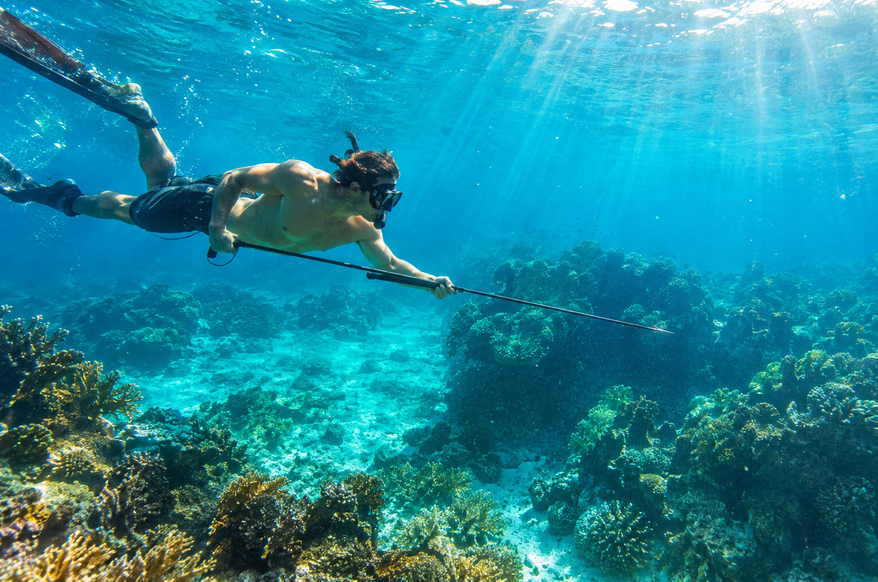
Jumping into the ocean, swimming down and spearing your own fish is one of the best things you can do on the water. In places like the Bahamas, where speargun use is restricted, pole spear fishing is the traditional and most accessible way to do it.
There is something uniquely rewarding about pole spear fishing. Instead of simply watching fish underwater, you become part of the environment, learning to move quietly, read fish behavior, control your breathing, and make a deliberate approach. For beginners, however, success is not simply about buying a spear and jumping into the water.
The right equipment, proper technique, familiarity with your gear, and patience all make a major difference. The original advice behind this guide emphasizes a simple philosophy: become comfortable in the water, understand your equipment, move naturally, and avoid rushing the shot.
These fundamentals are useful whether you are learning around a reef, snorkeling in shallow water, or developing your skills as a dedicated spearfisher.
Whether you are exploring pole spear fishing for beginners or sharpening your form, here is how to get started.
What Is Pole Spear Fishing?
A pole spear is a relatively simple spearfishing tool powered by an elastic band or similar propulsion system. Unlike a conventional speargun, the diver generally holds and loads the spear directly. This makes the technique highly dependent on body position, hand placement, distance, timing, and accuracy.
One advantage of learning with a pole spear is that it encourages you to get close to your target. Try to close the distance rather than rushing toward a fish from far away. When you can clearly identify details around the fish’s eye, face, or markings, you are in a much better position to make a controlled shot.
Is Pole Spear Fishing Legal?
Before start anything, ask the question every responsible diver asks first: is pole spear fishing legal where you plan to dive? The answer depends entirely on your location.
In the Bahamas, spearguns are illegal and divers rely on pole spears and Hawaiian slings. Other regions restrict spearing to certain species, depths, seasons or zones, and some protect popular gamefish completely.
- Check local fisheries regulations for permitted gear, size limits and bag limits.
- Confirm whether spearing is allowed in freshwater, estuaries or marine parks.
- Ask a local dive shop or fisheries office if the rules are unclear.
Beginner Pole Spear Fishing Gear
You do not need a garage full of equipment, but the right beginner pole spear fishing gear makes every dive safer and more comfortable. Work from the top of your body down.
1. Mask and Snorkel
Rule number one is never buy a mask online.
Masks are like shoes: they fit different faces differently. Hold the mask to your face, breathe in through your nose, and if it seals without straps, it is a good candidate. Pair it with a snorkel and you are set.
A mask should create a comfortable seal around your face without requiring excessive strap tension. Pair it with a suitable snorkel and make sure you are comfortable breathing and swimming before attempting to hunt
A properly fitting mask is one of the most important pieces of beginner pole spear fishing gear. Underwater visibility affects every part of the experience, from navigation and fish identification to aiming.
2. Wetsuit and Weight Belt
A good pole spear fishing wetsuit keeps your body warm, which means longer dive times and more comfort in the water. A weight belt lets you be properly weighted, which is essential for relaxed, controlled dives.
Also, the pole spear fishing wetsuit is primarily about warmth, comfort, and extending your time in the water. The appropriate thickness depends on water temperature and local conditions.
Being comfortable matters because cold can distract you and shorten your session. A properly selected wetsuit can help you remain focused on your technique rather than constantly thinking about the temperature.
Proper weighting is another important part of the equipment setup. A weight belt can help a diver achieve appropriate buoyancy, but weighting should be approached carefully and based on local conditions, experience, and proper training.
3. Fins
Fins range from basic plastic models to advanced composite and carbon-fiber designs. Beginners do not necessarily need the most expensive option. The important thing is choosing fins that fit properly and allow efficient movement without causing discomfort.
4. The Pole Spear Itself
Divers using spearguns often recommend buying the best you can afford, because you will use it for years. The same logic applies here. Visit a dive or fishing store where staff can let you handle a few options before you commit.
How to Choose a Pole Spear
Learning how to choose a pole spear comes down to your target fish, your environment and your travel needs. If you want the best pole spear for beginners, prioritize a reliable, mid-length model with a replaceable tip and a comfortable grip.
Important factors include length, construction material, propulsion system, tip design, portability, target species, and your own experience level.
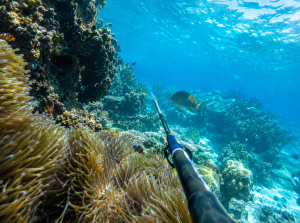
Pole Spear Length
Longer spears can provide additional reach, while shorter models can be easier to handle in confined environments. The best pole spear length for reef fishing depends on the environment, target species, visibility, and your ability to maneuver the spear.
A 6 ft pole spear for snorkeling is easy to handle in shallow water and around structure. For open reef work, the best pole spear length for reef fishing is usually a longer shaft that gives you more reach, as long as you can still control it. A solid pick as the best beginner pole spear for reef fishing balances reach with maneuverability.
However, there is no universal length that works for every diver or location.
Tip Style: Slip Tip, Single Barb or Multi-Prong
A cheap pole spear with slip tip is a practical starter option because a slip tip holds the fish on a cable so it cannot easily slide off the shaft.
When comparing 3 prong vs single barb pole spear setups, remember the trade-off: a single barb penetrates cleanly and suits stoning fish, while a 3 prong pole spear for fishing forgives small aiming errors and works well for flatfish, lobster and small reef species.
Shaft Material
- Fiberglass vs aluminum pole spear: fiberglass is flexible and forgiving, while aluminum is stiff, lightweight and often cheaper. Aluminum construction can provide a durable and familiar option, while fiberglass can offer different handling characteristics. Instead of choosing purely by material, consider the complete spear design and the conditions in which you will use it
- Carbon fiber vs fiberglass pole spear: carbon fiber is lighter and stiffer for faster, flatter shots, but it typically costs more. When comparing a carbon fiber vs fiberglass pole spear, consider the balance between weight, stiffness, durability, price, and intended use. Carbon fiber can offer a lightweight construction with desirable stiffness, while fiberglass is often considered a more accessible material for beginners
- Custom carbon fiber pole spear builder: experienced divers sometimes work with a custom builder to match length, stiffness and handle to their body and style.
Collapsible pole spear fishing can be attractive to divers who prioritize transportation and storage. A breakdown design can make equipment easier to carry, especially when traveling. Check how securely the sections connect and whether the assembled spear maintains the handling characteristics you need.
If you fly or hike to your dive sites, a collapsible pole spear fishing setup breaks down into short sections for easy packing. A travel pole spear for freshwater fishing is ideal for lakes and rivers where permitted, but always confirm local rules first.
Pole Spear Tips: Three-Prong, Single-Barb and Slip Tips
The spear tip is another major consideration when selecting equipment.
1. 3 Prong Pole Spear for Fishing
A 3 prong pole spear for fishing can be useful for certain close-range applications. Multiple points can provide a different approach to securing smaller fish, but the appropriate tip depends on local regulations and target species.
2. 3 Prong vs Single Barb Pole Spear
The 3 prong vs single barb pole spear comparison is largely about intended use, penetration, fish size, and shooting conditions. A three-prong configuration can be useful in situations where a wider point arrangement is desirable, while a single-barb configuration can provide a different penetration and holding profile.
3. Slip Tips
A cheap pole spear with slip tip may appear attractive to buyers looking for additional versatility, but price should not be the only consideration. Check the quality of the tip, connection system, shaft, band, and overall construction before purchasing.
Pole Spear vs Hawaiian Sling
The pole spear vs Hawaiian sling comparison is common among beginners. Both are relatively simple underwater hunting systems, but their operation and handling are different.
A pole spear incorporates the shaft and propulsion system into one tool, while a Hawaiian sling uses a separate hand-held propulsion mechanism. Your choice can depend on comfort, local regulations, target species, and the type of hunting environment you expect to encounter.
Spearfishing Pole Spear vs Speargun
The spearfishing pole spear vs speargun decision is another important consideration. Spearguns can provide greater range and power, whereas pole spears encourage close approaches and can be mechanically simpler.
It is an important location-specific example: the speaker explains that spear guns are illegal in the Bahamas and that pole spears and Hawaiian slings are used there. This should not be interpreted as a universal rule.
Is pole spear fishing legal? That depends on the specific country, state, territory, body of water, protected area, species, season, equipment restrictions, and fishing regulations. Always verify the current local rules before entering the water.
Pole Spear vs Hawaiian Sling vs Speargun
Newcomers often compare options. A pole spear vs Hawaiian sling debate usually comes down to feel: a pole spear has the rubber attached to a fixed grip and shaft, while a Hawaiian sling has a separate shaft and a sling you fire through your hand. For the spearfishing pole spear vs speargun question, a speargun offers greater range and power, but a pole spear is simpler, quieter and often the only legal choice in some regions. It also forces you to get close, which builds real hunting skill.
If you plan to target larger species, a heavy duty pole spear for big fish uses stronger shafts, tougher tips and more robust bands. Treat it as a tool for experienced divers, not a starting point.
How to Use a Pole Spear: Technique That Works
Mastering your weapon is one of the best things you can do to become a better spearo.
1. Loading the Rubber
Slip the rubber over your four fingers, take an overhand grip and an underhand grip, reach for the front of the grip and draw back while giving the rubber a simultaneous quarter twist. If you are using a roller pole spear, draw it straight back without twisting.
2. Aiming and Locking Your Arm
Once loaded, extend your arm, rotate it to lock it in place and keep it high near your eye for good peripheral aim. Dropping the spear low and away from your eye costs you accuracy.
Focus on the fish, not the spear tip, just like focusing on a target rather than the sights of a gun. Keep your arm extended and locked when you release, because this drives the velocity of the spear. Flinching your arm back absorbs power and shortens your range.
3. Carrying and Tracking
- Keep the spear pointed toward the fish and your hand on the rubber in the ready-to-load position.
- Use two hands when tracking a fast-moving fish so you can swing around and lock and load quickly.
- When crawling the bottom, hold the spear like a pool cue on top of your working hand and keep it off the ground to avoid noise.
Know Your Lethal Range
Most pole spears have a lethal range of about three-quarters of their length, and very well-made ones can reach around 95 percent. The best way to learn your range is repetition: take hundreds of practice shots at what you believe is maximum range.
Float Line Setup
Never clip your float line to the back of the spear. It adds drag and undermines the design. Clip it to the rubber instead so the spear stays streamlined. On deeper dives, rest the spear on your hip like a pendulum and let gravity pull it straight down as you streamline your body.
Control Your Power
For long shots on big fish, pull the rubber back to full power. For lobster or small fish up close, pull it back only halfway so you penetrate the target without hammering the tip into the reef.
Three Pole Spear Fishing Techniques Beginners Should Learn
1. Be Non-Threatening
One of the strongest lessons from the source is to avoid appearing aggressive underwater. Fast kicking, sudden movements, and immediately swimming toward a fish can cause it to flee.
Instead, slow down. Move naturally and calmly. The source compares the desired movement to animals that naturally belong in the environment, such as stingrays or turtles.
This principle is especially important for pole spear fishing for beginners because a beginner’s natural reaction is often to rush when a good fish appears. Learning patience can make approaching fish considerably easier.
Kicking down hard with the spear outstretched sends fish running. Approaching slowly, lying on the bottom and letting fish come to you is a game changer.
2. Know Your Gear
Before hunting, spend time becoming familiar with your equipment. Understand how your pole spear loads, how it moves through the water, where your effective range ends, and how it behaves when you fire.
Test your mask before the trip and practice with your spear until you know where it will go when you release. Aim for a spine shot or a spot about an inch behind the eye for a quick.
3. Get Closer Than You Think
Distance is critical with a pole spear. Instead of taking a rushed shot from the edge of your effective range, wait for a better opportunity.
If you can see the details of the fish’s eye, cheek pattern and scarring, you are close enough. If not, get closer. Never rush the shot, and if you are running out of breath, surface and try again.
The source’s practical rule is to get close enough to see detailed features of the fish’s face. If you cannot clearly see those details, you may simply be too far away.
How to Aim a Pole Spear
Proper positioning can improve consistency.
Try to keep the spear relatively high toward eye level and using your peripheral vision to help establish alignment.
When aiming, concentrate on the fish rather than staring at the very tip of the spear. The concept is similar to focusing on a target rather than becoming distracted by the sights or equipment itself.
When swimming, keeping the pole spear oriented toward the direction of the fish can reduce unnecessary movement. The source also describes maintaining the hand in a ready-to-load position so the diver can respond when an opportunity appears.
When a fish moves quickly across your field of view, two-handed control can help with tracking and positioning. The objective is to maintain smooth movement rather than making exaggerated swings.
Knowing your effective range is essential.
Many pole spears have an effective lethal range around three-quarters of the spear’s length, while some well-made models can potentially reach considerably farther.
Pole spear performance varies according to construction, band setup, technique, target, water conditions, and shooting angle.
The best way to understand your own equipment is controlled practice.
Repeated practice shots can help you learn where the spear consistently performs well and where you are asking too much from it.
Anyway, not every situation requires maximum power.
The source describes using more power for longer shots at larger fish and less power when shooting smaller targets at close range.
This is particularly relevant when hunting around a reef. Excessive power at close range can create unnecessary impact against the surrounding environment or damage equipment.
For anyone searching for a heavy duty pole spear for big fish, remember that equipment should match the target species and local regulations. Larger targets may require different spear construction, tip systems, and experience than small reef fish.
The key to use the pole spear is always learn how the band loads, how your grip affects the shot, how your arm position changes accuracy, and exactly how far you can shoot effectively.
The more familiar you become with your equipment, the less attention you need to spend thinking about the mechanics during an actual encounter.
Best Beginner Pole Spear for Reef Fishing
The best beginner pole spear for reef fishing should be manageable, reliable, and appropriate for the fish and environment you are targeting. A maneuverable setup can be particularly useful around structure where a very long spear may become cumbersome.
Pole Spear Fishing for Flounder
Pole spear fishing for flounder requires careful observation because these fish can blend into the bottom. Slow movement and attention to the seafloor are important.
Pole spear fishing for flounder is a classic starting point because flatfish lie still on the bottom and reward a patient approach.
Pole Spear Fishing for Tarpon
Pole spear fishing for tarpon is a different story: tarpon are heavily regulated or protected in many areas, so check local law before even considering it.
Pole spear fishing for tarpon involves a substantially different challenge from hunting smaller reef species. Target size, power requirements, local regulations, and safety considerations should all be evaluated before attempting to pursue larger fish.
Pole Spear Fishing for Blue Marlin
Pole spear fishing for blue marlin is not a realistic or responsible goal for a pole spear; large pelagic gamefish demand specialized gear and experience. Start with reef fish, flatfish and lobster where legal.
Pole spear fishing for blue marlin is an example of a highly specialized scenario rather than a typical beginner application. Large pelagic species involve substantial size, power, environmental, and safety considerations. Beginners should focus on appropriate legal species and controlled environments while developing fundamental skills.
Safety and Ethics
Safety should always take priority over getting a fish. Never rush a shot because you are running out of breath. If you need to surface, surface. The source specifically emphasizes waiting for another opportunity rather than taking an unnecessary risk.
- Check local spearfishing regulations before entering the water.
- Confirm which species, sizes, seasons, and equipment are permitted.
- Never exceed your comfortable breath-hold limits.
- Practice with your equipment before hunting.
- Maintain awareness of other divers, boats, and underwater hazards.
- Use appropriate flotation and line-management equipment where required.
- Avoid damaging coral and other sensitive underwater habitat.
- Never dive alone and always know your limits.
- Surface early if you feel short of breath.
- Follow size and bag limits and respect protected species.
- Aim for clean, quick kills and take only what you will eat.
Frequently Asked Questions
What is the best pole spear for beginners?
The best beginner pole spear option depends on your location, target species, water conditions, budget, and experience. A manageable spear that you can confidently control is generally more useful for learning than simply choosing the most powerful model.
Look for a mid-length spear with a slip tip, a comfortable grip and good build quality. Handle a few in a store if you can.
What is the best pole spear length for reef fishing?
There is no universal best length. Shorter models can be easier to maneuver around structure, while longer models provide additional reach. Choose according to the reef environment, visibility, target species, and your experience.
Is carbon fiber better than fiberglass for a pole spear?
Neither material is automatically best for every diver. Carbon fiber can provide lightweight stiffness, while fiberglass can offer a different balance of durability, flexibility, and cost. Consider the complete spear rather than material alone.
What beginner pole spear fishing gear do I need?
Basic equipment includes a properly fitting mask, snorkel, wetsuit appropriate for the water temperature, suitable fins, appropriate weighting, and a legal pole spear setup. Additional equipment depends on the location and style of diving.
Can I use a pole spear for freshwater fishing?
Potentially, but this depends entirely on local regulations. Some freshwater environments prohibit spearfishing or restrict the equipment and species that may be taken. Always verify the rules before using a pole spear.
Do I need a wetsuit?
In most places, yes. Staying warm gives you longer dives and better comfort.
Should I attach the float line to the back of the spear?
No. Clip it to the rubber to reduce drag and keep the spear streamlined.
Can I buy a mask online?
It is better not to. Try it on and test the seal in person.
Conclusion
Pole spear fishing rewards patience, preparation and respect for the ocean. Get the right gear, learn your local laws, practice until your spear feels like an extension of your arm and approach fish calmly. Do that and you will be eating your own catch sooner than you think.
Also, you must learn to become comfortable underwater with suitable gear, understand how it works, move naturally, approach fish patiently, practice your aim, and know your effective range.
The biggest lesson is patience.
Fish will provide other opportunities, while an unsafe or rushed decision can have consequences. Whether you are researching a best pole spear for beginners, comparing materials, considering a 3-prong setup, or learning how to approach reef fish, build your skills gradually and respect the environment and local regulations.
Master the equipment first, then master your approach. With those fundamentals in place, pole spear fishing can become a rewarding way to experience the underwater environment while developing precision, patience, and confidence.
Key Takeaways
- Check local laws before you dive; rules vary widely.
- Never buy a mask online, and know your gear before the trip.
- Choose your spear by length, tip style, material and travel needs.
- Keep your arm high, extended and locked for accurate, powerful shots.
- Clip the float line to the rubber, not the back of the spear.
- Be non-threatening, get close and never rush the shot.
- Choose equipment based on your environment and experience.
- Make sure your mask fits correctly and practice with your gear before hunting.
- Move slowly and avoid appearing threatening to fish.
- Get closer rather than rushing a long-range shot.
- Keep the spear positioned for effective peripheral aiming.
- Learn your actual effective range through controlled practice.
- Match spear power and tip selection to the intended target.
- Never sacrifice safety because you are running out of breath.
- Always verify current local spearfishing regulations.

One thought on “Pole Spear Fishing: Beginner Guide, Gear & Techniques”