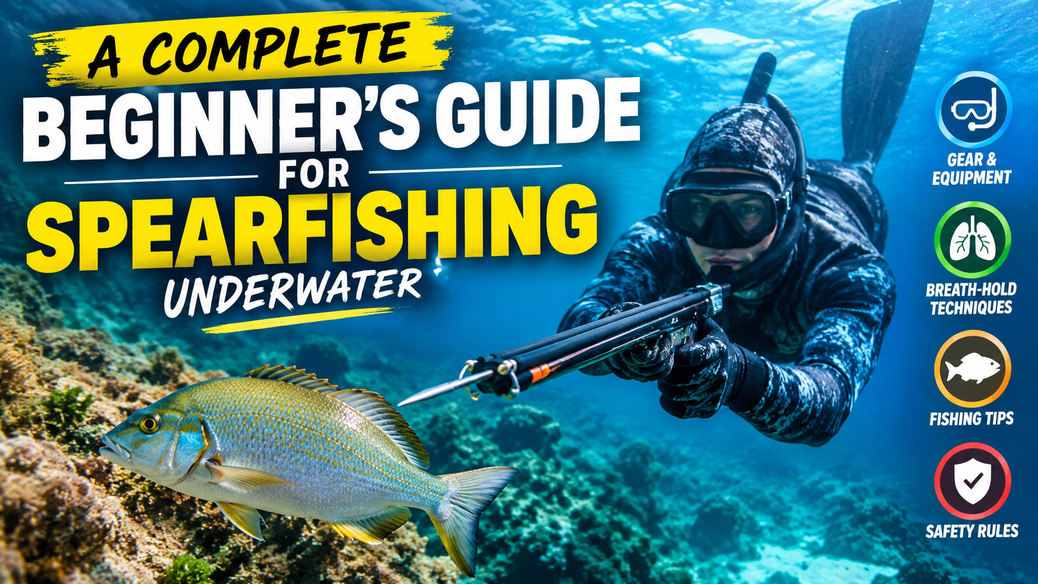
A Complete Beginner’s Guide Spearfishing Underwater: How to Hold Breath Longer
Spearfishing underwater is more than swimming beneath the surface and shooting fish. It requires patience, efficient movement, breath-hold awareness, the right equipment, and a solid understanding of marine conditions.
For beginners, learning these fundamentals: how calm you are, how well your gear fits and how quietly you move can make every dive more comfortable, productive, and enjoyable.
Many new divers make the same mistakes: rushing into the water, kicking too aggressively, buying unsuitable equipment, and trying to stay underwater longer than their experience allows. The good news is that these habits can improve with proper instruction, consistent practice, and a safety-first mindset.
This guide explores the essential techniques behind successful spearfishing, from understanding your body’s response to breath-holding to choosing suitable gear, finding productive reef locations, and handling your catch responsibly.
Here, you will also learn lessons from several experienced spearos, from breath-hold physiology to shallow-water snapper hunting, so you can skip years of trial and error in spearfishing activity
1. Understand Breath-Hold Basics Physiology Before Diving
One of the most important lessons for new spearfishers is understanding what happens inside the body during a breath-hold dive. Your body continues consuming oxygen while carbon dioxide or CO2 accumulates in your bloodstream. These processes create different physiological effects.
Most beginners get into the water, swim hard and feel breathless within seconds. The problem usually isn’t a lack of oxygen. It’s tension.
If you want to hold your breath longer in spearfishing, you first need to understand what happens in your body once you stop breathing
Why the Urge to Breathe Increases
Your body keeps using oxygen while carbon dioxide builds up as a byproduct. For most of a breath hold, the urge to breathe is driven by rising CO2, not by oxygen running out. That is a useful warning, and it is also where the danger lies: oxygen can keep falling without an obvious signal, and if it drops low enough you can black out
As you dive more, your body becomes more tolerant of CO2. That means you can feel comfortable while your oxygen is actually low, so breath-hold diving should never be treated casually and should always be done with someone watching you.
On the other hand, rising CO2 levels contribute to the urge to breathe. You might notice diaphragm contractions, chest discomfort, or an increasingly strong desire to inhale. These sensations are not reliable indicators of how much oxygen remains in your body.
Oxygen levels can fall dangerously low even when you do not feel an overwhelming urge to breathe. This can cause hypoxic blackout, which is particularly dangerous underwater because consciousness can be lost without sufficient warning.
Time in the water is the best training, but pool breath-hold sessions and dry apnea work also help. The goal is not to suffer through a long hold. It is to teach your body and mind to stay relaxed as CO2 rises.
Never Hyperventilate Before a Dive
Rapid or excessively deep breathing before a dive doesn’t load extra oxygen, because the blood leaving your lungs is already highly saturated. Instead, it lowers CO2 levels and can delay the urge to breathe while oxygen continues to decline.
Any list of spearfishing underwater breath hold tips should start here: do not hyperventilate
Never hyperventilate to extend a breath-hold dive. Use comfortable, normal breathing at the surface, and dive only with a properly trained buddy who can actively supervise you and respond to an emergency. Breath-hold training in a pool or open water should never be performed alone.
The Mammalian Dive Reflex
Your body has built-in help. When cold water hits your face, your heart rate can slow, blood flow is prioritized to the brain and heart, and the spleen can release extra red blood cells. These responses are not a free pass to ignore your limits, but they show you are well designed for breath-hold diving, and they become more efficient with time in the water.
2. Spearfishing Underwater Breathing Techniques That Work
Effective spearfishing underwater breathing techniques focus on relaxation rather than forcing longer breath-holds. A calm approach before entering the water can help reduce unnecessary exertion and make your preparation more consistent.
Your breathe-up is not about cramming in oxygen. It is about reaching the calmest, most relaxed state possible, and for many divers that is simply normal tidal breathing.
Among spearfishing underwater breathing techniques, the best one is whichever helps you relax. Every heartbeat and muscle contraction uses oxygen, so a lower heart rate and less tension means you use the oxygen you already have more efficiently
Relax Before Entering the Water
- Allow enough time to prepare your equipment without rushing.
- Use comfortable, normal breathing rather than rapid or exaggerated inhalations.
- Relax your shoulders, jaw, and other muscles that tend to become tense.
- Stay adequately hydrated and prepare for the physical demands of the session.
- Wear an appropriately fitted wetsuit to maintain warmth and comfort.
These spearfishing underwater breath hold tips are about controlling effort, not pushing through discomfort. Never treat chest contractions, dizziness, confusion, or an unusual loss of coordination as challenges to overcome. End the dive immediately when something feels wrong.
How to Hold Breath Longer in Spearfishing
If you want to hold breath longer in spearfishing, develop your skills gradually with qualified freediving instruction. Training can improve relaxation, movement efficiency, and familiarity with the sensations associated with breath-holding. However, increased comfort does not guarantee adequate oxygen levels.
Dry apnea exercises, where appropriate, should follow qualified instruction. Never perform breath-hold exercises in water alone, and do not use maximum-duration attempts as a measure of readiness for hunting. Your priority should always be a safe return to the surface.
3. Master an Efficient Duck Dive and Staying Warm
An efficient duck dive helps you descend with less splashing and unnecessary movement. Beginners often rush their descent, kick excessively, or struggle with their orientation. These actions consume energy and can disturb fish before the hunt begins.
Improve Your Descent
-
- Begin from a stable, comfortable surface position.
- Position your body and legs to initiate a controlled descent.
- Keep movements smooth and purposeful rather than forceful.
- Maintain awareness of your surroundings and your buddy.
- Abort the descent and return to the surface whenever you feel uncomfortable.
- Break the surface cleanly, get your legs up and let momentum and gravity do the work.
- Avoid big rushed breaths, splashing and a hectic descent.
- Stay warm: once you get cold, relaxing becomes difficult and your breath hold suffers.
Experienced divers often use subtle hand movements or carefully controlled positioning near the bottom rather than relying on constant, powerful fin kicks. Keep your fins from flailing against the reef, and avoid movements that stir up sediment or frighten nearby fish.
Remember that efficient movement is not a reason to extend a dive beyond safe limits. Depth, currents, water temperature, and individual experience all affect how demanding a descent can become.
4. Beginner vs Pro Spearfishing Mistakes
The difference between beginner vs pro spearfishing mistakes often comes down to preparation, efficiency, and decision-making rather than breath-hold duration alone.
Beginners may concentrate on shooting fish immediately
Meanwhile, experienced divers tend to pay closer attention to positioning, conditions, and the environment.
Common Beginner Mistakes in Spearfishing You Must Avoid
-
- Rushing into the water: This can cause fatigue before the first dive.
- Using unsuitable equipment: Poor-fitting masks and inappropriate wetsuits create avoidable problems.
- Excessive finning: Aggressive movement wastes energy and disturbs fish.
- Ignoring the weather: Rough seas and strong currents can quickly turn a dive dangerous.
- Repeating the same reef: Excessive pressure on one area can damage local fish populations.
- Comparing performance: Trying to match another diver’s depth or breath-hold can encourage dangerous decisions.
- Orientation: Beginners often descend facing the wrong direction and drift away from where they want to be.
- Crawling the bottom: Stronger divers pull themselves along with a hand instead of kicking, since big leg muscles burn more oxygen and scare more fish.
- Fins: Beginners let their legs splay or their fins flail up. Pros keep fins down and stay low.
- Selectivity: Advanced divers pass on poor shots, wait for another pass and take only what they need.
Habits That Help Divers Progress
Experienced spearfishers tend to plan dives around suitable conditions, work with trusted regular buddies, explore responsibly, and recognize when to stop. They also understand that a successful outing does not require bringing home the biggest fish.
Progress takes time. Learn from mistakes, seek feedback from experienced divers, and prioritize good decisions over impressive underwater performances.
5. Choose the Right Spearfishing Equipment
Suitable diving equipment improves comfort and helps you manage common challenges in the water. Invest in reliable essentials before spending money on specialized accessories.
Mask, Fins, and Wetsuit
A well-fitting mask is essential. The best low volume dive mask for underwater spearfishing is not necessarily the most expensive option; it is one that seals comfortably, offers appropriate visibility, and suits your face. Try different models at a dive shop whenever possible.
Freediving fins are designed for efficient movement during breath-hold diving. Models with replaceable blades can also offer flexibility when upgrading equipment later. Choose a properly fitted wetsuit that provides suitable thermal protection without restricting movement.
- Wetsuit: If you will be in the water for hours, a proper open cell spearfishing wetsuit keeps you warm and stops chafing.
- Mask: Make sure try masks on in a dive store before making any purchase. The best low volume dive mask for underwater spearfishing is the one that seals on your face without leaking.
- Fins: Choose freediving fins, not scuba or snorkeling fins. Removable blades let you upgrade later and keep your foot pockets.
Spearguns and Pole Spears
Choose your hunting tool according to local regulations, target species, water conditions, and your experience. The best beginner pole spear for clear reef water should be manageable, appropriate for legal target species, and easy to control under qualified supervision. Plus, it must be a simple, short setup that lets you practice close-range stalking
For anyone researching compact pneumatic speargun for murky water tips, remember that reduced visibility is primarily a reason to reconsider whether the dive should proceed. A compact speargun does not make poor visibility safe. If you cannot clearly identify your target and what lies beyond it, do not shoot. Additionally, this compact pneumatic speargun must be short shots, a handy size and getting close, since you can’t see far. A light, maneuverable gun also matters in shallow kelp, where you may have to hold it out of the water.
Never load or unload a speargun underwater unless you have received appropriate training and the manufacturer’s procedure specifically permits the action. Understand the safety mechanism, keep the weapon pointed away from people, and never point it at anything you do not intend to shoot.
Float Lines and Weight Belts
A clearly visible spearfishing float can help surface users and boat operators identify your location. It may also provide a place to secure equipment, subject to the float’s design and local practices.
The best spearfishing float line length for reef hunting depends on the terrain, expected depth, current, equipment setup, and local hazards. Select a line that suits the location without creating excessive tangling or entanglement risks.
When learning how to choose spearfishing weight belt quick release systems, look for a belt you can drop instantly with one hand, because that is a key safety feature. A float makes you visible to boats and mates, gives you somewhere to rest and stores your fish in the water. As for the best spearfishing float line length for reef hunting, it depends on your depth and the structure around you, so ask local divers and keep the line manageable around ledges and kelp Weighting must be appropriate for your exposure suit and diving conditions.
6. Shallow Water Spearfishing Tips and Techniques
Shallow reefs can be rewarding places to learn because they offer opportunities to observe fish behavior and practice positioning without automatically requiring deep descents. However, shallow water is not risk-free. Waves, surge, sharp reef structures, boat traffic, and currents can all present serious hazards.
These shallow water spearfishing tips and techniques come from a diver hunting snapper in just 2 to 5 metres of water.
Improve Your Approach
- Choose a location with suitable sea conditions and safe entry and exit points.
- Observe fish behavior before moving closer.
- Keep fin movements controlled and avoid stirring up the seabed.
- Maintain awareness of your buddy and the direction of the current.
- Respect marine protected areas, minimum sizes, bag limits, and seasonal restrictions.
How to Approach Fish While Spearfishing Underwater
Knowing how to approach fish while spearfishing underwater means being quiet and slow, and creating a low silhouette that is hard for the fish to identify.
- Barely fin, so you don’t spook anything ahead of you.
- Pop your head in and out of the water to navigate.
- Don’t take low-probability shots. Leave the fish and keep quiet.
- Shoot from the surface when the fish is shallow enough.
- Stay low in the kelp for species like butterfish, which often pop out of the weed.
When learning how to approach fish while spearfishing underwater, patience is more valuable than speed. Observe how fish react to movement, maintain a controlled position, and avoid chasing animals across the reef. Never compromise safe breath-hold limits to obtain a closer shot.
Look for a mix of terrain. Solid white rock or solid kelp makes fish hard to find, but kelpy rock surrounded by a barren patch is a likely spot for a snapper to park up. White rock also reflects a lot of light, and fish tend not to sit still over it
7. Weather, Visibility, and Reef Scouting
Good planning begins before you reach the water. Swell, wind, tides, currents, and visibility can determine whether a location is suitable for diving. Conditions can change quickly, so check reliable marine forecasts and local warnings before leaving shore.
Spearfishing in Low Visibility Water Tips
In one algae bloom, the diver became a dark, indistinguishable silhouette on the surface, zigzagged the coastline to cover ground and still took fish. These spearfishing in low visibility water tips come down to staying quiet, covering more ground and using the poor visibility to your advantage, since snapper tend to like it
When visibility decreases, identifying fish, assessing distance, and maintaining awareness of other divers become much harder. The safest option is generally to postpone the dive or select a location with clearer water. Never shoot at indistinct shapes or rely on a powerful speargun to compensate for poor visibility.
Find New Locations Responsibly
Maps and satellite imagery can help you identify potential reef structures and access points. However, underwater conditions may differ significantly from what appears on a map. Verify access permissions, marine restrictions, local hazards, and conditions before entering the water.
Explore different legal locations rather than repeatedly placing pressure on a small reef. Keep a respectful attitude toward other divers’ hard-earned knowledge and avoid sharing sensitive locations that could attract unsustainable fishing pressure.
On the other side, always check swell, wind and tide. Offshore winds, which blow from land to sea, help flatten the swell, while big tide changes can create strong currents that pull you out to sea. Weather apps are helpful but not always accurate
8. How to Spearfish From Shore Without a Boat
If you are wondering how to spearfish from shore without a boat, start by scouting.
Satellite maps show where reefs sit along your coastline, which is typically where fish hang out. Rotate between spots rather than hammering one reef, to avoid pressuring the fish life, and always check your local laws on where spearfishing is allowed. Joining a local club can also fast-track your learning.
Shore-based spearfishing can be a practical way to explore suitable coastal locations without owning a boat. However, successful shore access requires careful planning and an honest assessment of your swimming ability and the conditions.
- Choose a legal location with safe access and a manageable return route.
- Check swell, wind, tide, currents, and visibility before setting out.
- Use a suitable float and required diver-down signaling equipment.
- Dive with a trained buddy and establish clear communication procedures.
- Keep your equipment secure and avoid locations with dangerous surf or heavy boat traffic.
- Turn back if conditions deteriorate, even if you have not caught a fish.
Never assume a short swim makes a location safe. Strong currents and changing surf can make returning to shore significantly harder than entering the water.
9. How Deep Can You Spearfish Safely?
There is no single depth that is safe for every spearfisher. The answer to how deep can you spearfish safely depends on training, experience, environmental conditions, physical readiness, and the ability to recover safely at the surface.
Beginners should learn with a qualified freediving instructor in controlled conditions and avoid attempting depth records while hunting. Never descend simply to match another diver. Increasing depth can increase physiological demands and the risk of hypoxia, pressure-related injury, and loss of consciousness.
How to Equalize While Spearfishing
Equalization helps balance pressure in the ears and other air spaces as you descend. Learn appropriate equalization techniques from a qualified instructor, equalize early and gently, and never force through pain. If equalization fails, stop descending and return to the surface safely. Do not dive with congestion or other conditions that prevent comfortable equalization.
10. Essential Spearfishing Safety Rules for Beginners
Spearfishing combines breath-hold diving with a loaded hunting tool, making safety procedures essential. Every dive should begin with preparation, communication, and a clear plan.
-
- Never dive alone; use a trained buddy who actively supervises your dives and understands freediving rescue procedures.
- Never hyperventilate before breath-hold diving.
- Do not push through strong urges to breathe, dizziness, confusion, or unusual discomfort.
- Use appropriate exposure protection and correctly fitted equipment.
- Understand safe speargun handling and keep the muzzle pointed away from people.
- Check local fishing regulations and identify your target species correctly.
- Monitor changing sea conditions and establish clear turnaround criteria.
- Stop diving when tired, cold, unwell, or unable to maintain safe coordination.
- Push your limits only when your buddy is focused on you.
- Take your time, stretch your legs and hydrate to reduce cramping.
- Use a float so boats and buddies can see you.
- Land big fish quickly, since sharks may be nearby, and be careful of spear tips when handling a speared fish.
A float and visible signaling equipment can improve your visibility to surface traffic, but they do not replace a trained buddy or appropriate supervision. Build your skills through recognized training rather than experimenting with maximum-depth or maximum-duration dives.
11. How to Clean and Prep Fish After Spearfishing
Handling your catch properly is the final part of a responsible spearfishing trip. Good food hygiene helps preserve quality and reduces the risk of foodborne illness.
Knowing how to clean and prep fish after spearfishing keeps the meat fresh. Bleed the fish once you shoot it, then remove the guts. With butterfish especially, do this in the water rather than bringing a mess back to the boat. Keep fish in your float or esky, and check size against a measuring decal where one is available
- Confirm that the species is legal to keep and meets applicable size and catch limits.
- Handle the fish carefully and avoid contact with sharp fins, teeth, and the speargun shaft.
- Keep the catch cool promptly using clean ice and a suitable insulated container.
- Clean and fillet the fish with clean hands, utensils, and a suitable preparation surface.
- Remove unwanted tissue and bones carefully, and inspect the flesh for any visible damage or parasites.
- Store the fish at a safe temperature and cook it thoroughly according to food-safety guidance.
Different species have different handling requirements, and some reef fish may carry ciguatoxins in affected tropical and subtropical regions. Cooking does not reliably destroy these toxins. Check local advisories before eating unfamiliar reef species.
12. Learn, Practice, and Become a Better Spearfisher
Consistent practice, good preparation, and time spent observing the underwater environment are central to improvement. Joining a reputable spearfishing club or training group can help beginners learn from experienced divers, understand local conditions, and develop sustainable hunting habits.
Experienced divers can also benefit from reviewing their decisions, refining their equipment setup, and seeking feedback. The goal is not to imitate another person’s performance but to develop reliable skills suited to your own experience.
Frequently Asked Questions
1. What is the most important skill for beginner spearfishers?
Safety awareness is the most important foundation. Beginners should learn buddy procedures, relaxed preparation, efficient movement, equipment handling, and local regulations before attempting challenging dives.
2. Can practicing breath-holding make spearfishing safer?
Qualified, progressive training can improve technique and comfort, but it does not eliminate blackout risk. Never hyperventilate or practice breath-holding in water alone.
3. Is shallow water better for beginners?
Suitable shallow locations can provide useful learning opportunities, but they can still have dangerous currents, surge, surf, and underwater obstacles. Choose conditions appropriate to your training and experience.
4. Do I need a float for spearfishing?
A suitable float can improve visibility and provide a place to secure certain equipment. Follow local signaling requirements and remember that a float does not replace active buddy supervision.
5. What should I check before going spearfishing?
Check marine forecasts, swell, wind, tide, currents, visibility, access restrictions, fishing regulations, equipment, and your buddy’s readiness. Cancel or change plans if conditions are unsuitable.
6. How to load a speargun underwater safely?
The safest approach to how to load a speargun underwater safely is to follow the manufacturer’s instructions, keep the tip pointed away from yourself and your buddy and load only when you are ready to hunt. Many divers prefer to load at the surface, so get coaching from an experienced diver or club first.
7. How to equalize while spearfishing?
Learning how to equalize while spearfishing means gently clearing your ears as you descend, early and often, rather than waiting for pain. Relaxation helps here too, and a freediving course is a good way to learn it properly.
8. How can I hold my breath longer in spearfishing?
Focus on relaxation, a calm breathe-up, an efficient duck dive and consistent training in the water, a pool or dry apnea sessions.
9. Is hyperventilating before a dive safe?
No. It removes CO2, which delays your warning signal while oxygen is still being used.
10. What spearfishing`s gear should a beginner buy first?
A proper wetsuit, a mask that fits your face, freediving fins and a float.
11. Can I spearfish without a boat?
Yes. Scout reefs along your coastline, check local regulations and consider joining a club.
12. How do I find fish in shallow water?
Look for changes in terrain, such as kelp meeting white rock, and approach slowly and quietly.
Conclusion: Key Takeaways for Spearfishing Underwater
Successful spearfishing underwater is built on patience, sound judgment, efficient movement, and respect for the marine environment. Understanding breath-hold physiology helps explain why relaxation matters, but it also shows why discomfort cannot be used as a reliable measure of oxygen availability.
Before focusing on catching more fish, learn safe freediving practices, choose properly fitted equipment, study local conditions, and practice with qualified supervision. Avoid hyperventilation, never dive alone, and never push beyond your training.
Key takeaways:
-
- Prioritize safety and active buddy supervision on every dive.
- Use normal, relaxed breathing and never hyperventilate and never dive alone.
- Improve movement efficiency without extending dives beyond safe limits.
- Choose appropriate gear and learn correct equipment handling.
- Study weather, currents, visibility, and legal fishing areas.
- Respect marine ecosystems and handle your catch responsibly.
- Relaxation extends your breath hold more than extra oxygen does.
- Invest early in a good wetsuit, mask, fins and float.
- Move slowly and quietly, and stay low in shallow water.
- Read swell, wind and tide before every dive.
- Be selective, take only what you need and care for your catch.
Spearfishing underwater rewards patience, preparation and calm. Efficient breathing, reliable gear, smart scouting and strict safety habits matter far more than expensive equipment or trophy fish. Take your time, learn from experienced divers and enjoy your own journey.
With consistent learning and responsible decisions, you can develop your spearfishing skills while protecting yourself, your dive partners, and the underwater environment.
