

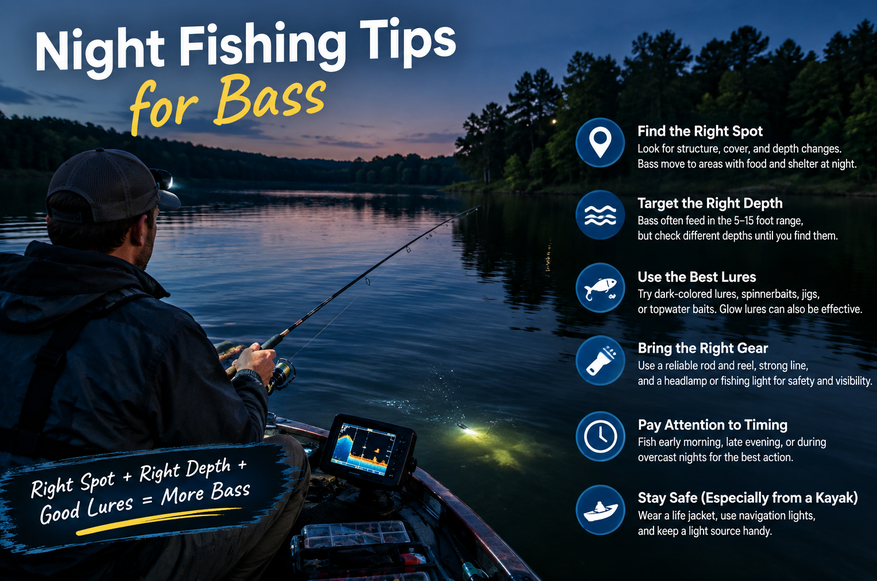
Night Fishing for Bass: 10 Mistakes to Solve Based on Experience
Night fishing for bass can completely change the way you approach a lake, pond, or reservoir. In the night, reduced visibility makes it harder to watch your lure, identify subtle bites, and judge exactly where you’re casting. But darkness does not mean bass stop feeding. Instead, successful anglers rely more heavily on location, depth, retrieve speed, lure vibration, and careful observation.
The most useful lesson from beginner fishing is simple: when nothing bites, don’t immediately blame your rod or lure. The problem may be your location, presentation, depth, or failure to recognize a bite. The same troubleshooting approach becomes especially valuable after dark.
Here are 10 common mistakes to avoid when learning how to catch bass night fishing.
1. Bringing Too Much Gear Without a Starting Setup
A large tackle box may look like preparation, but too many choices can make night fishing unnecessarily complicated. In darkness, changing hooks, weights, colors, and lures constantly can prevent you from learning what is actually working.
Start with one dependable rod and reel combination, manageable line, pliers, a small selection of proven bass lures, and basic safety equipment. Your objective is to understand how your setup behaves before adding more variables.
Build a Simple Night Fishing Setup
- Medium or medium-heavy spinning or baitcasting rod
- Matching reel with a properly adjusted drag
- Appropriate bass fishing line
- Several proven night-friendly lures
- Long-nose pliers or hook-removal tool
- Headlamp or hands-free fishing light
- Landing net when appropriate
- Required license and safety equipment
A simple setup also makes it easier to detect unusual line movement. So you must learn one familiar setup instead of constantly switching between unfamiliar combinations.
2. Choosing the Wrong Lure Size
Bigger does not automatically mean better. A common beginner mistake is assuming a larger lure will always attract larger bass. In reality, lure size should match the forage, conditions, water clarity, and feeding behavior you encounter.
When researching the best bass lures for night fishing, look for presentations that bass can detect through vibration, movement, silhouette, or water displacement. Spinnerbaits, buzzbaits, soft plastics, jigs, and selected topwater lures can all have applications after dark.
What Is the Best Bait for Night Fishing Bass?
The best bait for night fishing bass depends on conditions rather than one universal choice. A soft plastic can provide a subtle presentation, while a spinnerbait can create vibration and flash. A topwater lure can be useful when bass are actively feeding near the surface.
If you are receiving repeated taps without hooking fish, consider whether the lure is too large or whether you are reacting too quickly. Well, you must try making the bait smaller before replacing the entire setup.
3. Ignoring Your Knot and Line
A perfect cast and productive location mean very little if your knot slips or your line has been damaged. Night fishing makes this particularly important because you may not notice abrasion until the fish is already hooked.
Before casting, inspect the final section of line for nicks, rough spots, flattening, or other damage. Pull firmly on the connection to make sure it is secure.
Check Your Line Before the First Cast
- Inspect the last several feet of line.
- Retie after significant abrasion.
- Test your knot with steady pressure.
- Keep pliers accessible.
- Replace damaged line instead of gambling on it.
Always make sure to test the connection and checking for line damage caused by rocks, wood, or other cover.
4. Fishing Convenient Water Instead of Productive Water
This is one of the most important night fishing for bass tips: don’t choose a location simply because it is easy to reach. Bass are not distributed evenly throughout a body of water.
Instead, look for places that give bass a reason to be there. Weed edges, docks, fallen trees, points, drains, drop-offs, current breaks, and areas where shallow and deeper water meet can all deserve attention.
Look for Food, Cover, and Depth Changes
Ask yourself: Why would a bass stop here? If you cannot identify food, cover, a depth change, current relief, or another reason for fish to use the area, consider moving.
For you to note that fish tend to gather around features that provide food, cover, protection, or access to different depths.
5. Walking Directly to the Water and Spooking Fish
Darkness can make anglers feel hidden, but bass can still detect movement and disturbances around shallow water. Walking loudly along the bank or shining bright lights directly across productive shallow areas can reduce the stealth advantage you are trying to create.
Stop several steps away from the edge and observe first. Make an initial cast before walking right up to the shoreline.
This is particularly useful when night fishing for largemouth bass around shallow cover. Bass may move surprisingly close to shore, so the water immediately in front of you should not automatically be ignored.
6. Casting Randomly Instead of Covering Water Systematically
Long casts are not always the answer. At night, accuracy and systematic coverage can be more important than trying to reach the opposite side of the lake.
Imagine the water in front of you as a clock face. Cast slightly left, straight ahead, and slightly right. Then repeat those angles at different distances. This fan pattern prevents you from repeatedly fishing the same lane.
When fishing a dock, weed edge, or fallen tree, consider casting beyond the target and retrieving alongside it. This can keep your lure in the productive zone for longer.
Record Productive Casts
If a bass strikes at a particular angle, distance, depth, or cover type, repeat that presentation before immediately exploring somewhere else. You must remember the angle and distance of successful casts because fish may group around the same small piece of cover.
7. Changing Lures Instead of Changing Depth and Speed
One of the most valuable lessons for how to night fish for bass is that lure color is not always the first variable to change. A bass can be nearby without being willing to chase a lure presented above or below its feeding zone.
Start with a controlled retrieve. Experiment with pauses and different depths rather than changing everything simultaneously.
What Depth Do Bass Feed at Night?
There is no single universal answer to what depth do bass feed at night. Bass may move shallow to feed, remain around vegetation or structure, or suspend at different depths depending on forage, water temperature, weather, and the specific lake.
Instead of assuming a particular depth, systematically test the water column. If a sinking lure never contacts vegetation, rocks, or bottom, allow it to sink longer. If it constantly snags, shorten the count or choose a higher-running presentation.
At this point, you must firstly test depth before speed and change one variable at a time.
8. Watching the Scenery Instead of Your Line
One of the hardest parts of night fishing is detecting subtle bites when you cannot clearly see the lure. A bass may not produce a dramatic rod-bending strike.
Watch where your line enters the water. A twitch, sideways movement, unexpected tightening, or unusual pause during the fall can provide important information.
Keep enough contact with the lure to detect changes without completely eliminating its natural movement. It means that any unexplained line movement deserves attention, even though it does not automatically mean a fish.
9. Setting the Hook Too Soon or Too Hard
Once you detect a bite, your hook-setting response should match the lure and hook system. Do not automatically make a huge overhead hook set every time you feel contact.
With a moving lure, continue reeling until the rod begins to load, then apply firm pressure. With a worm or other presentation, allow enough time to establish contact before reacting.
Keep Pressure on the Fish
After the bass is hooked, the goal changes from detecting the strike to maintaining consistent pressure. Keep the line tight, allow the drag to work when necessary, and guide the fish away from weeds, branches, and dock posts.
Avoid pointing the rod directly at the fish because doing so reduces the rod’s ability to absorb sudden movements. When the fish reaches the bank, keep it in the water until you are ready to land it.
10. Staying in an Unproductive Spot Too Long
Persistence is useful, but repeatedly making the same unproductive cast is not a strategy. Instead, use an adjustment ladder.
- Cover the location with purposeful casts.
- Change the depth.
- Change the retrieve speed.
- Try a genuinely different presentation.
- Move to another piece of promising cover.
If there are no signs of baitfish, surface activity, follows, taps, or other evidence of life, consider moving. Here, moving is not admitting defeat but it is to test the next likely location.
Choosing Lures for Night Bass Fishing
When building night fishing gear for bass, prioritize a small group of lures that cover different presentations rather than carrying every lure you own.
Best Color Lure for Night Bass Fishing
There is no universally guaranteed best color lure for night bass fishing. Dark silhouettes can be useful against a night sky or surface, while other colors may be appropriate depending on water clarity and available light.
Related to this, natural colors and quieter movement can make sense in clear water, while stronger silhouettes, vibration, or brighter accents may help in dirty water. These are starting principles rather than guarantees.
Best Black Spinnerbait for Night Fishing
When searching for the best black spinnerbait for night fishing, focus on a model that produces the vibration and profile you need while matching the depth and cover you are targeting. Black or dark spinnerbaits are often considered for their strong silhouette in low-light conditions, but retrieve speed and location remain critical.
Best Topwater Lure for Night Bass
The best topwater lure for night bass is ultimately the one that creates an appropriate surface presentation for the conditions. If bass are actively feeding near the surface, a topwater presentation can be worth testing. If they are holding deeper, changing to a subsurface or bottom-oriented presentation may be more productive.
Best Plastic Worm for Night Bass Fishing
A soft plastic worm is another versatile option when bass are not aggressively chasing moving lures. The best plastic worm for night bass fishing should be selected according to the cover, depth, rigging method, and presentation you intend to use rather than simply choosing the largest worm available.
Glow in the Dark Lures for Night Bass
Glow in the dark lures for night bass can be considered when visibility is extremely limited, but glowing properties should not replace good location and presentation. If the lure is being fished through empty water, increased visibility alone is unlikely to solve the fundamental problem.
Night Fishing Lights and Safety
Lighting is an important part of your night fishing equipment. A headlamp can help with tying knots, landing fish, handling tackle, and moving safely along the bank.
A submersible fishing light for bass may also be useful in specific fishing situations, but lighting equipment should be used according to local regulations and the conditions of the water you are fishing. Do not assume that adding light automatically attracts bass or creates a productive fishing spot.
If you’re fishing from a kayak, visibility and safety become even more important. When learning how to night fish for bass from a kayak, carry appropriate navigation and personal safety equipment, maintain awareness of other watercraft, and avoid unnecessary movement in unstable conditions.
When Is the Best Time to Fish for Bass at Night?
The best time for night fishing bass varies with season, water temperature, forage activity, weather, and the individual body of water. Rather than relying on a single clock time, pay attention to transitions and signs of feeding activity.
In line with this, always treat every bite as a clue. If bass strike after a particular sink count, near a specific type of cover, or during a particular retrieve speed, repeat that pattern.
A Simple Night Bass Fishing Troubleshooting System
When the bite disappears, resist the urge to change everything at once. Use this sequence:
- Location: Is there food, cover, current relief, or a depth change?
- Depth: Is your lure actually reaching the likely feeding zone?
- Speed: Is your retrieve too fast or too slow?
- Presentation: Would a different lure type make sense?
- Color: Only now consider changing the lure’s color or profile.
- Location again: If the area shows no signs of life, move.
The core troubleshooting rule here: location first, depth second, speed third, and lure details last.
Night Fishing for Bass FAQs
Is night fishing good for bass?
Night fishing can be productive when bass are using shallow areas, cover, structure, or feeding zones. However, success depends on conditions and location rather than darkness alone.
What is the best bait for night fishing bass?
There is no single best bait for every situation. Soft plastics, spinnerbaits, jigs, and topwater presentations can all have applications. Choose according to depth, cover, forage, and bass activity.
What color should I use for bass at night?
Dark silhouettes are commonly considered for low-light conditions, but water clarity and lure action matter as well. Try treating color as a later adjustment after location, depth, and speed have been tested.
What depth do bass feed at night?
Bass can feed at different depths at night. Rather than assuming one depth, test shallow water first when conditions suggest bass may be moving up, then systematically explore deeper zones.
What gear do I need for night bass fishing?
A dependable rod and reel, appropriate line, a small lure selection, pliers, a headlamp, landing equipment when appropriate, and required safety equipment form a practical starting point. The exact setup should match your fishing location and target species.
What is the best bait for night fishing bass?
Noisy, dark baits are the safest starting point. Buzzbaits, spinnerbaits, chatterbaits, and dark plastic worms all give bass something to locate by vibration. The best bait for night fishing bass is the one you can fish confidently and slowly.
How do I catch bass night fishing as a beginner?
Learn how to catch bass night fishing by simplifying: one setup, a tested knot, a quiet approach, and a spot with food or cover. Then follow the adjustment ladder rather than changing everything at once.
Do I need special lights for night bass fishing?
You need a reliable headlamp, ideally with a red mode, and any lights your local boating rules require. Extras such as a submersible fishing light for bass are optional and may be restricted in some areas.
Is night fishing for bass safe?
It can be, with preparation. Tell someone your plan, wear a life jacket on the water, carry a charged phone, and scout the spot in daylight if you can.
Are glow in the dark lures worth buying?
They can be a useful test on very dark nights, but they are not a requirement. Start with a black or dark lure and add glow only if you want to experiment.
Key Takeaways for Night Fishing for Bass
Successful night fishing for bass is less about owning secret tackle and more about having a repeatable process. Start with a simple setup, choose water that gives bass a reason to be there, and make controlled casts instead of randomly covering the lake.
When nothing happens, do not immediately change lure colors. Test location, then depth, then speed, and finally presentation details. Watch your line carefully because subtle movements can reveal bites that you cannot see in the darkness.
Most importantly, treat every strike as information. Remember the angle, depth, retrieve speed, and type of cover that produced the bite. A short note after each trip can turn future night fishing trips into a process based on evidence rather than guesswork.
You do not need perfect gear or a giant tackle box. You need a clear reason for every cast and a calm method for deciding what to change next.
- Start with one familiar setup instead of a full tackle box.
- Use smaller baits when you get taps without hookups, and test your knot and line by feel.
- Fish structure, shade, lit docks, and windblown banks, not just convenient water.
- Approach quietly and cover water with organized fan casts.
- Choose noisy, dark lures and change depth before speed, and speed before color.
- Set the hook on weight, keep pressure steady, and always follow local rules.
- Remember: location, depth, speed, then lure details.
Conclusion
Night fishing for bass is less about secret gear and more about a clear reason for every cast. Prepare simply, approach quietly, choose water that gives fish a reason to be there, and adjust in order. Do that, and the dark becomes an advantage instead of an obstacle.
