Spinning Reel Type Explained and How to Use It Correctly: Beginner Guide
Understanding spinning reel type and how to use it can make fishing easier, more enjoyable, and more productive. Whether you are a beginner learning to cast or an experienced angler targeting larger fish and saltwater species, choosing the right reel and mastering its controls are essential skills.
Fishing reels come in several designs, including spinning, spincast, baitcasting, conventional, fly, centerpin, underspin, and specialized surf reels.
Every type of spinning reel has particular strengths and limitations. However, the spinning reel remains one of the most versatile options because it handles lightweight lures, live bait, freshwater species, and many saltwater applications.
In this guide, you will learn how different fishing reels work, how to use a spinning reel correctly, how to select the right size, and how to adjust drag and gear ratio, so you can pick the right reel and avoid the mistakes that wreck gear and tangle line.
1. Types of Fishing Reels and How to Use Them for Beginners
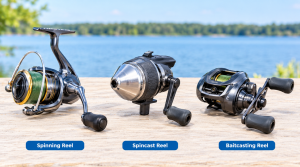
The types of fishing reels and how to use them for beginners come down to three main designs: spinning, spincast and baitcasting. Each hangs on the rod differently and casts differently.
1a. Spinning Reels
A spinning reel hangs underneath a spinning rod. Its spool remains stationary during casting while the line comes off the spool in loops with almost no resistance. When you turn the handle, the rotor and bail rotate around the spool to retrieve the line.
That is why spinning reels excel with light lures, finesse rigs and live bait. They are inexpensive, easy to use and give you long, accurate casts and a smooth drag
Spinning reels are popular because they are relatively easy to operate, cast lightweight lures effectively, and offer smooth drag systems. They are suitable for everything from small panfish and trout to bass, catfish, and many inshore saltwater species.
1b. Spincast Reels
Spincast reels are the cheapest type and the least durable, called closed-face reels, that also have a protective cover over the spool keeps dirt out, but it also traps moisture from wet line, which can rust internal parts.
Also, spincast reels use a push button to release the line in which this kind of spinning reels are straightforward for beginners and help reduce many common casting tangles.
They sit on top of a casting rod and work best with line up to about 10 lb.
Their enclosed design introduces additional friction, which can reduce casting distance. Many entry-level models are best suited to lighter lines and smaller fish. Moisture can also collect inside the housing, so regular cleaning and drying are important.
1c. Baitcasting Reels
Baitcasting reels sit on top of a casting rod and shine with heavy line and heavy cover with a rotating spool. They offer excellent casting control and are particularly useful when fishing around vegetation, timber, docks, or other heavy cover.
The whole spool spins during the cast, which gives pinpoint accuracy but risks a backlash, or “bird’s nest,” if the spool outruns the lure. This happens when the spool continues rotating faster than the line leaves it.
Beginners should practice with a suitable lure weight, adjust the braking system, and learn to control the spool with their thumb. They cost more and need more maintenance.
Other Specialized Fishing Reels
- Conventional reels: Designed for heavy-duty winches for offshore giants like tuna and marlin.
- Fly reels: Store fly line and provide drag when needed. The weighted fly line, rather than the reel, helps propel the fly during casting. Mostly line storage with a smooth drag, since the fly line does the casting
- Centerpin reels: Allow line to flow freely for natural presentations in moving water, especially when float fishing rivers. It has no drag at all, used for natural drifts in rivers
- Underspin reels: Combine an enclosed line-release mechanism with an underneath-the-rod mounting position. It is a spincast-style cone mounted under the rod with a trigger release
- Surf reels: Specialized reels designed to cast bait long distances from the shore and withstand demanding coastal conditions. It is oversized spinning reel with sealed drags and long spools for distance casting
1d. How to Use Type of Reels for Spinning vs Spincast vs Baitcasting
Here is how to use type of reels for spinning vs spincast vs baitcasting, side by side:
- Spinning: pin the line with your index finger, open the bail, cast, release the line partway through, then close the bail and reel.
- Spincast: press and hold the button, cast, and release the button about halfway through the cast.
- Baitcasting: press the spool release, thumb the spool, cast, lift your thumb partway through, and thumb the spool again when the lure lands.
If you are just starting, a spincast reel is forgiving, but moving up to a spinning reel quickly pays off. Spinning reels are more versatile, more enjoyable to use and last much longer.
2. How to Use a Spinning Reel Correctly
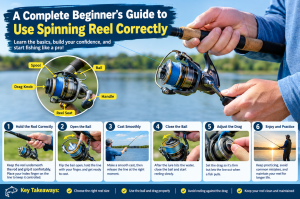
Learning how to use a spinning reel correctly starts with understanding its position, handle, bail, spool, drag knob, and anti-reverse mechanism. These parts work together to control casting, line retrieval, and fish fighting.
2a.How to Hold a Spinning Rod and Reel Correctly
Hold the rod with the reel hanging underneath it. Position your hand around the reel seat so you can comfortably reach the handle and maintain control. Many anglers place one or two fingers in front of the reel stem, depending on the rod design and personal preference.
Use your index finger to trap the line against the rod before opening the bail. This keeps the line controlled and prepares the reel for casting. Avoid turning the reel upside down or retrieving backward as a substitute for changing the handle position.
Smaller anglers can rest the rod on the hip while setting up and use both hands for the cast
2b. How to Use the Bail on a Spinning Reel
The bail is the most important part of the reel. Here is how to use bail on spinning reel properly:
- Check that your lure is securely attached and the line runs through the rod guides.
- Hold the line against the rod with your index finger.
- Flip the bail open to release the line.
- Make a smooth forward cast and release the line from your finger at the appropriate point.
- Allow the lure to travel toward the target and control the line with your finger if needed.
- Close the bail manually, check that the line is seated correctly, and begin retrieving.
Manually closing the bail after casting helps you control when line pickup begins and can reduce unnecessary strain on the mechanism. It also encourages you to check for loose line before turning the handle.
2c. How to Switch a Spinning Reel Handle Left to Right
Most spinning reels allow the handle to be moved from one side to the other. Consult the manufacturer’s instructions, remove the handle or retaining cap as designed, transfer the handle to the opposite side, and tighten it securely.
This adjustment lets you retrieve with your preferred hand while holding the rod comfortably with the other. Unlike spinning reels, most baitcasting reels have a fixed handle side, so choose the correct configuration before purchasing.
On the other hand, spinning reels are ambidextrous. To switch the handle from left to right, unscrew the handle or its cap, move it to the other side, and tighten it securely. All spinning reels allow this, so you can reel with whichever hand you prefer.
2d. How to Use Anti-Reverse on a Spinning Reel
Anti-reverse prevents the handle from rotating backward during normal retrieval. Most modern spinning reels use a continuous anti-reverse setting, while some models have a switch that allows backward handle movement.
For beginners, keeping anti-reverse engaged usually provides more consistent hook-setting control. If your reel has a switch, check the manual to understand its function and avoid accidentally allowing the handle to turn backward while fighting a fish.
Additionally, some spinning reels have an anti-reverse switch. Learn how to use anti-reverse on a spinning reel by keeping it on, so the handle only turns forward. If it gets flipped off, you can crank backward and throw line everywhere. Check it before handing your rod to a friend.
3. How to Choose a Spinning Reel Size: 1000, 2500, and 5000
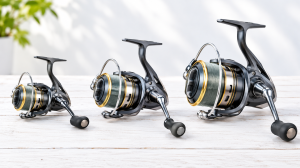
Reel size generally increases with its model number, but numbering systems differ between manufacturers. A 2500 from one brand may not match the dimensions, weight, or line capacity of a 2500 from another. Here is how to choose a spinning reel size 1000, 2500, 5000:
| Reel size | Typical application | What to consider |
|---|---|---|
| 1000 | Ultralight fishing, small trout, and panfish | Light line, low weight, and balanced ultralight rods |
| 2500 | General freshwater fishing and many bass applications | A versatile balance of line capacity, weight, and control |
| 3000–4000 | Larger bass, pike, catfish, and some inshore fishing | More line capacity and suitable drag performance |
| 5000 and larger | Heavier inshore fishing, surf applications, and larger targets | Line capacity, spool design, corrosion resistance, and drag strength |
Sizing is not standardized between brands. A 4500 from one maker can be comparable to a 6000 from another, and a 2500 from one brand can match a 4000 from another. If possible, handle the reel in a tackle store before buying.
3a. How to Choose a Spinning Reel Size for Ultralight Fishing
For how to choose a spinning reel size for ultralight fishing, go small, around 1000-size reel which is often a practical choice for ultralight fishing because it can balance a lightweight rod and accommodate light line.
Many anglers buy reels that are too large and then carry extra weight and line they never use. Reels this small can still hold hundreds of yards of 10 lb braid. Avoid going too small for big fish, though. Their gears wear out under long fights
However, the ideal combination depends on the rod’s specifications, target species, lure weight, and the line you plan to use.
3b. How to Choose a 2500 or 5000 Reel
A 2500-size reel is a useful starting point for many general freshwater anglers. A 5000-size reel may be more appropriate when you need additional line capacity, heavier line, or stronger drag performance. It can also be suitable for certain surf and saltwater applications, depending on the reel’s construction.
Before buying, compare the manufacturer’s line-capacity specifications, actual reel weight, gear ratio, and maximum drag. Whenever possible, handle the reel and mount it on your rod to check the balance and comfort.
4. How to Use and Adjust Fishing Reel Drag Systems
The drag system allows a fish to pull line from the reel when tension becomes too high. Proper drag adjustment helps protect the line, leader, knots, and rod while giving you a better chance of landing a strong fish.
The drag limits line tension so a hard-pulling fish or a hard hook set does not break your line. Here is how to use and adjust fishing reel drag systems the right way.
4a. How to Set Drag on a Spinning Reel
The adjustment knob is usually on top of the spool. On most spinning reels, turn it clockwise to tighten and counterclockwise to loosen. Here is how to set drag on a spinning reel accurately:
- Quick method: tie the line to a heavy object, bend the rod and walk backward. The drag should slip well before the line breaks.
- Precise method: hook the line to a scale and pull with the rod bent. Drag should slip at about one-third to one-half of your line rating. With 12 lb line, that is roughly 4 to 6 lb.
A lighter drag gives fish time to take the bait, while a heavier drag sets the hook faster and helps pull fish out of timber.
On the other side, you can also apply this technique to set a drag on your spinning reel
- Identify the drag adjustment. On many spinning reels, it is a knob on top of the spool; some models use a rear-mounted adjustment.
- Turn the knob gradually to tighten or loosen the drag. On most front-drag reels, clockwise turns tighten it, but verify the direction for your model.
- Pull the line steadily by hand to check the resistance.
- For a more accurate setting, use a suitable scale and pull smoothly with the rod held at a safe angle.
- Adjust until the drag releases line before the line, knot, or leader is likely to fail.
A common starting guideline is to set drag at approximately one-third of the line’s rated breaking strength, then adjust for the leader, knots, rod, hook, and fishing conditions. For example, 12-pound line might suggest an initial target around 4 pounds. This is a starting point, not a universal rule.
4b. How to Adjust Front Drag on a Spinning Reel for Heavy Fish
When targeting larger fish, do not automatically tighten the drag to its maximum. Start with a controlled setting appropriate for your line and tackle, then adjust gradually if the fish is pulling too much line or threatening to reach heavy cover.
Maintain a safe rod angle and avoid locking the drag completely. Excessive pressure can break line, pull hooks free, or damage equipment. If a fish is making a strong run, let the drag work instead of forcing the handle.
Or, to adjust front drag on a spinning reel for heavy fish, you can tighten the knob slightly, keeping it below the point where line could snap. When a big fish runs, never reel while the drag is pulling out line. It does nothing useful and adds line twist. Instead, wait for the drag to stop, lower the rod tip and reel, then pull back without reeling and repeat
4c. Front Drag vs. Rear Drag: Which Is Better for Beginners?
Front-drag reels typically place the adjustment directly on the spool and are often favored for their drag performance.
Rear-drag reels offer convenient access to an adjustment behind the reel body and may feel easier for some anglers to operate.
Neither design is automatically best for every beginner. Prioritize smooth, predictable drag performance, ease of adjustment, and the reel’s overall quality. Choose the configuration that feels comfortable and suits your fishing style.
Anyway, for most anglers, front drag is better for beginners because it is simpler, more reliable and easier to find
5. How to Cast a Spinning Reel Without Backlash
Unlike a baitcasting reel, a spinning reel’s spool does not rotate during a normal cast. This means traditional baitcaster backlash is not a typical spinning-reel problem. However, loose coils, wind knots, and line loops can still form if the line is poorly managed.
To reduce tangles, fill the spool to the manufacturer’s recommended level, keep tension on the line while retrieving, and close the bail manually after casting. Avoid reeling while the drag is releasing line because this can create unnecessary line twist.
For baitcasting reels, adjust the braking and spool-tension systems to suit the lure weight, use a smooth casting motion, and apply thumb pressure as the lure slows down. Practice in open space before attempting precise casts around obstacles.
Again, to learn how to cast a spinning reel without backlash, keep your finger on the line until release, close the bail manually, and do not overfill the spool. A smooth, steady cast and reasonably light line also help. Heavy line, such as 100 lb test on a small 2500 reel, can limit casts to about 20 yards
6. How to Avoid Spinning Reel Mistakes
Here is how to avoid spinning reel mistakes that I see all the time:
-
- Reeling against the drag: Do not crank the handle while a fish is pulling line from the drag. Wait for the run to slow, then retrieve line as you lower the rod after a controlled lift.
- Ignoring line twist: Spinning lures can twist line. Use a suitable swivel when appropriate and check that the lure rotates as intended.
- Closing the bail carelessly: Close it manually when practical and make sure the line is properly seated.
- Overfilling the spool: Too much line can fall off in loose loops. Follow the reel manufacturer’s fill guidance.
- Using the wrong reel size: Match reel weight and line capacity to your rod, lure, target species, and fishing environment.
- Neglecting maintenance: Remove salt and dirt according to the manufacturer’s cleaning instructions and dry the reel before storage.
- Using the wrong line. Overly heavy line on a small reel kills casting distance.
- Reeling against the drag. It creates line twist and tangles.
- Reeling backward. Keep the anti-reverse on.
- Mounting the reel upside down. A spinning reel hangs under the rod, and you always crank forward.
- Dunking the reel in saltwater. Rinse with distilled water or reel cleaner, and avoid chlorinated tap water, which can corrode parts.
- Forgetting to open the bail when spooling. Remove the spool, open the bail, and reattach.
Line twist is the spinning reel’s biggest weakness, but it is largely preventable. Add a swivel when using spinning lures like spoons and inline spinners.
7. How to Line a Spinning Reel for Saltwater Surf Fishing
For surf fishing, choose line according to the reel’s capacity, target species, casting conditions, and the rig you plan to use. Braided line offers a relatively thin diameter for its strength, while monofilament provides stretch and can be convenient for certain rigs.
- Attach the line securely to the spool using a suitable knot or backing arrangement.
- Check the reel manufacturer’s recommended line capacity.
- Wind line onto the spool under steady tension, following the line manufacturer’s instructions.
- Keep the line lay even and avoid overfilling the spool.
- Add a suitable leader when required by the target species, surf conditions, or rig.
Saltwater surf reels should have suitable corrosion-resistant construction and maintenance requirements for coastal use. Rinse away salt and sand according to the manufacturer’s instructions. Avoid directing high-pressure water into the reel or assuming that every reel can safely be submerged.
Here, you can use a large, long-spool surf reel and balance line strength against casting distance. Heavier line gives strength but shortens casts. Thin braid lets you cast farther, but fill the spool properly and keep the line from tangling in the rotor.
Inshore vs. Offshore Spinning Reels: Differences and How to Pick
The inshore vs offshore spinning reels differences and how to pick come down to size, gears and sealing:
- Inshore: lighter reels in the 2500 to 4000 range for fish like redfish and trout, which are easy to cast all day. Inshore reels are commonly used in bays, estuaries, flats, and nearshore waters. They should balance manageable weight with sufficient line capacity, drag performance, and protection against corrosion.
- Offshore: larger, beefier reels with heavy gears and sealed drags for powerful fish. Offshore reels may need greater line capacity, stronger drag systems, and more robust construction to handle powerful fish and longer runs.
In either case, look for a sealed or water-resistant drag and a threaded, screw-in handle that has less play and holds up longer.
Choose based on your target species, expected line strength, fishing depth, and environment rather than relying on size numbers alone.
8. Gear Ratio and Reel Maintenance
How to Select Spinning Reel Gear Ratio for Topwater Lures
Gear ratio describes how many times the rotor turns for each complete handle revolution. A higher ratio can help retrieve slack line quickly, while a lower ratio may provide more controlled retrieval. Actual line pickup also depends on spool diameter and how much line remains on the spool.
For topwater lures, consider how quickly you need to work the bait and recover slack between rod movements. A faster reel can be helpful when fishing walking baits or covering water, but lure action and personal technique matter just as much.
To select spinning reel gear ratio for topwater lures, a medium-to-higher gear ratio is a solid general rule. It lets you work walking baits and poppers quickly and pick up slack after a strike. Choose a lower ratio if you want slow, steady control with heavier gear
Basic Reel Care
After fishing, inspect the bail, line roller, spool, handle, and drag adjustment. Clean the reel according to the manufacturer’s directions, particularly after saltwater use. Use only recommended lubricants and avoid unnecessary disassembly if you are unfamiliar with the internal mechanism.
Frequently Asked Questions
1. Which fishing reel is easiest for beginners?
A spincast reel offers simple push-button casting, while a spinning reel provides greater versatility and room to develop more advanced skills. Many beginners benefit from learning on a spinning reel early.
2. Can a spinning reel catch large fish?
Yes. A properly selected spinning reel can handle large freshwater and saltwater fish when its line capacity, drag, rod, and other tackle are appropriate for the target species.
3. Should I reel while a fish pulls line from the drag?
No. Wait until the fish’s run slows or stops, then retrieve line while lowering the rod after a controlled lift. Reeling against an active drag can twist line and make tangles more likely.
4. How much drag should I use?
A common initial guideline is approximately one-third of the line’s rated breaking strength. Adjust for knots, leader strength, hook type, rod rating, and fishing conditions, and test the setting safely before fishing.
5. What reel size is best for general freshwater fishing?
A 2500-size reel is a useful starting point for many freshwater applications. A 1000-size reel suits many ultralight setups, while larger sizes may be better for heavier line and bigger fish. Manufacturer sizing varies.
6. How can I prevent spinning-reel line twist?
Avoid reeling while line is leaving the drag, use swivels when appropriate for spinning lures, maintain proper spool fill, and retrieve line under steady tension.
7. What is the best spinning reel size for beginners?
A 2500 is the safe all-around choice for most freshwater and light inshore saltwater fishing.
8. Can I use a spinning reel upside down?
No. A spinning reel always hangs underneath the rod and is cranked forward.
9. Is a spinning reel easier to use than a baitcaster?
Yes. Spinning reels are more forgiving and far less likely to produce a backlash.
10. How tight should my drag be?
Set it to slip at about one-third to one-half of your line rating, then adjust for the fish you are targeting.
11. Why does my spinning reel line twist?
The most common cause is reeling while the drag is pulling line out. Spinning lures without a swivel add to it.
Conclusion: Choose the Right Reel and Learn Its Controls
Understanding spinning reel type and how to use it gives you a solid foundation for better fishing. Spinning reels are versatile, beginner-friendly, and effective across many freshwater and saltwater situations. Spincast reels simplify casting, while baitcasting reels offer precise control when you learn to manage their rotating spools.
Start by matching your reel to your rod, line, target fish, and fishing environment. Practice opening and closing the bail, casting smoothly, adjusting drag, and retrieving line correctly. With consistent maintenance and sound technique, your reel will perform more reliably and help you handle unexpected fish with greater confidence.
Key Takeaways
-
- Choose a reel based on your fishing conditions, not its size number alone.
- Keep the spinning reel underneath the rod and use the bail correctly.
- Set drag to protect your weakest tackle component.
- Never crank against an actively releasing drag.
- Prevent line twist through good retrieval habits and suitable rig components.
- Clean and maintain your reel according to the manufacturer’s instructions.
- Spinning reels hang under the rod; spincast and baitcasting reels sit on top.
- Close the bail by hand to extend the life of the mechanism.
- Set drag to about one-third to one-half of your line rating.
- Never reel while the drag is pulling out line.
- Keep anti-reverse on, and rinse saltwater exposure with distilled water or reel cleaner.
- Choose the smallest reel that fits your target fish, typically 2500 for all-around use.
The spinning reel is affordable, easy to learn and versatile enough for targeting panfish, bass, catfish and saltwater fish. Master the bail, the drag, the anti-reverse and sizing, and you will cast farther, tangle less and protect your gear for years
